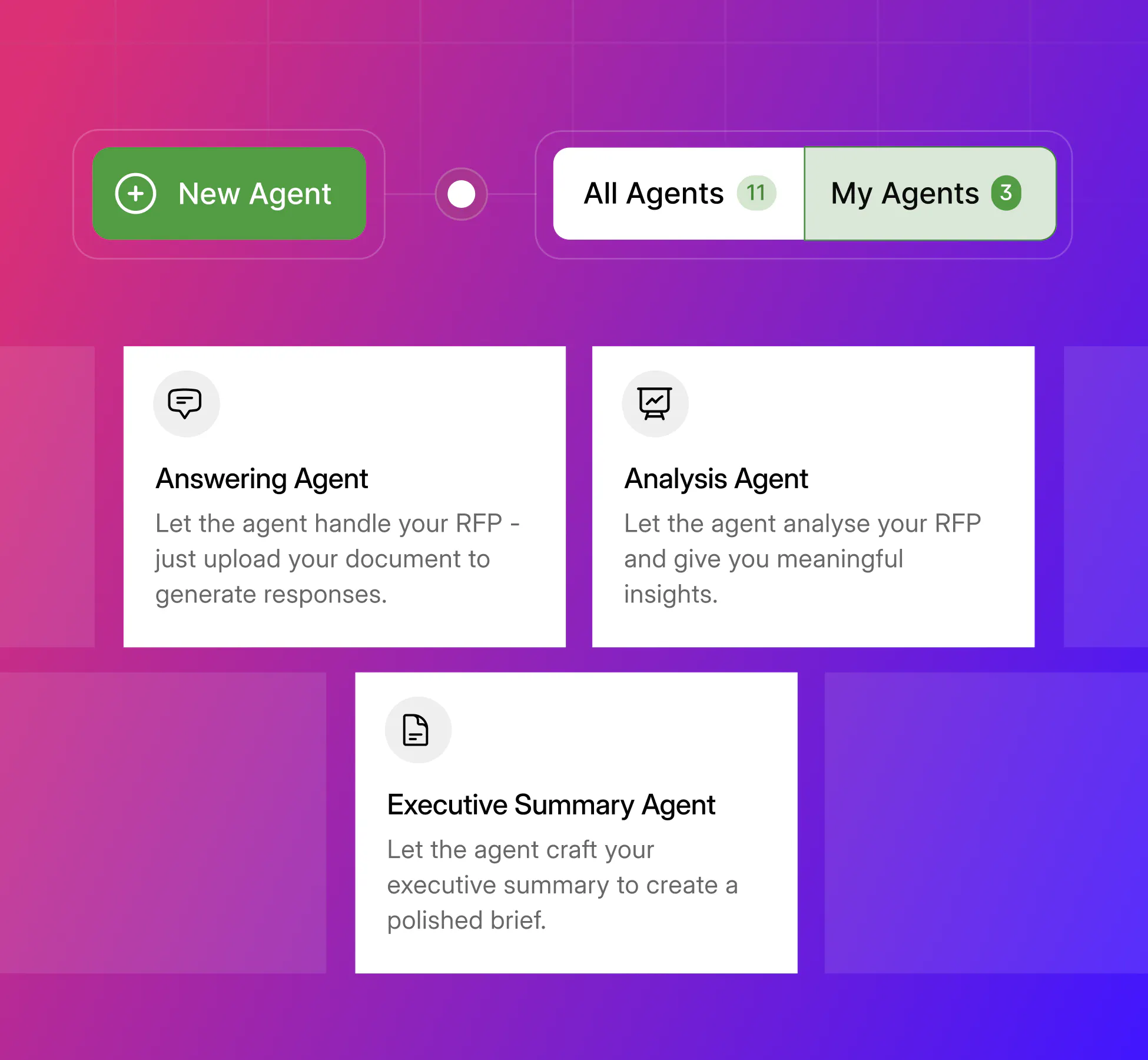
AI proposal intelligence software transforms how organizations respond to RFPs, security questionnaires, and sales proposals by combining centralized content management with artificial intelligence to automate drafting, improve accuracy, and accelerate turnaround times. These platforms address a critical pain point for sales teams, procurement organizations, and compliance departments who face increasing volumes of complex information requests while working with limited resources and tight deadlines. The technology has gained significant traction since 2022, driven by advances in large language models and the widespread adoption of retrieval-augmented generation (RAG) patterns. Organizations report measurable improvements in response times—often reducing proposal preparation from weeks to days—while maintaining consistency and compliance standards across their responses. As RFP volumes continue to grow and customer expectations for faster, more detailed responses increase, these platforms are becoming essential infrastructure for competitive organizations. When evaluating AI proposal intelligence software, you'll need to assess four key areas: automation and collaboration capabilities, data management and content organization, integration with existing workflows, and the platform's ability to deliver accurate, trustworthy results with measurable ROI.
What AI proposal intelligence software actually does
At its core, this software centralizes your organization's approved answers and documents into a searchable content library, then uses AI to match relevant content to incoming questions and generate first-draft responses. The platform typically handles document ingestion by automatically extracting questions from uploaded RFPs, parsing complex procurement documents, and organizing requirements into manageable sections. The AI component relies primarily on retrieval-augmented generation, which combines traditional search capabilities with generative AI models. When you receive a new question, the system searches your content library for relevant information, retrieves the most appropriate answers, and uses that context to generate a response that's grounded in your approved content rather than hallucinated from general knowledge. Common workflow features include automated question routing to subject matter experts, collaborative review processes with version control, and project management tools that track deadlines and assignments. Many platforms also offer browser extensions or portal integrations that can automatically populate customer procurement portals, eliminating manual copy-paste work. The primary users span multiple organizational roles. Sales teams use these platforms to respond to prospect RFPs and create personalized proposals. Compliance and security teams leverage them for due diligence questionnaires and vendor assessments. Procurement teams use the software both to respond to supplier requests and to create their own RFPs more efficiently. Professional services firms apply these tools for statement-of-work generation and client pitch development.
How to evaluate automation and collaboration features
The most impactful AI proposal intelligence platforms excel at automating repetitive tasks while enhancing team collaboration. Look for systems that can automatically populate 60-80% of standard questions with first-draft responses, significantly reducing the manual effort required for routine proposals. The best platforms maintain citation trails, showing exactly which approved content sources contributed to each generated response. Collaboration capabilities should streamline how your team works together across time zones and departments. Effective platforms provide real-time editing, comment threads on specific questions, and automated routing that sends technical questions to engineers and commercial questions to sales teams. The system should maintain clear audit trails showing who reviewed what content and when approvals were granted. Workflow automation extends beyond content generation to project management. Strong platforms automatically create timelines based on RFP due dates, send reminder notifications to assigned reviewers, and provide dashboard views showing bottlenecks in your response process. This visibility enables managers to reallocate resources and meet critical deadlines more consistently.
Managing data and content effectively
Your content library forms the foundation of any AI proposal intelligence system, making organization and accessibility crucial success factors. The platform should ingest content from multiple sources—SharePoint documents, previous proposals, marketing materials, product specifications—and maintain version control as content evolves. Look for systems that can handle various file formats and automatically update references when source documents change. Effective content management requires sophisticated search capabilities that go beyond simple keyword matching. The best platforms use semantic search to understand conceptual relationships, finding relevant content even when questions are phrased differently than your stored answers. This capability becomes essential as your content library grows beyond what any individual team member can mentally catalog. Content governance features ensure your responses remain current and compliant. The platform should flag outdated information, track content approval workflows, and provide analytics showing which content pieces are most frequently used or generate the highest win rates. Some advanced systems offer content gap analysis, identifying areas where your library lacks sufficient depth for common question types.
Integration impact on existing workflows
The most successful AI proposal intelligence implementations integrate seamlessly with tools your team already uses daily. Essential integrations include your CRM system for opportunity tracking, Microsoft 365 or Google Workspace for document collaboration, and single sign-on systems for security compliance. These connections eliminate context switching and ensure proposal activities are automatically logged in your sales process. Advanced integrations extend to customer procurement portals, where browser extensions or API connections can automatically populate responses directly into vendor submission systems. This capability eliminates transcription errors and reduces the time spent navigating complex procurement interfaces. Some platforms offer bi-directional CRM synchronization, automatically creating proposal projects when opportunities reach certain stages. The integration architecture should also support your security and compliance requirements. Look for platforms that maintain comprehensive audit logs, support data loss prevention policies, and can operate within your organization's data residency requirements. The system should complement rather than complicate your existing governance frameworks.
Accuracy, performance, and measurable outcomes
Trust factors form the foundation of successful AI proposal intelligence deployment. The platform should provide clear provenance for every generated response, showing exactly which approved content sources contributed to the output. This transparency enables reviewers to verify accuracy quickly and maintains accountability for the information you submit to prospects. Performance metrics help justify the platform investment and guide optimization efforts. Track quantitative measures like response time reduction (typically 50-70% improvement), win rate changes, and the percentage of questions that can be auto-populated without manual intervention. Monitor qualitative factors such as response consistency, brand voice adherence, and customer feedback quality. Compliance capabilities ensure your responses meet regulatory and company policy requirements. The platform should enforce content approval workflows, maintain complete audit trails for regulatory review, and provide controls that prevent outdated or unauthorized information from appearing in customer-facing responses. Some organizations require additional features like content expiration dates or approval-level hierarchies based on content sensitivity. The ROI calculation extends beyond time savings to include opportunity cost. Organizations frequently report that AI proposal intelligence software enables them to respond to more RFPs with higher quality submissions, directly impacting revenue pipeline. The platform should provide analytics that connect proposal activities to closed deals, helping you optimize your response strategies over time.
What separates leading platforms from the rest
The AI proposal intelligence market contains dozens of vendors with seemingly similar feature sets, making careful evaluation essential. The most capable platforms distinguish themselves through superior AI accuracy, comprehensive integration ecosystems, and robust governance frameworks that enterprise organizations require. Leading platforms invest heavily in RAG optimization, using advanced techniques to reduce hallucinations and improve response relevance. They maintain partnerships with major LLM providers while offering flexible deployment options for organizations with strict data sovereignty requirements. The best vendors also provide transparent documentation about their AI capabilities and limitations, helping you set appropriate expectations with your team. When selecting a platform, consider these critical questions: Does the vendor provide clear data usage policies and commit to not training models on your content? Can the system handle your industry's specific compliance requirements and audit trails? How quickly can the platform scale to support increased RFP volumes during peak seasons? Does the integration ecosystem support your existing technology stack without requiring costly customizations?
The strategic value of AI proposal intelligence
AI proposal intelligence software has evolved from a productivity tool to a strategic capability that enables organizations to compete more effectively in complex procurement environments. By automating routine tasks and improving response consistency, these platforms free your team to focus on relationship building, solution customization, and strategic positioning that directly impact win rates. The most important evaluation criteria center on the platform's ability to integrate with your existing workflows, maintain accuracy and compliance standards, and deliver measurable improvements in both efficiency and outcomes. Organizations that invest in platforms with strong content management, robust AI capabilities, and comprehensive integration support position themselves to scale their proposal operations while maintaining quality standards. Looking ahead, expect continued advances in AI automation, with platforms becoming more capable of handling complex, multi-stakeholder responses and providing predictive analytics about proposal success factors. The organizations that establish strong AI proposal intelligence foundations today will be best positioned to leverage these emerging capabilities as they become available.
FAQs
Q: How does AI proposal intelligence software actually work to improve RFP responses?
A: AI proposal intelligence software centralizes your organization's approved answers and documents into a searchable content library, then uses retrieval-augmented generation (RAG) to match relevant content to incoming questions and generate first-draft responses. The system automatically extracts questions from uploaded RFPs, searches your content library for relevant information, and generates responses grounded in your approved content rather than hallucinated information. Most platforms can auto-populate 60-80% of standard questions while maintaining citation trails that show exactly which approved sources contributed to each response.
Q: What kind of time savings and automation can we expect from these platforms?
A: Organizations typically see 50-70% reduction in response times, often cutting proposal preparation from weeks to days. The software automates repetitive tasks like document ingestion, question extraction, content matching, and even portal submission through browser extensions that eliminate manual copy-paste work. Teams report being able to respond to significantly more RFPs with higher quality submissions, as the platform handles routine questions automatically while freeing subject matter experts to focus on strategic customization and relationship building.
Q: How does the software integrate with our existing tools and manage our content?
A: Leading platforms integrate seamlessly with CRMs like Salesforce, collaboration tools like Microsoft 365 and SharePoint, and customer procurement portals through API connections or browser extensions. The system ingests content from multiple sources—previous proposals, marketing materials, product specifications—while maintaining version control and automatically updating references when source documents change. Advanced platforms offer bi-directional CRM synchronization and support single sign-on systems to ensure proposal activities are logged in your existing sales processes without context switching.
Q: What are the limitations and where is human oversight still required?
A: While AI can auto-populate most standard questions, human review remains essential for accuracy verification, strategic positioning, and compliance approval. The technology can still produce hallucinations despite RAG safeguards, which is why leading platforms provide clear provenance showing exactly which content sources contributed to each response. Human experts are needed for complex technical questions, relationship-specific customization, final quality review, and maintaining content governance including approval workflows and keeping the content library current and compliant.
Q: What should we evaluate when selecting an AI proposal intelligence platform?
A: Focus on four key areas: automation capabilities that can handle your question volume while maintaining accuracy, content management features that support your governance requirements and integrate with existing document sources, workflow integration that connects to your CRM and collaboration tools without disrupting current processes, and measurable ROI through clear analytics on time savings and win rate improvements. Evaluate the vendor's data usage policies, compliance capabilities for your industry requirements, and whether the platform can scale to support peak RFP volumes while providing transparent audit trails for regulatory review.