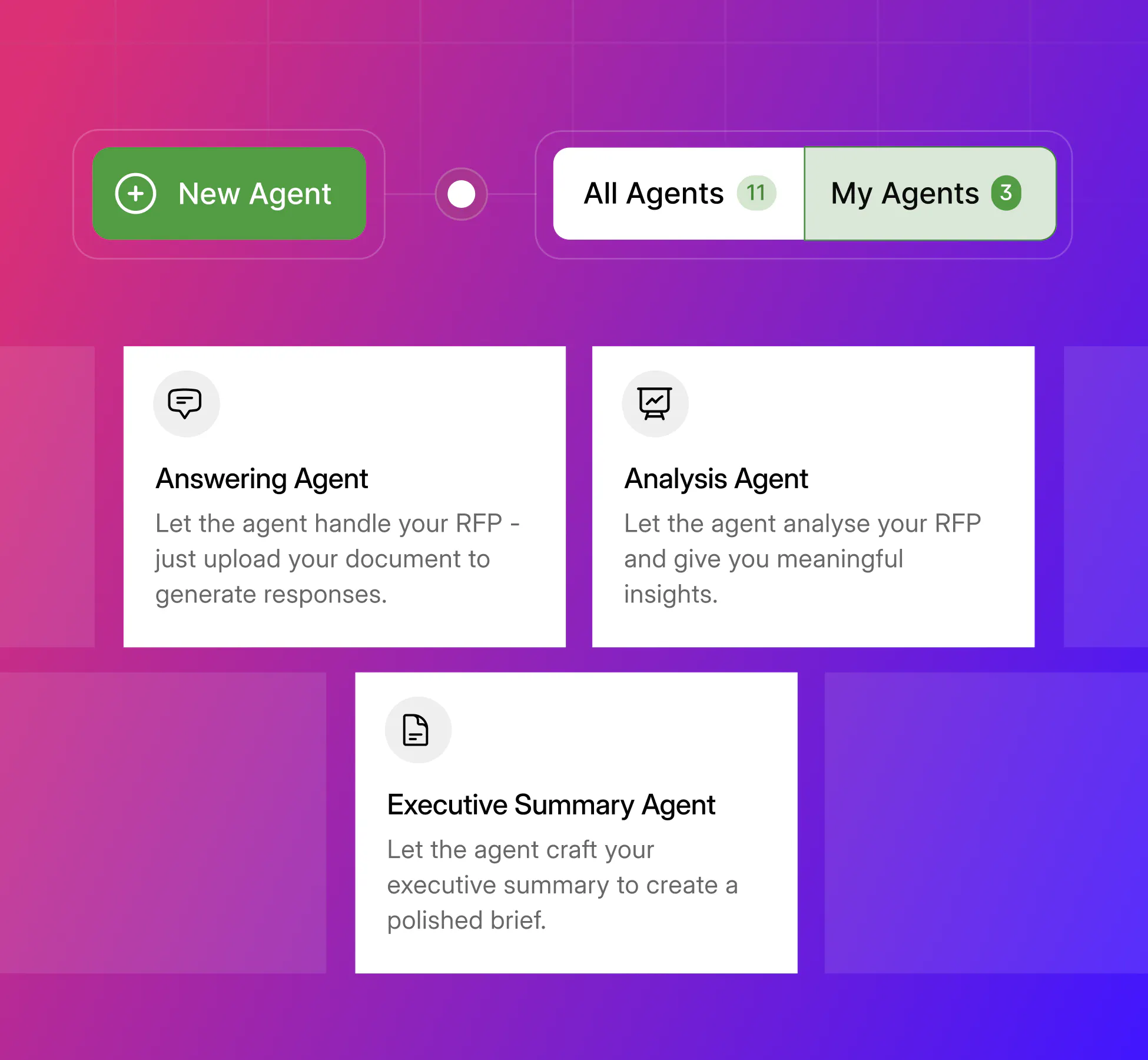
AI request-for-proposal software represents a fundamental shift in how organizations handle one of their most time-intensive business processes. These platforms combine curated content libraries with natural language processing technologies to automate the creation, completion, and analysis of RFP responses, security questionnaires, and vendor information requests. What traditionally required days of manual searching, copying, and editing can now be streamlined into hours of guided review and refinement. The timing for this technology couldn't be more critical. Modern businesses face an avalanche of information requests—from procurement RFPs to security due diligence questionnaires—while simultaneously dealing with distributed teams and increasingly complex compliance requirements. Manual processes simply don't scale when you're responding to hundreds of requests annually, each requiring consistent, accurate, and compliant information across multiple stakeholders. Organizations evaluating these solutions should focus on four key areas: automation capabilities and collaboration features, content management and organization systems, integration with existing workflows, and measurable results with appropriate trust controls. The right platform will not only accelerate response times but also improve win rates through more consistent, higher-quality submissions.
What these platforms actually do
At its core, AI RFP software solves the content discovery and reuse problem that plagues response teams. Instead of searching through scattered documents, emails, and past responses, teams can access a centralized library of pre-approved answers with rich metadata and version control. The AI layer adds semantic search capabilities, meaning you can ask "How do we handle data encryption?" and receive relevant content even if your stored answers use different terminology. The technology stack typically includes large language models for drafting and editing, vector databases for semantic search, and retrieval-augmented generation (RAG) systems that ground AI responses in your organization's actual documentation. This combination reduces hallucination—the AI equivalent of making things up—by ensuring generated content draws from verified sources rather than the model's general training data. Common workflows start with question ingestion, where the platform parses RFP documents or captures requirements from web portals. The system then suggests relevant content from your library, generates first drafts when needed, and routes questions to appropriate subject matter experts. Throughout this process, audit trails track changes and approvals, ensuring compliance teams can verify the accuracy of final responses. Sales teams, procurement professionals, and compliance officers are the primary users, but implementation typically involves IT, legal, and executive stakeholders who need visibility into response accuracy and process efficiency.
Essential evaluation criteria
Automation depth and team collaboration Look beyond simple auto-fill capabilities to understand how the platform handles complex, multi-part questions and supports collaborative workflows. The best systems can break down compound questions, suggest relevant content for each component, and maintain context across related sections. Team features should include real-time collaboration, SME routing with notification systems, and approval workflows that don't become bottlenecks. Content management sophistication Your content library becomes the foundation of all responses, making organization and accessibility critical success factors. Evaluate how platforms handle content versioning, metadata tagging, and permissions management. Can you easily retire outdated answers? How does the system surface related content when reviewing responses? Advanced platforms offer content analytics to identify gaps and frequently requested information. Integration ecosystem impact Seamless workflow integration determines whether the platform becomes a productivity multiplier or another system to manage. Essential integrations include CRM systems for opportunity tracking, cloud storage for document access, and collaboration tools where your teams already work. API availability enables custom workflows and data synchronization with existing business systems. Accuracy, performance, and trust mechanisms Measurable results matter more than feature lists. Look for platforms that provide citation tracking, confidence scoring for AI-generated content, and performance analytics including response times and win rates. Security and compliance features—including data encryption, access controls, and audit capabilities—are non-negotiable for organizations handling sensitive information.
Why platform selection demands careful attention
The AI RFP software market includes both established response management vendors adding AI capabilities and AI-native startups building purpose-built solutions. This diversity means features, pricing models, and technical approaches vary significantly between providers. Some platforms excel at handling complex technical questionnaires but struggle with narrative proposal sections, while others optimize for speed but sacrifice customization options. Data governance considerations add another layer of complexity. Organizations must understand where their content is processed, whether it's used to train AI models, and how different deployment options (cloud, private instance, or on-premises) affect security and performance. Vendor lock-in risks are real when your entire content library lives within a proprietary system. When evaluating providers, ask these targeted questions: How does the platform handle sensitive or regulated content? What specific AI models are used, and can they be customized for your industry? How does pricing scale with usage, and what happens to your data if you need to switch providers? Can the system integrate with your existing security and compliance frameworks? Finally, what measurable results have similar organizations achieved, and how long did implementation take?
The strategic advantage
AI RFP software transforms response management from a reactive, resource-intensive process into a strategic capability that can influence win rates and market positioning. Organizations report reducing response preparation time by 50-70% while improving consistency and compliance across all submissions. More importantly, the time savings allow teams to focus on relationship building, proposal strategy, and competitive differentiation rather than administrative tasks. When selecting a platform, prioritize automation capabilities that match your response volume and complexity, content management systems that grow with your organization, and integration options that enhance rather than disrupt existing workflows. Trust and accuracy features—including human review processes, audit trails, and performance measurement—should be non-negotiable requirements. Looking ahead, expect continued advancement in domain-specific AI models, deeper enterprise system integrations, and more sophisticated analytics that provide insight into market trends and competitive positioning. Organizations that establish robust AI-enabled response capabilities now will be better positioned to handle increasing information request volumes while maintaining the quality and speed that modern procurement processes demand.
FAQs
Q: How does AI RFP software work and what benefits does it provide?
A: AI RFP software combines centralized content libraries with natural language processing to automate RFP response creation. The platform uses semantic search to find relevant pre-approved answers, applies large language models to draft responses, and maintains human oversight through review workflows. Organizations report 50-70% reduction in response preparation time while improving consistency and compliance across submissions.
Q: What specific tasks can AI RFP software automate and how much time does it save?
A: The software automates question parsing from RFP documents, content discovery from your answer library, first-draft generation using AI, and routing questions to subject matter experts. Instead of days spent manually searching through scattered documents and copying content, teams can complete responses in hours with guided review. Common automated workflows include question ingestion, content suggestion, draft creation, and approval tracking.
Q: How does AI RFP software integrate with existing tools and manage our content?
A: Most platforms offer standard connectors for CRM systems like Salesforce, cloud storage like SharePoint and Google Drive, and collaboration tools like Teams and Slack. The content management system centralizes pre-approved answers with rich metadata, version control, and permissions management. Advanced platforms provide content analytics to identify gaps and frequently requested information while maintaining audit trails for compliance.
Q: What are the limitations and where is human oversight still required?
A: AI-generated content can be plausible but incorrect, making human review mandatory for compliance-sensitive responses. The technology still requires humans for strategic proposal decisions, relationship management, and final quality control. Content library maintenance, SME routing, and approval workflows need human governance. Organizations must also verify data privacy policies and ensure generated responses align with current company positions.
Q: What should buyers evaluate when selecting an AI RFP platform?
A: Focus on four key areas: automation depth and collaboration features that support complex workflows, sophisticated content management with versioning and analytics, integration capabilities with your existing tech stack, and trust mechanisms including accuracy controls and performance measurement. Evaluate data governance policies, deployment options, pricing models, and measurable results from similar organizations. Consider whether vendors use your data for AI training and what happens to your content if you switch providers.