When a small team builds something that works, the enterprise pays attention. In large organizations, transformations are more successful when backed by evidence rather than driven by a mandate.
At Carelon, a payer-agnostic health services business within Elevance Health, that evidence came from a small proposal team that chose to address a problem many enterprises tolerate: fragmented knowledge, manual workarounds, and burnout that passes as productivity.
Jackie Gaston, Director of Proposal Strategy and New Business Development, built the Carelon proposal team from the ground up around the Response Platform, dead set on improving outcomes in an environment where speed, accuracy, and collaboration carried real consequences. The prospect of influencing the other six proposal teams across Elevance never occurred to Jackie until she had an opportunity to share her team’s success.
What followed demonstrates how AI-powered Strategic Response Management (SRM) scales in practice. Teams that align people, process, and technology around a single source of truth create results that other parts of the organization can see and trust.
Starting from a blank canvas and why that mattered
When Jackie joined Carelon, there was no centralized intake, no consistent data management, and no shared source of truth. Content lived on individual laptops. Processes varied by product. Institutional knowledge reset at the end of each day.
That situation is common. The 2025 State of Strategic Response Management Report shows that 33% of organizations cite a lack of knowledge centralization as a top challenge when responding to RFPs and questionnaires, alongside tight deadlines and limited resources.
Rather than working around those gaps, Jackie addressed them directly. Her early priorities were clear:
- Build a cross-trained team that could support multiple solutions rather than single products
- Define a repeatable process that applied to every request
- Establish one system to manage content, collaboration, and response workflows
“We didn’t have a source of truth. We didn’t have the technology that supported it. Those were the first things that we looked at.”
Jackie Gaston
Director of Proposal Strategy and New Business Development at Carelon
By focusing on fundamentals before speed, the team created conditions that later supported scale.
Why a single source of truth matters most for small teams
Small proposal teams experience pressure first. When volume increases and timelines compress, inefficiencies surface immediately.
Market data reflects this reality. The UK & European Market Trends Report shows that more than four in five organizations face pressure from faster response expectations, tighter budgets, and increased buyer scrutiny. Teams that cannot reuse trusted knowledge feel those pressures more acutely.
At Carelon, Responsive became the system that anchored daily work.
- Templates replaced manual formatting
- Automated responses reduced repetitive rewriting
- Shared projects created visibility across contributors
- Knowledge moved out of documents and into a governed system.
“My team is small. Using templates alone made a difference. Auto response saved hours. Those improvements compounded quickly.”
Jackie Gaston
Director of Proposal Strategy and New Business Development at Carelon
In one case, the team completed a proposal in 24 hours that previously required three weeks. The work maintained quality because it relied on approved, centralized content.
AI-powered SRM delivered value by converting time savings into usable capacity.
Automation that fits how teams actually work
Automation only helps when it aligns with real workflows. Carelon’s gains came from automation embedded into everyday response work. Responsive enabled:
- Content reuse grounded in approved answers
- Structured collaboration with subject matter experts in a shared system
- Immediate capture of new content without additional cleanup
Carelon’s experience mirrors broader performance patterns. The 2025 State of SRM Report shows that high-performing organizations are 88% more likely to maintain centralized knowledge hubs that support self-service and reduce internal bottlenecks.
How team-level success influenced the enterprise
When Elevance Health decided to unify all seven of its proposal teams on a unified platform, Carelon’s efficiency and AI-readiness resulting from Responsive became part of the conversation.
Initially, Carelon was not included in the enterprise evaluation because it already had a system in place. Luckily, Jackie learned about Elevance Health’s initiative and insisted that Responsive be included in the evaluation. “I’ve worked with many platforms,” Jackie said. “I did not want us to lose ground by moving backward.”
What differentiated Responsive emerged when leadership compared how different tools actually handled AI in live response scenarios.
Carelon used its existing Responsive environment to walk Elevance stakeholders through real work. They showed how:
- AI-generated drafts were grounded in approved content
- Source citations created confidence during review
- Automation reduced effort without introducing risk
Instead of describing AI capabilities in the abstract, the team demonstrated them inside active proposals and questionnaires.
What quickly become evident is that while other tools could generate text, they struggled to explain where answers came from, how content stayed current, or how teams could govern outputs at scale. Carelon’s demo showed that Responsive AI operated within a structured system, one that understood proposal workflows, content ownership, and review requirements.
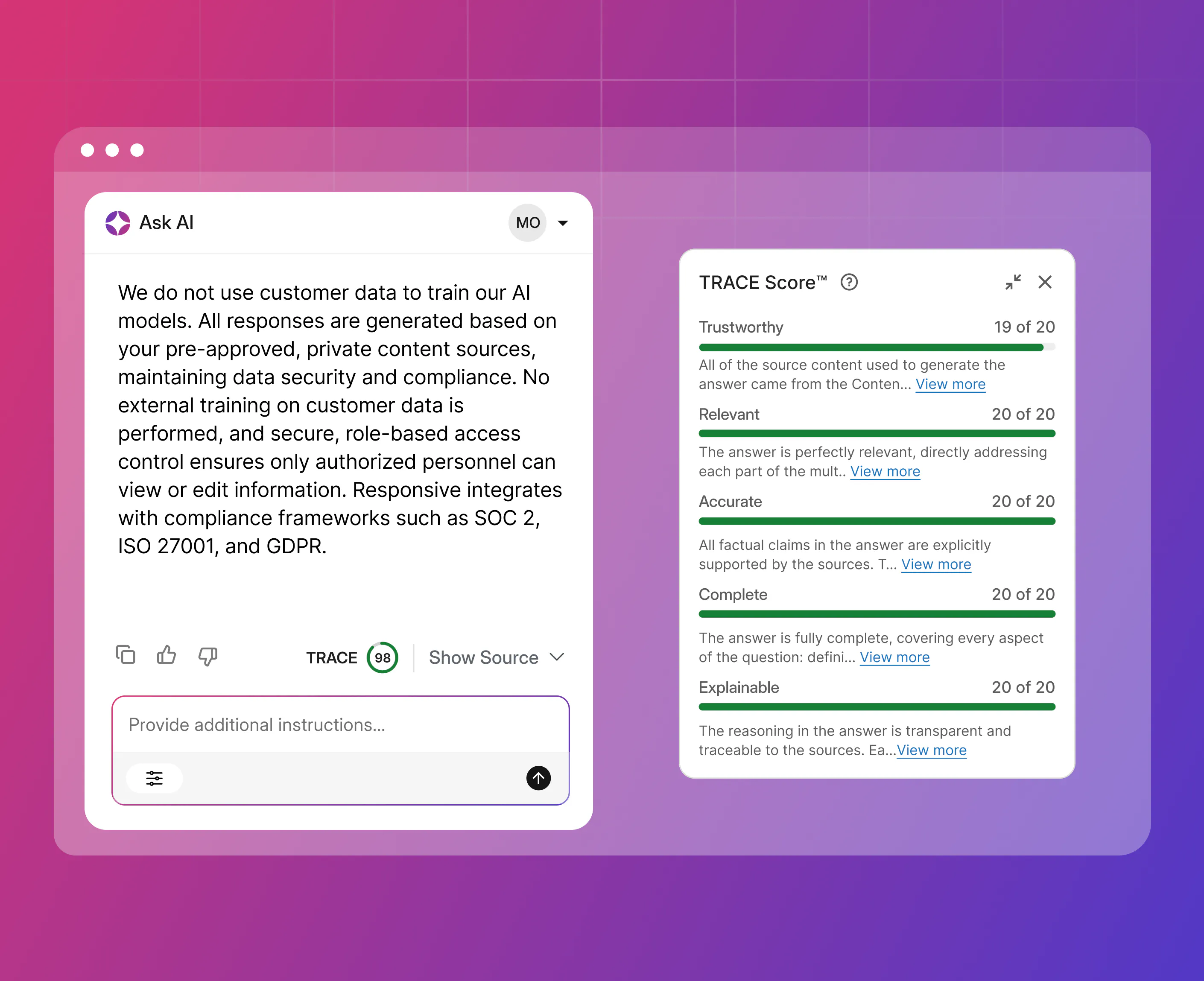
According to Jackie, Responsive’s AI performed at a level that was clearly ahead of alternatives because it was engineered AI for proposal work, not adapted from general-purpose tools. Leadership could see that the platform supported accuracy today and provided a foundation for future AI capabilities without forcing teams to relearn how they worked.
Carelon was not just using Responsive to respond faster. The team was using it to manage risk, maintain quality, and prepare for how proposal work will evolve as AI becomes more deeply embedded. That combination demonstrated to Elevance decision-makers why Responsive was the strongest choice for proposal teams now and why it positioned Elevance for what comes next.
Winning business in the age of AI
Measuring success and scaling impact through people, process, and technology
Carelon’s experience reflects how effective response operations are evolving across regulated and complex industries. The shift is visible in market data and reinforced by how leading organizations invest.
The 2025 Financial Services Industry Report found that nearly 80% of firms now view proposal teams as direct contributors to revenue. At the same time, only a small percentage have fully deployed AI across response workflows. That gap points to a clear pattern. Results are not driven by intent to adopt AI, but by how organizations align people, process, and technology around it.
Carelon’s approach illustrates what that alignment looks like in practice. The team invested deliberately in three areas:
- People: Cross-trained teams that share workload, reduce burnout, and maintain continuity as volume fluctuates
- Process: Standardized workflows that hold up under pressure and make collaboration predictable
- Technology: AI embedded into daily response work and governed by a centralized source of truth
Data from the State of Strategic Response Management Report emphasizes this further with data that shows organizations combining AI adoption with process clarity and staffing support achieve higher win rates and stronger employee satisfaction. At Carelon, AI reinforced expertise by giving teams better inputs, faster access to knowledge, and confidence in the quality of every response.
Those same signals appear across Responsive customers in different sectors. Microsoft built a centralized proposal library in Responsive and saves an average of 30 minutes per question while supporting thousands of sellers globally. Qualtrics unified institutional knowledge to deliver consistent responses across sales and security workflows as buyer scrutiny increased. Open Up Resources created a shared source of truth that allows lean teams to respond confidently across diverse funding and procurement requirements.
Across industries, the pattern is consistent. Centralized knowledge, governed AI, and disciplined investment in people and process enable organizations to scale response operations without adding friction. Carelon’s success shows how that model works first at the team level and then across the enterprise.
Why this approach matters now
Buyers expect faster, more accurate responses and increasingly use AI in their own evaluations.
The Inside the Buyer’s Mind report shows that 90% of buyers conduct research before first contact, and nearly two-thirds use generative AI during evaluation. Response quality and consistency influence decisions earlier than ever.
For small teams, limited capacity magnifies risk. For enterprises, inconsistency multiplies quickly. Carelon’s experience shows how improvement spreads. A small team focused on fundamentals built a model that the broader organization could adopt with confidence.
AI-powered Strategic Response Management scales because it strengthens how teams work, first locally and then across the enterprise. Watch the Carelon conversation with Jackie Gaston at the top of this article to hear the story directly, and see how team-level execution influenced enterprise adoption.

RD Symms
Sr. Copywriter @ Responsive
With more than 15 years in writing, content development, and creative strategy, RD brings a rare combination of conceptual thinking and executional range to the proposal management space. He's spent his career turning complex ideas into content that earns attention which makes him a natural fit for an audience of proposal managers and sales leaders who read critically and buy carefully.