
What is the gold mine most strategic response teams have been sitting on? Knowledge. Knowledge is the most valuable, current, and compelling customer-facing asset every team and organization has, yet few teams have used it to its full advantage. When shared and used effectively, knowledge democratization can significantly improve key metrics that leadership teams care about, such as win rate, time spent per proposal, and revenue.
As Responsive CEO Ganesh Shankar explained in this year’s Responsive Summit keynote, Strategic Response Management (SRM) has made simple answers in content libraries one of the most significant competitive advantages for any strategic response team. It’s a full-blown SRM era and movement, as Ganesh said, one that is bigger than just proposal management.
How can your team join this movement to unlock effective knowledge democratization? It’s simple. It starts by bringing your team’s best answers into the flow of every deal, every questionnaire, and every ad hoc request. When your organization integrates your answers and content holistically, you shift from scattered answers to a centralized advantage.
The market has shifted, and buyers are not waiting
Buying cycles are under greater scrutiny than ever, with more stakeholders involved in the evaluation process. This is true for buyer expectations, too. As the 2025 State of Strategic Response Management (SRM) Report found, more than 75% of organizations say:
- Buyers have tighter budgets,
- Expect faster response times,
- Require a higher degree of personalization
Teams also notice that buyers are bringing their own AI to the table, from drafting RFPs to scoring responses, and using AI for evaluations and assessments. 59% of respondents have noted this trend, with a quarter already seeing direct impacts on their ability to win business.
More than 350 B2B buyers further supported these metrics, as reported in Responsive’s "Inside the Buyer’s Mind" ebook. When asked how much they typically know about a vendor before first contact, only 10% of buyers said they do minimal research.
Instead, the vast majority of buyers said they come prepared:
- Over a third (35%) do moderate research, reviewing key details like pricing and capabilities
- 37% go further, conducting thorough comparisons and competitor analyses
- 18% do extensive due diligence — from financial reviews to case studies — before ever reaching out
As buyers continue to ramp up their expectations, especially regarding response speed, your content and processes must keep pace. This is where SRM earns its name. Company knowledge further amplified by AI-powered SRM provides every team with a reliable way to capture, curate, and share the best of what your company knows, ensuring that every answer is accurate, consistent, and on-brand.
“Responsive isn’t just for proposal teams. You can democratize this knowledge across your entire team to address any requests for information, including RFPs, RFIs, and security questionnaires. Provide your sellers and other field personnel with fingertip access to your organization’s best answers.”

Ganesh Shankar
Responsive Co-Founder and CEO
Chasing scattered files will now consistently leave you behind. Instead, centralize your knowledge and work collaboratively from a shared source of truth to keep up and potentially even ahead of expectations. You don’t need to reinvent the wheel with every request. Instead, reuse and refine your best content that you know wins.
Using SRM to democratize knowledge organization-wide
When your teams can tap into accurate, shared knowledge in seconds, every response gets faster, more consistent, and easier to scale. An effective SRM platform gives you an organization-wide knowledge base that turns scattered answers into a real growth asset. By using an SRM platform to handle RFPs, security questionnaires, and other high-stakes requests, you can strengthen three critical areas of your business.
Knowledge acquisition
Whether you need answers for an RFP, DDQ, security questionnaire, or ad hoc customer question via phone or email, you should only have to visit SMEs once, not every time the same question arises. SRM platforms and strategies facilitate the dissemination of questions throughout the broader organization, making it easier than ever to gather answers from your subject matter experts (SMEs).
Knowledge curation
SRM platforms also offer several capabilities to help ensure that content is relevant, accurate, and up-to-date. By keeping knowledge current, you make it much easier to leverage that knowledge more broadly.
Knowledge democratization
Responsive isn't just for proposal teams. You can, and should, democratize this knowledge across your entire team to address any requests for information, such as RFPs, RFI, security questionnaires, and more. Knowledge democratization represents a vast, untapped opportunity for many teams still using siloed knowledge libraries.
Most teams are using Responsive for RFP responses, but almost all teams can leverage this knowledge more broadly. This includes providing IT and security teams with access to expertise for answering InfoSec and other security-related questionnaires. Beyond that, you can provide your sellers and other field personnel with fingertip access to your organization's best answers to address customer and prospect inquiries.
Standardize on a single platform to manage all customer-facing knowledge, then broadly democratize it to drive tremendous value. Responsive users see three key values of democratizing knowledge.
- It can help you grow faster by handling information requests much more efficiently.
- It ensures that the responses are both compelling and compliant and have been approved, which reduces risk.
- Your teams can access this knowledge much more easily, and the answers you provide to your customers and prospects are more relevant.
The quick checklist for effective SRM adoption
In his keynote, Ganesh outlined five key actions every team can take right now to start the process of adopting effective SRM organization-wide.
Position teams as strategic within your organization
Top-performing response teams have found consistent success by renaming their departments, such as Strategic Response Management Teams or Microsoft’s own Proposal Center of Excellence. These names are more than just a simple internal rebranding. They signal the strategic value your teams are delivering to the broader organization.
Talk business outcomes instead of activity-based metrics
This year’s State of SRM Report and Inside the Buyer’s Mind ebook showed that many Responsive customers are already doing this. However, for those of you considering taking the first steps into the world of SRM, demonstrating the revenues you directly influence will make your storytelling more compelling.
Share the win rates you are helping drive, along with the operational efficiency you achieve, rather than just the number of RFPs touched or the average turnaround time.
Leverage your SRM platform’s capabilities
Once you’ve brought an SRM platform on board, ensure you’re fully utilizing every aspect of the platform, especially the new AI capabilities, to shorten response times.
Democratize your team's knowledge across the enterprise
Adopting a platform is only the first step. You then have to ensure that everyone is using the platform effectively. This means reaching out early to key teams and players, such as sales and IT leaders, to inform them about the knowledge your teams are managing.
For example, Ask conversational AI puts knowledge at the fingertips of sales and IT teams, accessible through a desktop app or on their phones. It’s also a good idea to let them know how they can help manage that knowledge with good content hygiene.
Highlight how advanced customers are delivering value in their orgs
Highlight how real customers deliver value within their organizations to increase wins and revenue. Responsive users like O.C. Tanner, Tenable, and Perceptx are leveraging insights from the front lines to inform both company-level offerings and product-level go-to-market strategies, ultimately helping their companies win more.
- O.C. Tanner boosts productivity by 43% and saves $150K a year with Responsive
- Tenable leverages Responsive AI to elevate strategy and sustain a 70% win rate
- Perceptyx completes RFP response drafts in 30 minutes using Responsive AI agents
Where Responsive customers win with SRM
Microsoft found success democratizing knowledge at scale
Microsoft’s Proposal Center of Excellence turned a sprawling content universe into a single source of truth. The team hired dedicated knowledge managers, built a library with more than 20,000 proposal resources, and made it available company-wide with SSO.
“People go in, use AI-powered search, and find what they need. The feedback has been incredible, and we’re saving an average of 30 minutes per question. That’s huge. It means PCoE and our global user base can focus on strategic proposal work and customer engagement instead of searching for proposal content. It’s enabled autonomy, it’s enabled scale, and it’s taken a lot of pressure off the team.”
Alexis Hourselt
Compliance and Operations Leader at Microsoft
Beyond the library, the team at Microsoft built excitement around AI through a friendly, structured challenge. This approach helped people test real use cases, share what worked, and create a lasting knowledge base of AI techniques.
What to learn from Microsoft
- Establish knowledge ownership and assign accountability for each content domain.
- Give everyone quick access so the library can serve as a single source of truth.
- Build a habit of testing and teaching to allow AI adoption to grow faster.
ADP responds faster and stays relevant with democratization
Neel Shah, Division Vice President of Commercial Operations at ADP, sees the shift up close. He supports a global revenue organization, and his team has leaned into SRM and AI to match buyer expectations.
“Meeting the buyer where they are, that’s the challenge. Buyers already have 70% of the information before they talk to us. They’ve done their research. So for us, it’s about how fast we can respond, how relevant we can be, and how well we differentiate. If we’re too slow or too generic, we lose.”
Neel Shah
Division Vice President of Commercial Operations at ADP
His playbook is simple and disciplined. Map the end-to-end process, align sales, marketing, and proposal teams to one playbook, and give everyone access to the same trusted content. As Neel said, you don’t have to reinvent the wheel every time. It’s about knowledge sharing and using standardized content, with everyone pulling from a single source of truth, to keep his team moving faster with fewer missteps. AI clears the runway, so people can focus on buyers.
“We’ve been using AI to handle the setup work, and that’s taken about 30 to 40% off our proposal teams’ plates. That time is now spent engaging the buyer, following up, clarifying, and customizing.”
Neel Shah
Division Vice President of Commercial Operations at ADP
The result is more RFPs handled without extra headcount and a tangible lift in win rate.
What to learn from ADP
- Treat speed and relevance as a daily operating goal, not a once-a-quarter KPI.
- Standardize content and make it self-serve. Your experts will spend less time answering repeated questions.
- Let AI remove setup work, then use that time to personalize, clarify, and build trust.
Turning answers into an advantage
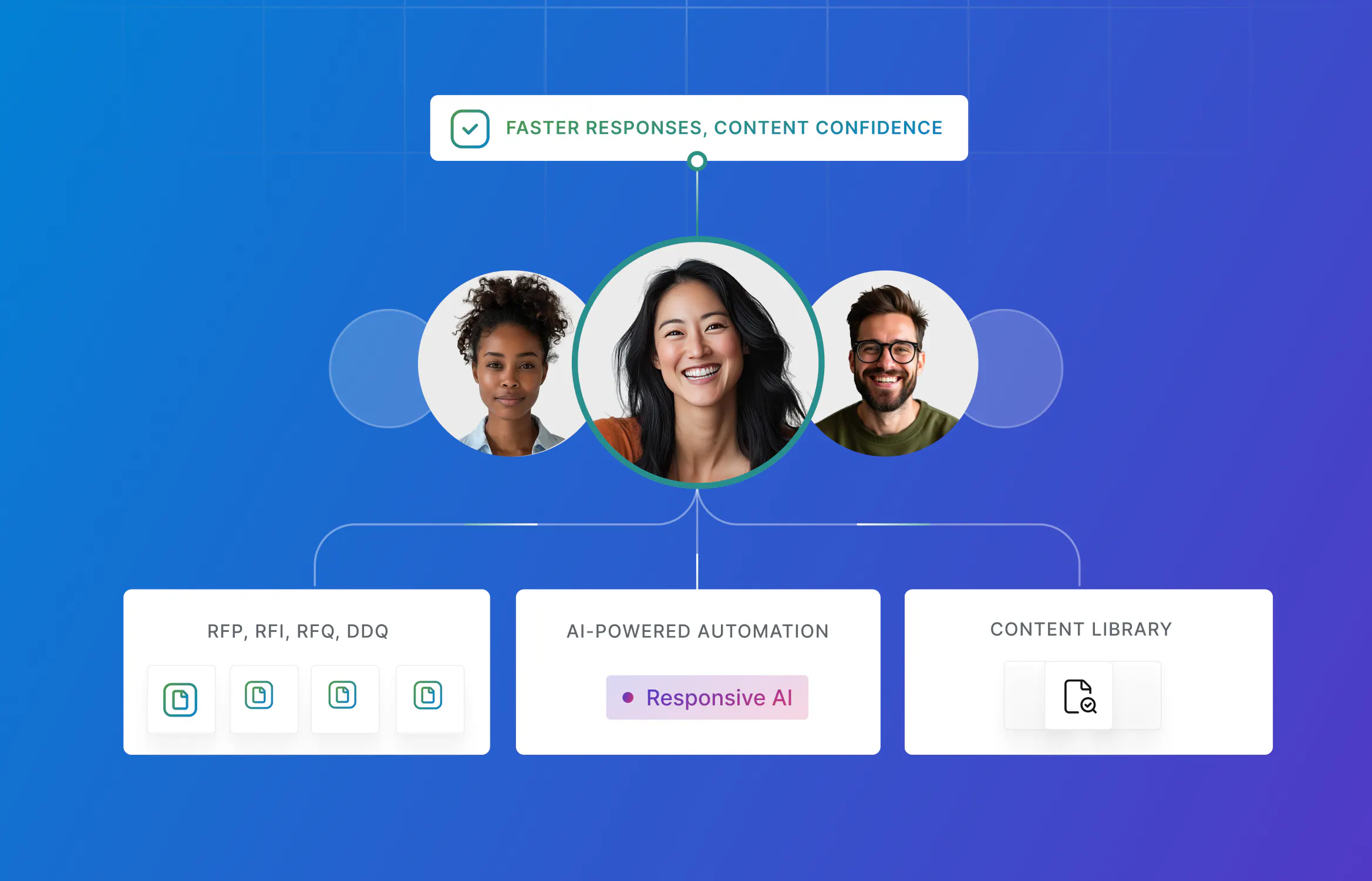
Leaders treat knowledge like a product, a crucial asset. They centralize it, keep it current, and make it easy to use. The performance gap is evident in the 2025 State of SRM Report: 88% of top-performing organizations say they have at least some centralized knowledge management. Among novices, just 67% say the same.”
When content is siloed or stale, field teams chase answers, proposal teams become the help desk, and cycle times stretch. When knowledge is democratized, teams move faster, quality holds steady, and everyone can self-serve with confidence.
The report also illustrates a simple operating model leaders follow to align people, process, and technology around SRM: adopt, align, and amplify.
- Adopt the right tech with intention, pair AI and AI agents with a curated knowledge base, and extract insight from every pursuit.
- Align people, processes, and ownership, expand capacity, and reduce bottlenecks with self-service tools.
- Amplify results, measure the full impact of SRM, then feed insight back into strategy and content.
This is not only about being efficient. Upsell and cross-sell are the top growth priorities, and a shared knowledge foundation is the bridge connecting strategy to daily execution.
Most teams already have the raw material to compete with more precision. It is the knowledge your teams created while answering real buyer questions, and it lives in your SRM. Turning that knowledge into an advantage is as easy as consistently acquiring, obsessively curating, and democratizing knowledge access across the organization.
When you do, you respond faster, you reduce risk, and you make the work better for your teams and your customers. For a complete picture of how this all comes together, watch Ganesh’s keynote at the beginning of the blog, or check out the 2025 State of Strategic Response Management Report for even more in-depth information.

Andrew Martin
Content Marketing Manager @ Responsive
Andrew Martin covers AI adoption, RFP strategy, and proposal management at Responsive, drawing on insights from Responsive's 2,000+ enterprise customer base and original research.