Requests for quotes (RFQs) look simple until they land on your desk.
A buyer sends a spreadsheet or portal form, sales promises a fast turnaround, and suddenly your team is chasing pricing inputs, legal language, product details, and approvals under a hard deadline. If you are still managing the RFQ process via inboxes and Excel, you are almost certainly leaving speed, consistency, and win rate on the table.
The best RFQ software turns this scramble into a repeatable RFQ management system that reliably feeds your pipeline.
A quick note: Buyer-side vs. supplier-side RFQ software
Many “best RFQ software” lists focus on buyer-side RFQ tools — systems procurement teams use to issue RFQs, collect bids, and compare supplier quotes.
This guide is about the other side of the table: supplier-side RFQ response software. These platforms help vendors receive, organize, and answer RFQs quickly and accurately, often alongside RFPs, RFIs, and security questionnaires.
TL;DR: Best RFQ software for supply-side vendors
- Best overall RFQ platform for vendors: Responsive
- Best for standardized RFQ formats: Loopio
- Best for AI-generated RFQ drafts: Inventive, AutoRFP, AutogenAI
- Best for AI-drafts in regulated industries: Rohirrim
- Best for transitioning legacy proposal management workflows: Qvidian
- Best for lightweight AI support: Tribble, Sifthub
RFQ software comparison at a glance
| Platform | Best for | RFQ response focus | AI approach | Key strengths | Key limitations |
|---|---|---|---|---|---|
| Responsive | Enterprise teams with complex RFQs and RFx | End-to-end RFQ and RFx lifecycle | Full-lifecycle, governed AI | Centralized knowledge, collaboration, quality checks, analytics | Requires process alignment and implementation |
| Loopio | High-volume, standardized RFQs | Answer reuse and collaboration | AI for content reuse | Strong answer library, reuse workflows, intuitive UI | Limited lifecycle and advanced analytics |
| Inventive | Teams needing fast AI drafts | Draft generation for RFQs/RFx | Generative drafting AI | Fast draft generation, connected knowledge sources, modern interface | Governance and lifecycle depth are less mature |
| AutoRFP | Teams drafting across large RFQ documents | Document parsing and response drafting | Generative drafting AI | AI-powered document ingestion, automated response generation, and basic workflow support | Heavy reliance on generative AI; lighter governed content controls |
| AutogenAI | Teams that want fast first drafts and stronger writing quality | Long-form RFQ and proposal drafting | Generative drafting AI | Strong long-form drafting, collaboration and editing tools, and branded output support | Limited workflow orchestration, fewer native connectors, struggles with Excel-based RFQs |
| Rohirrim | Regulated teams needing secure AI drafts | Structured RFQ drafting from proprietary content | Security-focused generative drafting AI | Closed environment, proprietary-content drafting, fast time-to-value | Lighter project management, governance, analytics, and fewer enterprise references |
| Qvidian | Legacy, compliance-heavy proposal teams | Content repository and document-centric RFQ workflows | Limited / legacy AI | Established repository, template automation, auditability, compliance-friendly workflows | Heavier implementation, older interface, limited modern AI, and collaboration |
| Tribble | Small teams wanting lightweight in-document AI help | Basic Q&A inside Word, Excel, and Slack | Extension-based AI assistance | Familiar in-document workflow, quick help with simple responses | Limited governance, weak collaboration, not built for complex RFQ workflows |
| SiftHub | Teams wanting lightweight AI inside Slack and Docs | Basic Q&A in chat and docs | Extension-based AI assistance | AI in familiar tools, lightweight setup, fast basic answer generation | Limited knowledge management and limited workflow structure can hit scale limits |
A deeper look at the 9 best RFQ software platforms
1. Best overall for end-to-end RFQ response: Responsive
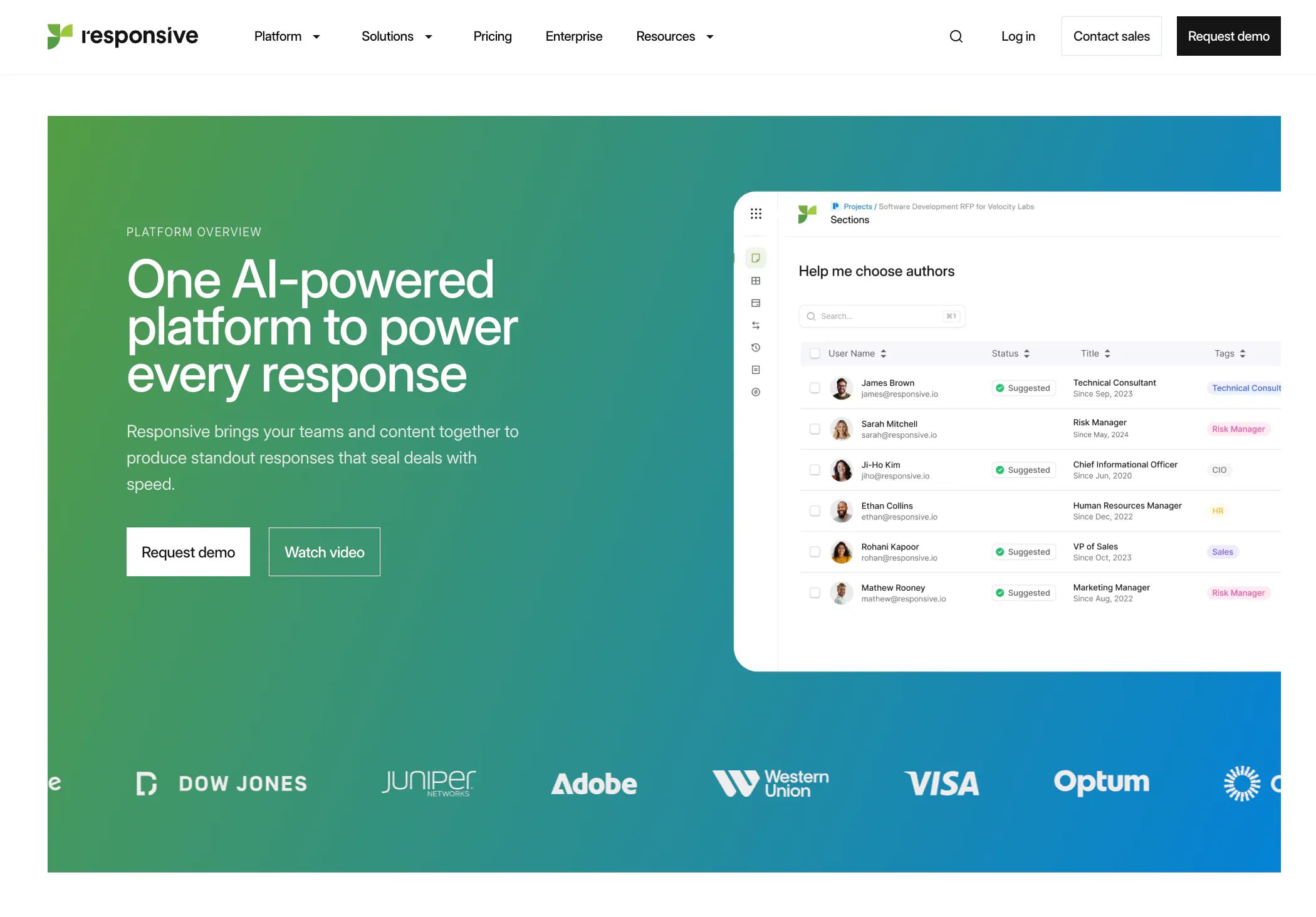
Responsive is an end-to-end Strategic Response Management (SRM) platform built for teams responding to RFQs, RFPs, RFIs, and tenders at scale. The Responsive team deliberately focused on building a vendor/supply-side RFx software rather than a buy-side procurement tool. Early differentiation included the ability to import real customer files, such as Excel spreadsheets, without forcing them into rigid templates.
Why Responsive is strong for RFQs:
- AI agents embedded across the RFQ lifecycle, including intake, drafting, review, and submission (not just answer generation)
- Centralized, governed knowledge for pricing, technical answers, and legal/commercial language
- Structured collaboration across sales, SMEs, legal, security, and finance in one workspace
- Quality and compliance checks, including scoring for completeness and alignment, before responses go out
- Analytics that track RFQ/RFx volume, cycle time, and win performance over time
Responsive tradeoffs:
- Works best when all teams are willing to align their processes around a shared SRM platform.
Responsive pricing:
Responsive pricing offers four tiers (Lite, Emerging, Growth, Enterprise). Specific pricing is available upon request.
2. Best for standardized RFQs: Loopio

Loopio emphasizes reusable answer libraries and structured collaboration, which suits high-volume, repeatable RFQs. By helping proposal teams to reuse answers efficiently, Loopio makes it easier to keep RFQ responses consistent and on-message across the organization.
Loop’s strengths include:
- Centralized answer libraries and robust reuse workflows
- Intuitive UI for contributors and reviewers
- Solid collaboration basics (assignments, reminders, comments)
Loopio limitations:
- Less support for full pursuit lifecycle and advanced analytics
- May struggle with more complex, narrative-heavy RFx work
Loopio pricing:
Loopio pricing offers three pricing tiers (Foundations, Enhanced, and Enterprise). Specific pricing is available upon request.
3. Fast drafting + growing integrations: Inventive
Inventive uses AI to help teams generate bids more quickly by drawing on connected knowledge sources and automating parts of the response workflow. Out of the many AI startups in the RFQ software space, Inventive pulls to the front of the pack.
Inventive strengths include:
- AI-first platform built around fast draft generation and workflow automation
- Connects to multiple knowledge sources and business systems to surface relevant content, such as Slack, Teams, Jira, Confluence, and CRM platforms
- Modern interface
Inventive tradeoffs:
- Greater emphasis on drafting speed than on end-to-end RFQ process management
- Governance and lifecycle depth are less mature than more established SRM platforms
- Long-term reporting, analytics, and enterprise operating model support are less established
Inventive pricing:
Inventive’s pricing model charges a flat platform fee plus a pay-per-RFQ charge. Get a personalized quote upon request.
4. Fast drafting across large RFQ documents: AutoRFP
AutoRFP serves as an AI assistant for RFQ responses, parsing large documents and suggesting answers. It helps speed up first drafts and can reduce overall administrative burden.
AutoRFP strengths include:
- AI‑powered document ingestion (Word, Excel, PDF) and automated response generation
- Basic workflow automation and collaboration support
- Integrations with systems like Notion, Google Drive, and Salesforce
AutoRFP tradeoffs:
- Heavy reliance on generative AI without the same level of governed content controls as enterprise SRM platforms
- Younger company profile and support model may be less proven for complex, global teams
AutoRFP pricing:
AutoRFP offers transparent pricing tiers starting at $899 per month.
5. Fast first drafts without the bells or whistles: AutogenAI

AutogenAI uses generative AI to turn prompts and past material into structured, on‑brand RFQ response drafts in a fraction of the usual writing time. It’s attractive to teams that want to save time and improve writing quality, especially when transitioning from manual, Word‑based processes.
AutogenAI advantages include:
- Generative AI to draft RFQ content using the organization’s input materials
- Collaboration and editing tools for refining AI‑generated responses inside the platform
- Integrations for ingesting content and exporting finished documents into branded templates
AutogenAI limitations:
- Primarily focuses on initial content generation; lacks full-lifecycle automation and workflow orchestration
- Lacks native connectors to major tools like CRMs and document ecosystems
- Struggles with Excel‑based RFQs
AutogenAI pricing:
AutogenAI does not publish any information about its pricing online.
6. Fast, security-focused AI drafts for regulated industries: Rohirrim

Rohirrim is an AI-powered RFx automation platform that focuses on fast draft generation and secure handling of sensitive proposal content. Compared with Inventive, AutoRFP, and AutogenAI, Rohirrim positions itself less as a general-purpose writing assistant and more as a closed, security-conscious AI workspace built specifically for proposal teams.
Rohirrim strengths include:
- AI-driven response generation across structured RFQs using customers’ own content (rather than open internet sources).
- A closed, enterprise-focused environment that protects proprietary data and aligns with security expectations in regulated markets
- Fast time-to-value for those who want AI help drafting responses without overhauling their entire RFx tech stack
Rohirrim tradeoffs:
- Lighter project management, collaboration, and governance than full Strategic Response Management platforms
- Less emphasis on deep, governed content libraries, analytics, and cross-team workflows than on tools that manage the full RFQ lifecycle
- Fewer enterprise references than long-established response management vendors
Rohirrim pricing:
Rohirrim does not publish any pricing information online.
7. Best for legacy, compliance-heavy proposal workflows: Qvidian
Qvidian is one of the older proposal management platforms on the market, with roots in managing large, document-heavy RFP responses for highly regulated organizations. It appeals most to enterprises that already rely on traditional content repositories and templates and that prioritize audit trails and compliance over modern, AI-heavy workflows.
Qvidian strengths include:
- A long-established content repository and template automation engine for RFPs and RFQs, designed to support large teams and complex documents
- Familiar, compliance-friendly workflows that align with governance expectations in industries like banking, healthcare, and government contracting
- Deep support for document-centric processes, version control, and auditability
Qvidian tradeoffs:
- A heavier, more implementation-intensive system with an older interface, which can slow adoption
- Limited modern AI capabilities and less native support for agentic workflows, governed AI scoring, or multi-channel RFQ collaboration
Qvidian pricing:
Qvidian pricing relies on a tiered model to meet different business needs, but does not publish this information online.
Other lightweight AI helpers for RFQs: Tribble and SiftHub
Not every team needs a full RFQ platform right away. Lightweight AI tools like Tribble and Sifthub help teams generate answers within familiar environments such as Word, Excel, Slack, and Google Docs. This can make them attractive for smaller teams or simpler questionnaires.
The tradeoff is that both tools are positioned more as AI overlays than complete RFQ management systems, with less support for governed content, structured workflows, and enterprise-scale collaboration.
Tribble and SiftHub strengths include:
- AI assistance inside tools teams already use, which reduces context switching and makes adoption feel easier
- Fast help with basic Q&A and straightforward response tasks
- Lightweight setups that may appeal to smaller teams or organizations with simple RFQ workflows
Tribble and SiftHub tradeoffs:
- Limited governance and knowledge management, which can make content harder to standardize, update, and reuse over time
- Little to no support for project management, collaboration, approvals, and progress tracking across complex RFQ workflows
- Can become limiting as response volume, compliance needs, and cross-functional complexity grow
Tribble pricing:
Tribble pricing for proposal automation starts at $30K/year with 50 annual projects, unlimited reviewers, source-cited answers, and guided implementation.
Sifthub pricing:
Sifthub does not publish any information about its pricing online.
What to look for in Request for Quotation (RFQ) software
Still not sure which RFQ management software is best for your teams? Evaluate multiple vendors and look for the following key features in each tool.
1. Centralized, governed RFQ content
RFQs are short, but every field matters. Teams need a single, governed library with:
- Approved pricing assumptions and discount policies
- Standard product and service descriptions
- Implementation timelines, SLAs, and support tiers
- Legal and commercial boilerplate approved by counsel
RFQ software has to deliver both speed and correctness, grounded in governed content.
“The AI being able to speed up our time is wonderful, but I can’t just have it giving me any answer. It needs to be the answer.”
Sheryl Frye
Manager of RFP/Audit Response at NTT Global Data Centers
2. End-to-end RFQ response workflow
RFQs may be simpler than RFPs, but the workflow around them is not. Look for tools that support:
- Capturing RFQs, scoring them, and making go/no-go decisions
- Building RFQ workspaces, setting deadlines, and assigning owners
- Auto-filling from the content library and letting contributors work in parallel
- Routing drafts to pricing, legal, and leadership before submission
Open Up Resources reported that this kind of structure helped cut response turnaround from two weeks to two to three days.
3. Real collaboration across sales, SMEs, legal, and finance
RFQs often pull in sales, pricing, product, security, and legal. Strong RFQ tools:
- Automatically assign questions to the right subject matter experts with due dates and reminders
- Show who owns what and what is overdue
- Keep comments and decisions in context instead of buried in email
CAPTRUST, for example, coordinates work from 15 teams and over 70 SMEs through a dedicated SME coordinator and the Responsive platform, which keeps SME load manageable and directly tied to revenue outcomes.
4. AI tuned for structured RFQs
For RFQs, AI is most valuable when it handles structure and precision, not just long-form copy.
High-value AI capabilities:
- Parsing RFQ spreadsheets or portal exports and mapping fields to your content library
- Suggesting answers from approved content, including pricing and terms
- Flagging missing fields, inconsistent numbers, or discounts outside policy
5. Analytics that make RFQs smarter over time
RFQs are data — your software should capture and analyze that data to provide your teams with insights that improve performance. Useful RFQ analytics include:
- Win and loss rates by RFQ type, product, or region
- Response time and cycle time metrics
- Content performance (which answers and pricing structures correlate with wins)
Teams use these insights to refine messaging, pricing, and pursuit strategy. For example, Lynda English, Senior Director of Research and Proposals at Open Up Resources, tracks which terms sales teams search for in the content library. Repeated searches signal new buyer trends and drive content and marketing updates.
Ready to test drive RFQ software?
If your RFQs are still bouncing between inboxes and spreadsheets, start small: pick one of these tools, run a live RFQ through it end-to-end, and measure the impact on cycle time, accuracy, and win rate.
The teams that move first with AI-powered RFQ responses will not just respond faster — they will build a repeatable, data-driven engine to win more of the right deals.
You might also like: Best RFP software: 2026 industry leaders vs. AI startups
Best RFQ platform FAQs

Andrew Martin
Content Marketing Manager @ Responsive
Andrew Martin covers AI adoption, RFP strategy, and proposal management at Responsive, drawing on insights from Responsive's 2,000+ enterprise customer base and original research.