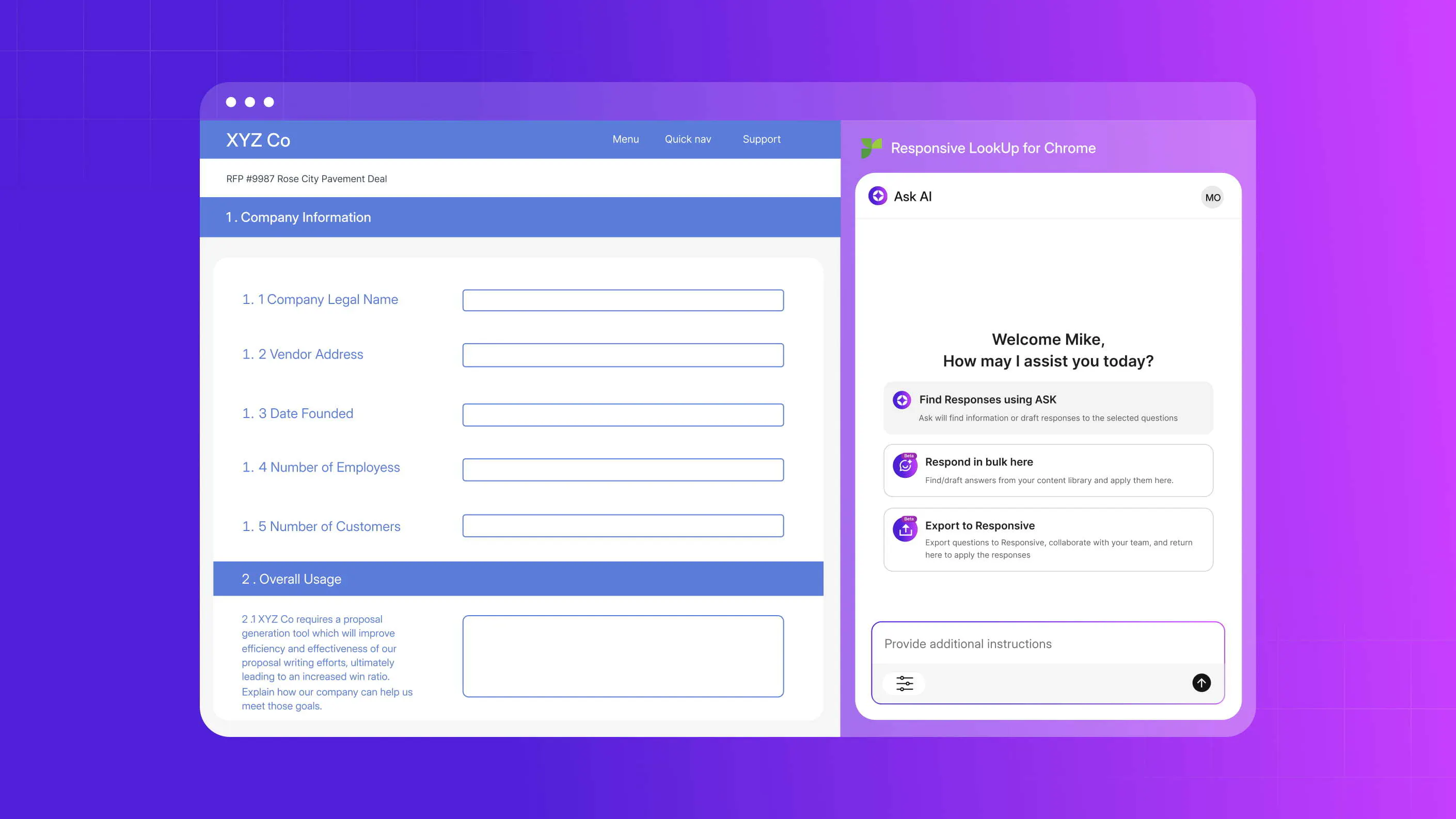
Strategic response teams are carrying more weight than ever. Budgets are tighter. Buying cycles are longer. Requirements are more detailed. Scrutiny is higher, especially across security and risk.
At the same time, AI is now the default way most teams draft, review, and package information. That creates a new reality: speed still matters, but so does quality. When the work is revenue-critical and risk-sensitive, “good enough” content often leads to rework, missed requirements, and even lost deals.
At Responsive, we spend a lot of time thinking about what teams actually need to succeed in this environment. The solutions continue to be rooted in the same foundation: trusted answers, grounded in approved knowledge, supported by the right workflows and collaboration. That is where Strategic Response Management (SRM), paired with AI, delivers real value.
Our March product release deepens these roots, building an even stronger foundation for faster, higher-quality work. I’m excited to show you how we’re bringing trusted Responsive intelligence to where response work is already happening, including the AI tools teams use every day and the portals where more questionnaires now live.
Here’s what’s new.
Responsive on ChatGPT: Governed answers inside everyday AI workflows
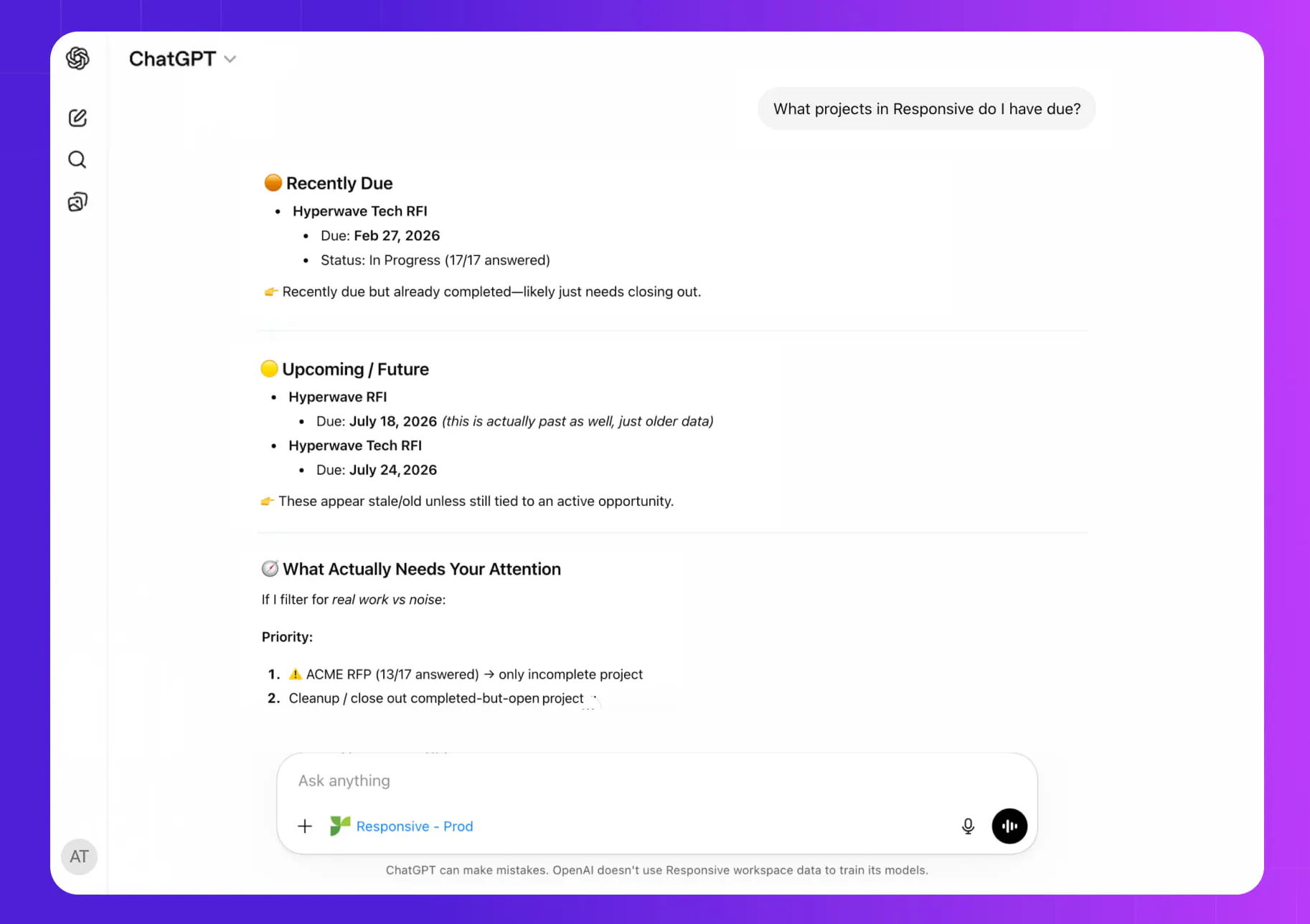
AI chat tools have become commonplace in the day-to-day workflows for many revenue, security, and proposal teams. New technologies are introduced faster than most organizations can keep up with them, let alone test and approve them. Yet, the risk is serious. Generic AI outputs can be disconnected from approved content, product reality, and policy constraints. In strategic response work, that gap can create inconsistencies, incorrect statements, and avoidable review cycles.
Responsive on ChatGPT is designed to bridge that gap. It brings your Responsive knowledge base directly into the chat experience via MCP Server integration, so teams can work where they already are while staying compliant and grounded in what your organization’s vetted and approved content.
With Responsive on ChatGPT, teams can:
- Ground AI outputs in approved knowledge. Use your curated Responsive content as the backbone for all responses and drafts.
- Access relevant content and project context inside chat. Pull in what you need without jumping between systems.
- Reduce risk in high-stakes work. Keep AI assistance aligned with governance and response standards.
This is a practical step forward for organizations that want the productivity benefits of AI chat tools without creating a parallel, ungoverned content stream.
Portal automation (beta): Autofill external portals with trusted, AI-powered answers
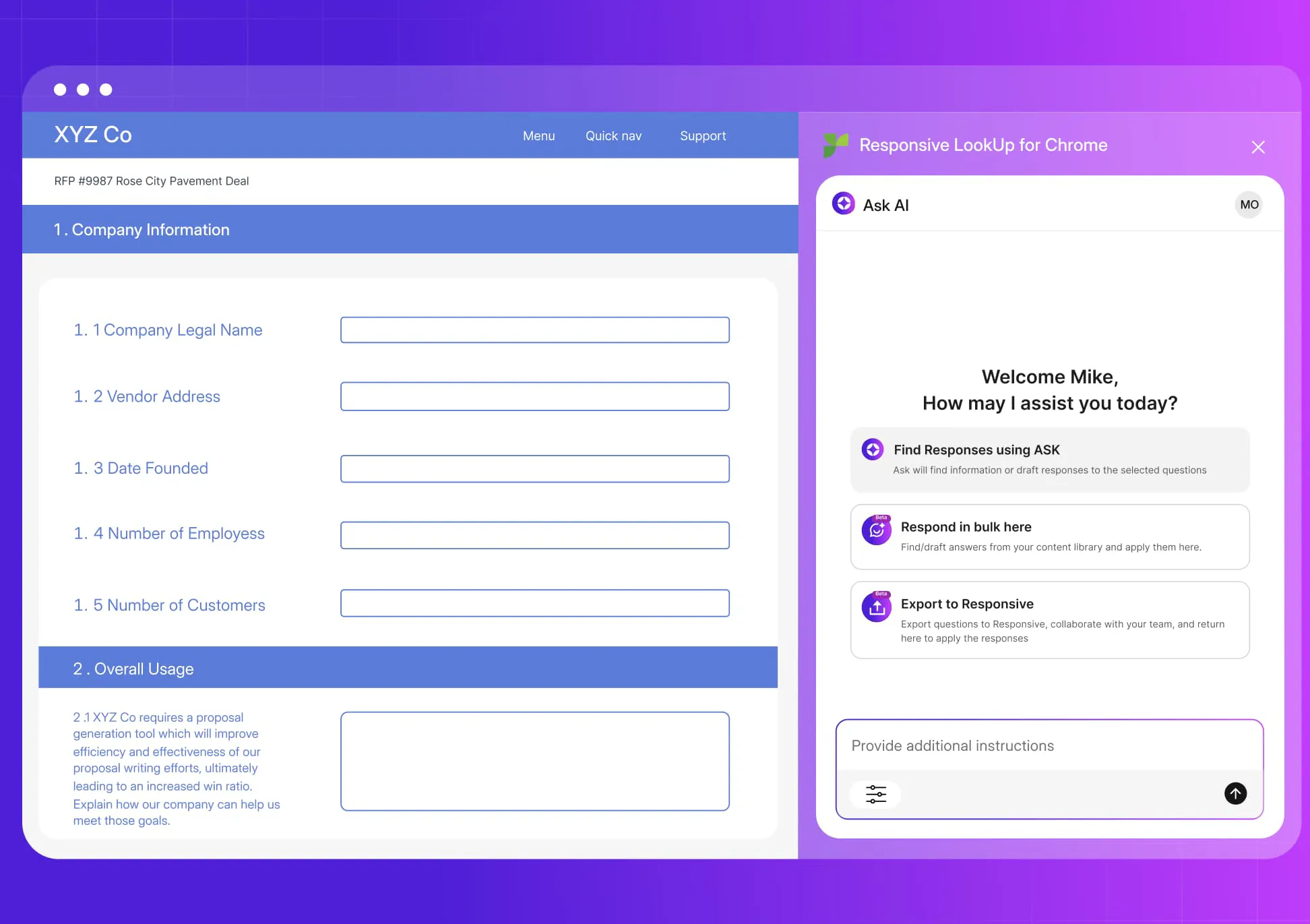
If you run responses at scale, you already know that questionnaires don't always arrive as documents you can collaborate on. Sometimes, requests arrive in a third-party portal built for submission, not collaboration.
Portals introduce significant friction into modern response processes:
- Teams get forced out of their governed workflow.
- Responses turn into copy-and-paste work, often across multiple contributors.
- Review cycles become harder because context is scattered.
- Errors are easier to introduce and harder to catch.
- Collaboration with subject matter experts (SMEs) becomes increasingly difficult
Responsive’s portal automation (currently in beta) is designed to eliminate that friction. Responsive can instantly detect questions, assist teams in responding with trusted knowledge, autofill answers directly within the portal interface, and export information requests into Responsive workflows so collaboration with SMEs doesn’t become another challenge or time sink.
This beta supports common portals, including Whistic, OneTrust, Venminder, Hologic, Coupa, and more.
There are two ways teams can use this capability, depending on the complexity of the request:
- Instant autofill for straightforward questionnaires
- Responsive detects the portal questionnaire
- AI-generated answers are grounded in your approved knowledge base
- Responses are filled into the portal with less manual effort and fewer opportunities for mistakes
- Extract into a Responsive Project for complex submissions
- Pull questions into a governed Responsive workflow
- Collaborate with SMEs, review, and refine
- Export the completed answers back to the portal for submission
The key benefit is continuity. Teams can move faster while maintaining governance, ensuring consistency, and reducing submission risk.
Trust Centers updates: Tailor access without duplicating content and connect to Salesforce
Trust content has become part of the buying process, with trust centers proactively sharing security and compliance documentation earlier in the process. The goal is simple: reduce friction, accelerate trust, and shorten the back-and-forth that slows down deals.
The operational challenge is also simple: different audiences need different levels of access. Some documents should be shared broadly. Others should be limited by customer type, region, product, or relationship stage. Managing this often results in either duplication across multiple trust centers or oversharing to keep things manageable.
Views for public Trust Centers solves that problem by allowing teams to tailor access while managing content in one place.
With Views, Trust Center admins can:
- Create audience-specific documentation experiences. Align what a viewer sees with what they should see.
- Apply granular document and section-level controls. Share confidently without resorting to duplicate repositories.
- Improve buyer experience while maintaining governance. Reduce friction without increasing risk.
This upgrade means any team using Trust Center can safely and confidently integrate it into a modern sales motion, especially in security-conscious markets.
Trust Center can now also connect to Salesforce via the new Salesforce Opportunity Sync. This connection bridges activity directly to Salesforce opportunities, giving revenue teams clear visibility into how buyers engage with security documentation during active deals. Teams can track views, downloads, shares, and NDA activity alongside pipeline data, making it easier to understand how trust-building efforts influence deal momentum and outcomes.
What comes next
Responsive continues to invest in what matters most for strategic response teams: bringing governed knowledge into more daily workflows, reducing friction in the places where the work is increasingly being done, and ensuring AI supports speed without compromising confidence.
If you are evaluating SRM or looking for a practical way to leverage governed AI in revenue-critical workflows, this release reflects how Responsive is shaping the next phase of AI in the marketplace: embedding trusted, governed knowledge directly into the tools and channels where critical work happens, so teams can move faster without compromising accuracy or control.
If you’re ready to try what’s new, connect with your Customer Success partner. And if you’ve got ideas for what comes next, we’d love to hear them. We’re building the future of SRM together, one response at a time.
Stay tuned for even more updates coming in the coming months.

AJ Sunder
Co-Founder and CTO @ Responsive
A highly experienced Information Security Analyst, Sunder oversees development of advanced SaaS technologies and AI to improve the response process and increase business close rates.