
Everyone is experimenting with AI to monetize it, to be more efficient, and to find real competitive advantage. Truth be told, time savings alone rarely unlock leadership buy-in. If AI is going to matter, it must be tied to measurable business outcomes. It must change how teams work, not just how fast they work.
That’s exactly what happened at BlueConic.
As a customer data platform used by enterprise marketers, BlueConic responds to hundreds of RFPs, RFIs, and security questionnaires each year. Those requests fall on a small presales team that is also responsible for designing and delivering tailored product demos. They needed:
- A single source of truth to simplify content access
- AI layered on top to generate accurate drafts from anywhere
- Data to prove the presales organization was a major contributor to revenue.
What follows is a practical playbook inspired by BlueConic’s transformation and some supporting data, proof points, and customer stories to show that BlueConic’s transformation can happen anywhere. This playbook for proposal leaders can show, with clarity and credibility, that they’re a revenue engine working with knowledge that can help every team in an organization.
Why time savings alone don’t win leadership buy-in
Time savings are nice, but leadership wants to know more. For executives, time is more valuable when it’s redirected toward growth.
Across industries, this pattern holds. In the 2025 State of Strategic Response Management Report, executives report feeling pressure from tighter budgets (84%), faster turnaround expectations (82%), and greater personalization demands (75%). Proposal teams are squeezed, but when every function is being asked to do more with less, time savings are no longer enough to stand out.
Additionally, even though AI adoption is accelerating and speeding up work, executives want evidence that AI enhances strategy, enables better decision-making, and contributes directly to revenue.
At BlueConic, AI was initially attractive for efficiency, but efficiency wasn’t the story that secured leadership attention.
“Leadership cares about the quality of responses, no question. But the time savings are a huge win… because it frees our team up for more high-value tasks like customer calls and tailored demonstrations.”
Justin Walsh
Solutions Consultant at BlueConic
Efficiency is only the beginning. Real value comes from identifying how efficiency creates capacity, and capacity creates revenue. Because leadership invests in revenue.
How BlueConic redirected time into revenue-driving work
BlueConic’s transformation began by reorganizing their Responsive Content Library.
“Cleaning up the content wasn’t glamorous, but it was the backbone of everything that followed. You need to feed AI quality content in order to get quality content back.”
Justin Walsh
Solutions Consultant at BlueConic
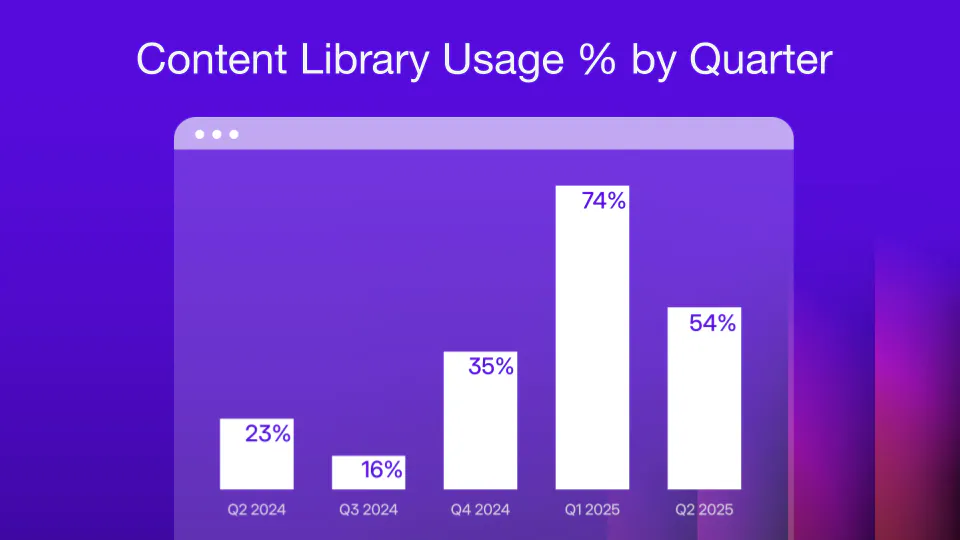
BlueConic reduced duplicates, rewrote content for clarity, and cut outdated entries. Content Library usage surged from 16% to 74% in just two quarters, an early proof point that if you build a reliable foundation, teams will use it.
But the real breakthroughs came when they asked: How can we use the time we saved? Three patterns emerged.
1. Better demos
Before Responsive AI, the presales team spent hours rewriting answers they had already written in past RFPs. That time was reclaimed and reinvested where it matters most: customer calls and tailored product demonstrations.
Based on findings from Inside the Buyer’s Mind, reallocating time for demos is a sound strategy: 78% of buyers say vendor presentations and demos significantly influence their final decision, nearly equal to the RFP response itself (81%).
Proposal efficiency is most valuable when it gives experts more time to shape the interactions that truly sway buyers.
2. More customer conversations
Demand for interactions is rising. Buyers now conduct 90% of their research before first contact, and they spend the most time in early-stage evaluation and shortlisting (75% and 61%). That means the conversations you do get must be high-quality and well-timed.
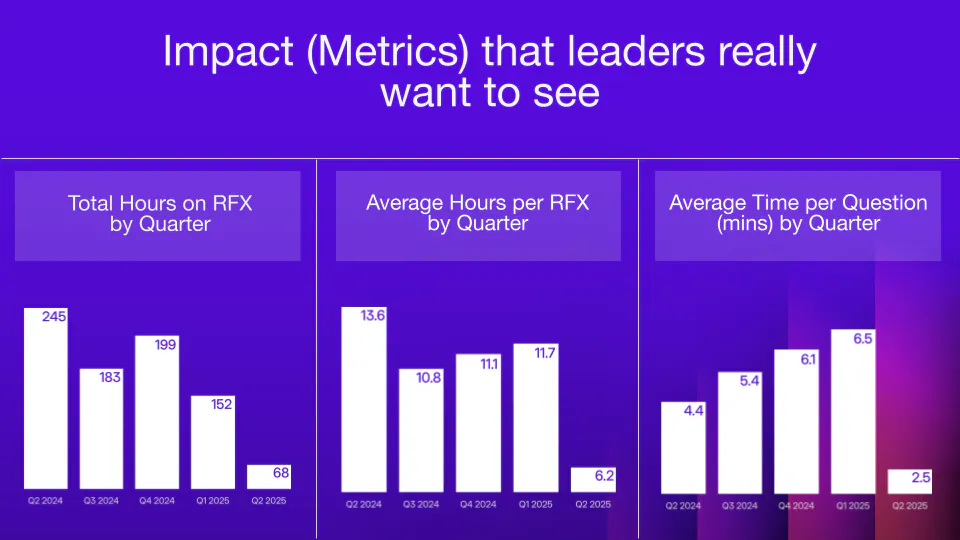
By cutting total RFP hours by 72% and average hours per RFP by 54%, BlueConic’s presales team suddenly had the bandwidth to engage earlier and more often, when buyers are forming impressions that determine the shortlist.
This is exactly where proposal teams can “move upstream,” contributing insights that help sales shape positioning before the RFP ever arrives.
3. Higher-quality tailoring
In a world where 75% of buyers say personalization is essential to decision-making, tailored responses are table stakes.
BlueConic used Responsive AI to automatically tailor content using approved responses and context-aware rewriting. Source citations and TRACE Score™ (a 0-100 confidence indicator provided with every AI-generated answer) gave reviewers confidence to approve faster without sacrificing quality.
Accuracy and relevance are what win. In financial services, for example, investors expect precise, compliant, personalized answers, and firms deploying AI in their SRM workflows see faster turnaround without quality tradeoffs. You can explore that in more detail in the video below featuring CAPTRUST, a financial advising firm in Bellevue, WA.
For BlueConic, Responsive AI empowers users to give customers better responses every time. “AI finds the most accurate and relevant content and tailors answers to each RFP, RFI, or security questionnaire,” Justin said. “It’s a huge win for us and for customers.”
How AI enables proposal teams to be more strategic
The proposal function is becoming more strategic, and AI is the catalyst. 72% of executives say the role of bid and proposal professionals must evolve because of AI. AI-enabled teams report higher employee satisfaction (42% vs. 22%) because they’re spending less time on administrative work and more time on strategic work.
Buyers increasingly use AI themselves to compare vendors (44%), draft RFPs (47%), and evaluate responses (37%), raising the bar for quality and speed on the vendor side.
When GenAI became mainstream, leading Strategic Response Management platforms had already built roadmaps that journeyed beyond the horizon of automating tasks to empowering proposal teams with AI-driven intelligence to impact revenue.
Shape pursuit strategy
Leading proposal teams are more than twice as likely to use AI for go/no-go analysis and win/loss insights, the very activities that shape which deals teams pursue and how they win them.
Guide revenue decisions
Kristen Carloni at BlackRock describes using Responsive data to quantify that 80% of proposal time went to revenue protection, reframing the team’s value entirely: “We’re not a cost center; we’re a team driving revenue protection at scale,” she said.
Enable field teams to self-serve
High-growth organizations are 88% more likely to have centralized knowledge hubs that eliminate internal bottlenecks and reduce the time SMEs spend answering repetitive questions.
Influence more of the sales cycle
AI-powered knowledge retrieval, document shredding, and content governance allow proposal teams to support discovery calls, competitive positioning, and solution shaping long before the RFP arrives. According to Darrell Woodward, Director at Prosfora Solutions, “The [proposal] role is shifting to be more proactive. We’re starting to be more thoughtful about what we chase.”
In other words, proposal teams offer more value as strategic partners instead of last-mile writers.
Get inside your buyer's mind
Positioning proposal teams as revenue enablers, not cost centers
If you want leadership to see your team differently, give them the story they’re already primed to hear. Across the data:
- Buyers say the RFP response is the #1 factor influencing their decision (81%).
- Organizations with mature SRM functions see higher win rates, faster cycles, and stronger cross-functional alignment.
- Teams deploying AI to orchestrate workflows, qualify opportunities, and analyze performance grow faster and report higher satisfaction.
Here’s how you turn that into a compelling internal narrative.
1. Show how your work influences revenue outcomes
Leadership cares more about revenue metrics than efficiency metrics. For example, at BlueConic that meant:
- Higher demo-to-win ratios
- Better proposal-to-win ratios
- Improved opportunity conversion after implementing AI
2. Visualize the impact of better knowledge and better AI
BlueConic reduced total hours per RFP from 13.6 to 6.2, and total quarterly RFP hours dropped 72%. That time went directly toward revenue-generating work. Pair that with industry validation: AI-driven responses deliver measurable ROI within the first year for 73% of firms, with 13% realizing ROI within 3 months.
High-performing organizations are 3x more likely to measure SRM’s impact on revenue directly.
3. Anchor your narrative in real outcomes, not abstractions
Every metric should ladder up to one question: Did this help us win more business? With Responsive Business Intelligence, proposal teams can now quantify:
- Win rate improvements
- Faster time-to-value
- Increases in response volume without increasing headcount
- Improved customer experience through higher-quality answers
Sharing this kind of proof with leadership is how you change perception and scale use of an SRM platform across your organization.
Other Responsive customers proving the value of SRM data
BlueConic isn’t alone. Across industries:
- BlackRock used Responsive data to show that most proposal time defended existing revenue, allowing them to advocate for AI investment that doubled their output and elevated the team’s strategic role.
- Microsoft saved an average of 30 minutes per question through knowledge democratization and AI-powered search, enabling global sellers to self-serve and freeing proposal experts for high-impact pursuits.
- Swisscom uses AI to analyze RFP complexity and allocate resources intelligently, preventing burnout and improving bid quality in a highly regulated environment.
- Asset managers across industries report that AI-assisted SRM reduces turnaround time by up to 80% and strengthens compliance and accuracy under strict regulatory standards.
Different industries, same pattern: AI + SRM + clean data = revenue clarity.
The playbook for telling a revenue story that lands
To recap, here’s your playbook:
1. Clean your knowledge base
Centralized, accurate content is the foundation of credible AI.
2. Automate the work that isn’t strategic
Drafting. Shredding. Tagging. Validating. Let AI handle it.
3. Redirect time to activities buyers say matter most
- Custom product demos (78%)
- Tailored responses (75%)
- Proof of concept (75%)
- Conversations that shape vendor selection (84%)
4. Instrument everything
Track hours, usage, AI adoption, demo-to-win, proposal-to-win, and conversion.
5. Tie results to revenue
As BlueConic did: “If you had only one slide to show leadership, it should prove adoption, impact, and outcomes,” Justin said.
Watch BlueConic’s presentation for the full story
For Justin Walsh of BlueConic’s full report, check out the video of his Summit26 presentation included at the beginning of this article.
For insight on how to reframe your team as a revenue accelerator, revenue protector, and revenue multiplier, request a demo. We’ll show you how AI gives you the data to prove it.

RD Symms
Sr. Copywriter @ Responsive
With more than 15 years in writing, content development, and creative strategy, RD brings a rare combination of conceptual thinking and executional range to the proposal management space. He's spent his career turning complex ideas into content that earns attention which makes him a natural fit for an audience of proposal managers and sales leaders who read critically and buy carefully.