Proposal teams sit where market demand meets organizational capability. They surface what buyers actually care about, translate complexity across internal teams, and manage the knowledge that determines whether deals move forward or stall. Yet despite this vantage point, they remain one of the most under-leveraged strategic assets in most organizations.
In many companies, the knowledge these teams steward is still fragmented, spread across spreadsheets, shared drives, and inboxes. Sales, security, IT, legal, product, and operations often work from different versions of the truth. As buying cycles compress and scrutiny increases, fragmented knowledge compounds risk and drag from slower deal cycles, inconsistent messaging, duplicated effort, and responses that miss the nuances buyers use to make decisions.
That pressure is driving a quiet shift in leading organizations, moving proposal teams from the edges of execution to the center of strategy. Companies outperforming their peers in win rates and sales velocity are making a deliberate change. They’re positioning proposal teams as stewards of enterprise knowledge — centralized, governed, and supported by AI — and gathering intelligence to accelerate growth, reduce risk, and deliver a more consistent buyer experience.
To see what this shift looks like in practice, look at organizations like Tenable and NTT Data.
From RFP support to strategic business impact
Both Tenable and NTT Data began with a straightforward goal: respond to RFPs more efficiently. What they built instead was Strategic Response Management (SRM) that transformed how their companies operate.
At Tenable, the global proposal team now supports 900 sellers across the business and has contributed to revenue growth from $187 million to $900 million in annual revenue. The team manages 2,600 RFPs annually, maintains a knowledge base of 43,000 assets, and supports cross-functional teams including sales, cybersecurity, and legal.
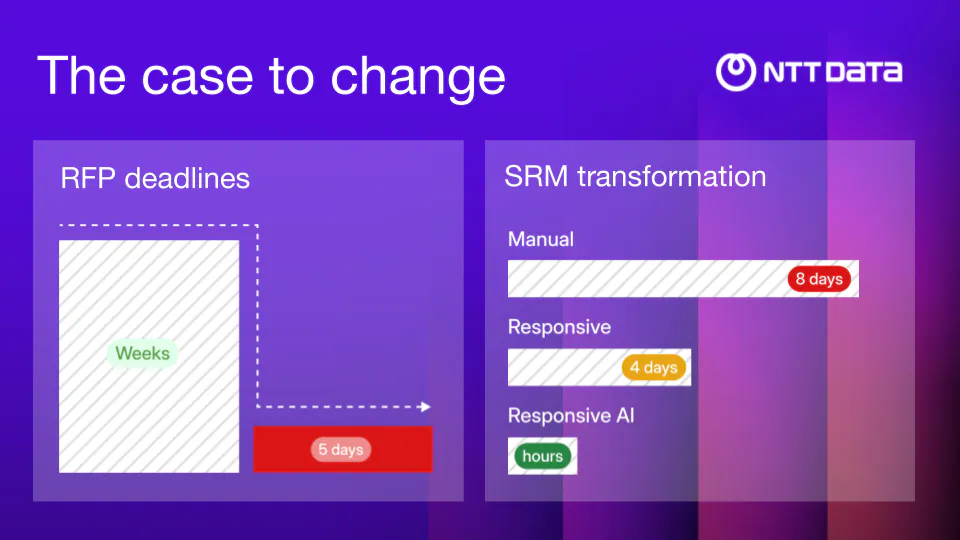
NTT Data’s scale is equally compelling. With 160 data centers across more than 20 countries, their proposal and audit teams manage high-stakes information for global customers where accuracy, trust, and consistency are paramount. Their volume is exploding, and so is buyer expectation: Customers that once granted NTT weeks for a response now give five days, sometimes less.
More importantly, both companies evolved from a reactive “proposal shop” to an enterprise hub for trusted, vetted knowledge that sales, legal, security, product, operations, and leadership depend on. It’s the shift from responding to shaping. From execution to impact. And it’s happening faster than many executives realize.
Proposal teams as the voice of the customer
Few functions have deeper visibility into what buyers value than proposal teams. Scale changes the role. When teams handle thousands of responses across regions, industries, and buyer profiles, they stop seeing individual requests and start seeing:
- Trends earlier than sales
- Shifts in buyer language before marketing
- Emerging requirements long before product roadmaps adjust
For SRM leaders, proposal teams have become the clearest voice of the customer inside the organization.
At Tenable, Vicky Bokhari’s team tracks buyer trends across thousands of global proposals and feeds that insight back into product, marketing, and legal. That real-time market intelligence has reshaped everything from product messaging to contractual frameworks. Two examples stand out:
- AI contract clauses: Tenable noticed customers increasingly submitting custom AI agreement language. Instead of waiting for risk exposure, they advised legal to proactively incorporate new AI clauses into their own master agreements, strengthening compliance and reducing friction in negotiation.
- Marketing validation: Proposal teams can see when buyers mirror company messaging back to them in proposals. It’s a simple but powerful signal of messaging traction, and an early indicator when messaging isn’t landing.
“Since we have visibility into what buyers are asking, we can take that information, summarize it, and collaborate with leadership to identify what the customers are interested in and what trends we’re seeing in the early stages of the sales cycle.”
Vicki Bokhari
Proposal Manager of Global GTM Operations at Tenable
Leading proposal teams are informing strategy, not just responding. And the data backs this up. In Inside the Buyer’s Mind, buyers cite the RFP response as the single most influential factor in their final decision (81%), over demos, price, or conversations. That means proposal teams inherently shape win probability long before a deal closes.
Feed your sales pipeline with buyer insights
Building an AI-ready knowledge base
Once proposal teams start surfacing real customer insight, the next question becomes scale: how do you make that intelligence accessible, consistent, and usable across the enterprise? That’s where AI enters the picture as a force multiplier. But AI built on a weak knowledge foundation exposes you to risk from inconsistent messaging, compliance gaps, hallucinations, and brand exposure.
Both NTT and Tenable emphasized that your AI output is only as good as your content. Without governance, tagging discipline, and accurate content, AI becomes noise rather than acceleration.
At NTT, their database was originally organized in a way that worked well for humans to easily find and distinguish the information they needed. However, when they started using AI to search the database, the AI would often return too much information, not just the specific answer they wanted. This happened because NTT’s Q&A database was structured so that one question could be linked to many answers (one-to-many), which made it harder for the AI to pinpoint the exact information.
To solve this, NTT restructured the database to use a one-to-one relationship between questions and answers with hierarchical tags. This change helps Responsive AI generate a response based only on exactly what users are looking for, minus any extra, unrelated information.
“We’re trying to get it down to a very simple case of the AI being able to find exactly what I’m looking for, and nothing else.”
Sheryl Frye
Manager RFP/Audit Response at NTT Global Data Centers, Americas
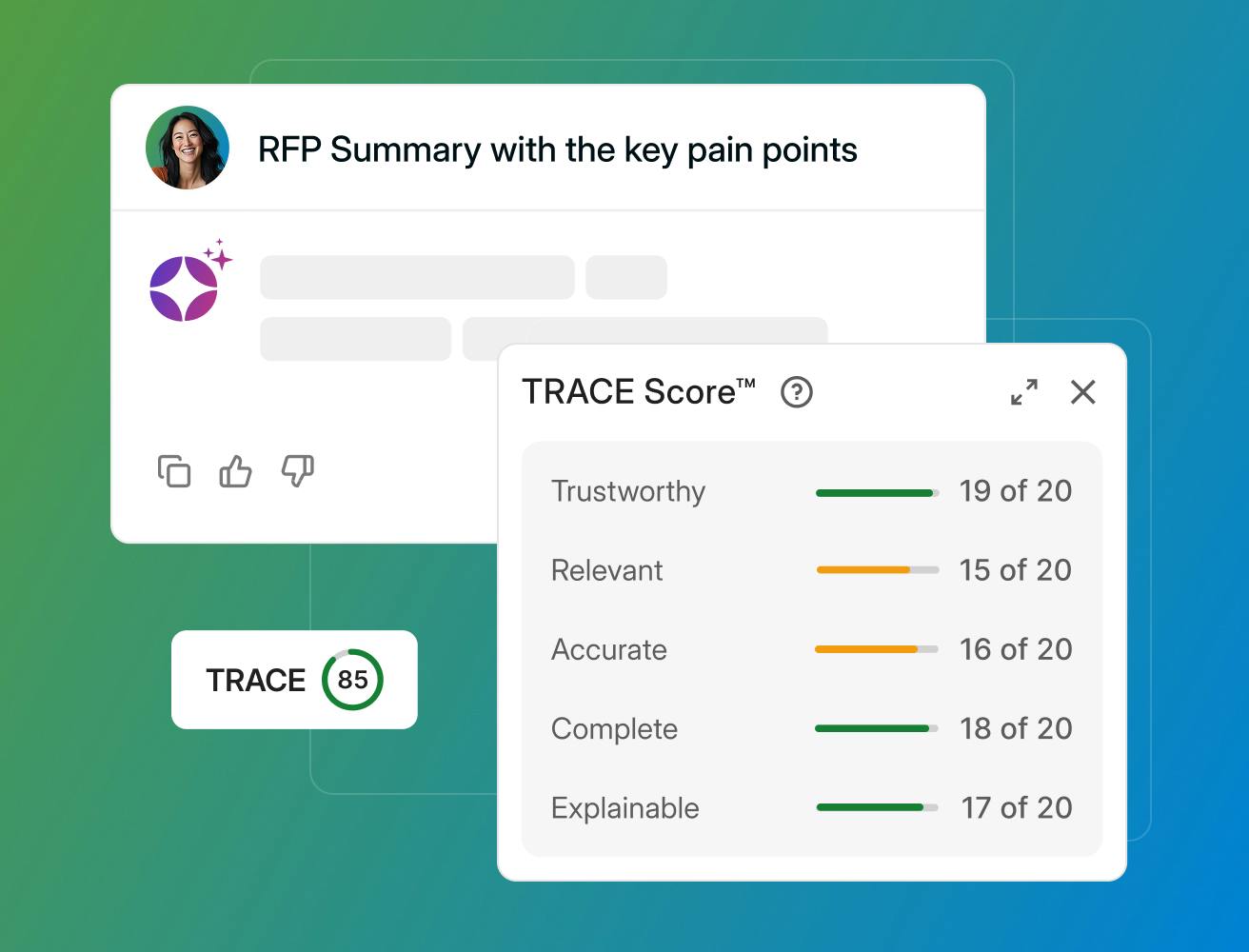
To confirm that Responsive AI generates an accurate response based its source documents, users can reference the TRACE Score™. This 1-100 rating based on relevance, accuracy, and trust not only helps users review AI output with confidence, it helps knowledge managers identify source content that is out of date or missing.
Creating an AI environment where data is safe
As AI accelerates response work, it also raises the stakes. When proposals shape buyer trust — and buyers increasingly use AI themselves to evaluate responses — accuracy, explainability, and governance become non-negotiable. For regulated and security-conscious organizations, it’s table stakes.
In the 2025 State of SRM Financial Services Industry Report, 32% of firms cite uncertainty around how to safely use AI in RFP processes, and 36% say their current tools can’t support the security or governance required. In other words, firms demand secure third-party AI tools that can offer more security peace of mind than public tools.
At Tenable, a cybersecurity company, Responsive AI keeps data inside its infrastructure, not in a shared cloud brain. For their risk profile, that distinction was non-negotiable.
This is why AI governance is now a leadership priority. And it’s why Strategic Response Management platforms built with embedded AI instead of AI wrappers are becoming the new standard.
Trusted knowledge reduces response speed from days to hours
Counterintuitively, strong governance doesn’t slow teams down. It’s what makes real speed possible. When content is trusted, tagged, and current, teams move faster because they don’t need to second-guess every answer.
- NTT: 150-question RFPs went from eight days manually, to four days with Responsive, to hours with Responsive AI, including review time.
- Tenable: Five- to seven-day cycles compressed to three to four days, and then to hours as their AI and content hygiene improved. They sustained a 70% win rate, more than double the industry average of 30% .
This velocity multiplies impact across the business: more pursuit capacity, faster deal cycles, better personalization, stronger compliance, and less midnight oil from teams who have been burning it for years.
What these companies are experiencing internally mirrors what buyers are now demanding externally.
- 82% of buyers say they now expect faster turnaround times.
- 80% of organizations feel customers require more personalized responses.
- Teams that deploy AI in SRM see ROI within three to twelve months, with more than 90% of fully deployed solutions generating positive return in the first year across industries.
Other organizations scaling knowledge enterprise-wide
A consistent pattern emerges across industries and operating models: Centralize knowledge, govern it well, and use AI to put it to work everywhere.
Microsoft
Microsoft built its Proposal Resource Library of more than 20,000 resources on the Responsive Platform. Supported by dedicated knowledge managers and AI-optimized metadata, proposal teams save 20 minutes per question and 18,000+ sellers self-serve faster.
Open Up Resources
As a nonprofit curriculum provider serving millions of students, Open Up Resources uses Responsive to maintain a clean, trusted knowledge hub that helps them respond quickly and consistently to school districts nationwide. They:
- Replaced manual processes with automated, AI-assisted workflows
- Protected accuracy of sensitive educational content
- Turned fast responses into mission-aligned impact
Qualtrics
Qualtrics scaled Responsive globally to support high-growth, multi-product expansion. By consolidating content, implementing governance, and using Responsive AI to accelerate drafting, they:
- Reduced response time
- Removed redundancy across teams
- Reinforced consistent messaging across every region
Qualtrics’ teams highlight Responsive’s impact on repeatability, time-to-value, and making approved knowledge easy to access for field sellers and subject matter experts (SMEs).
Key takeaway for C-suite leaders
Executives across industries are all facing the same pressures:
- Compressed buyer timelines
- Higher expectations for personalization and rigor
- More stakeholders influencing decisions
- Rapidly accelerating AI use on the buyer side
Industry leaders are doing more than simply adopting AI to increase efficiency. They are investing in clean, governed knowledge, embedding AI in core workflows, and reallocating the time savings into strategy, deal shaping, and growth. This approach helps them develop intelligence for:
- Sharper qualification
- Smarter risk mitigation
- Stronger cross-functional alignment
- Better messaging resonance
- Higher win rates
- Reduced burnout
Proposal teams are becoming one of the most strategic engines for growth; not because their mandate changed, but because the market did. Buyers move faster. Expectations are higher. AI is everywhere.
In that environment, the companies that win are the ones that treat knowledge as infrastructure, not content. They centralize it. Govern it. And make it available wherever decisions get made.
The question for leaders isn’t whether this shift will happen. It’s whether they’ll build the foundation before their competitors do.

RD Symms
Sr. Copywriter @ Responsive
With more than 15 years in writing, content development, and creative strategy, RD brings a rare combination of conceptual thinking and executional range to the proposal management space. He's spent his career turning complex ideas into content that earns attention which makes him a natural fit for an audience of proposal managers and sales leaders who read critically and buy carefully.