
You may have heard the adage that 80 percent of a company’s business comes from 20 percent of its customers. Many call these big customers “whales.”
Whether or not that number holds true for your company, big-ticket sales are the holy grail for any business. While sales teams would love their whale customers to click “buy” on their website and call it a deal, large purchases require time and due diligence on the buyer’s part and at least an equal amount of effort on the seller’s part.
Requests for proposals (RFPs) precede most large purchases and they specifically outline the customers’ requirements and goals and define the bidding process and desired contract terms. A typical RFP could have 100s to 1,000s of questions.
If that sounds like a lot, I’m not going to lie; it is. Strategic RFP response management requires expertise from multiple stakeholders across the organization, a tightly coordinated set of deliverables, and an excellent wordsmith or two.
Now for the good news.
The right RFP response management processes help make short work of creating winning proposals.
This blog post will show you how to create timely, accurate, and compelling proposals by establishing systematic response processes and hopefully land more whales.
Understanding RFP management
RFP management, at least from the vendor side, is the process of organizing and responding to requests for proposals. Of course, that definition is simplistic. RFP response management is about choosing whether an RFP is worth a response and coordinating subject matter experts (SMEs), stakeholders, deadlines and deliverables, and a postmortem.
A typical RFP response includes:
- A cover letter – Much like when you apply for a job, and perhaps even more so, a cover letter is an opportunity to shine beyond the document’s limitations. It may include information that shows you know what they need, how your company can address those needs, and maybe a little flattery, or at least a statement demonstrating that you’d like to work with them.
- An executive summary – An executive summary dives deeper than a cover letter. It might show how you plan to address the customer’s needs, competitive differentiators, and why your company is an expert.
- An implementation plan – This is usually part of the questionnaire. The implementation plan is about how you will meet customer needs, including timelines, onboarding and customer service team members, and so on.
- Terms of the deal – This section details the costs, post-implementation support, and a contract. Note that the customer may not sign that particular contract, but it will show them the terms and conditions.
- References – Potential customers want to know that you have a track record of meeting similar needs to theirs. Include at least a couple of references from a similar industry, size, or type of product or service.
The Response management process
Do you want to know my favorite part of a great RFP response management process? Cheating. As a matter of fact, cheating is encouraged, if not the only way, to respond effectively.
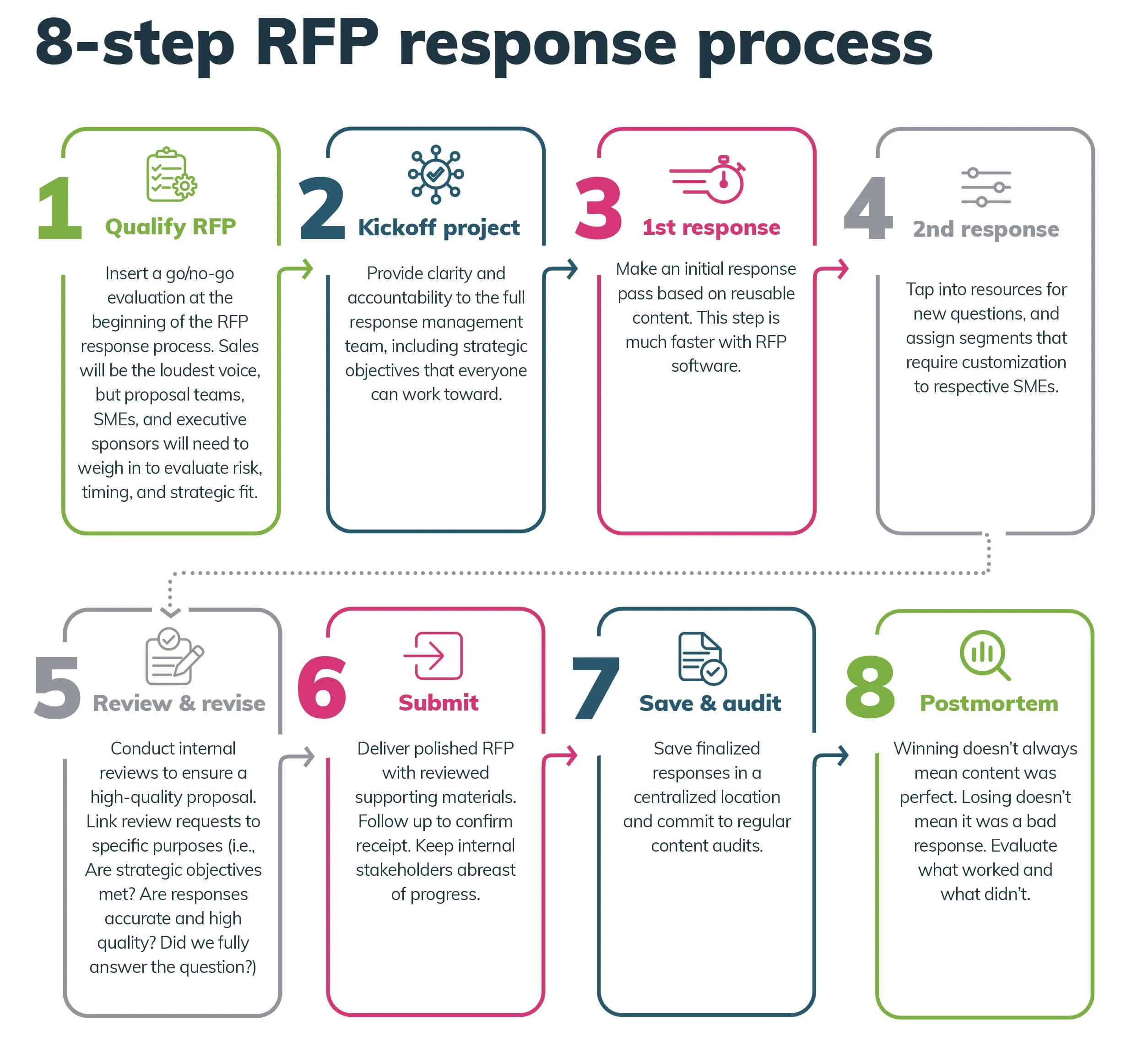
Below is the RFP process created by our response experts. You’ll get to the cheating part in step three, but please don’t skip steps one and two.
Step one – Should you bid or should you (no-)go?
Not all RFPs align with your business’s goals or capabilities. It’s okay to choose not to respond to an RFP that you probably won’t or might not want to win.
Step two – Hold a kickoff meeting
The most critical part of an RFP process comes before you ever receive an RFP. You should know your stakeholders and have a list of subject matter experts (SMEs) with their areas of expertise and availability.
Once you do receive the RFP, call a meeting with your SMEs, writers, editors, and others involved in the project. Fill them in on their roles, responsibilities, and deliverable deadlines.
Step three – First draft
Step three is almost fun, at least it should be if you have an up-to-date content and document library. Let the library do much of the work for you by responding to the questions you’ve seen before with its stored question-and-answer pairs.
Step four – Second draft
Depending on the age and health of your content library, you might arrive at step four with 80 percent of the work already done. Now is the time to roll up your sleeves and answer the rest of the questions. You will probably need to involve your SMEs.
Step five – Review and revise
When attempting to convey that your product or service is the best for the buyer’s needs, your RFP response should be perfect. Are your answers, including those from the content library, accurate and well-written? Are there any typos or grammatical errors?
Step six – Submit the response
Your response is polished and perfect and hopefully on time, if not early. Submit it as soon as it’s ready and wait for a receipt.
Step seven – Save and audit the responses
Your RFP response contains valuable information that is certain to be useful for future RFPs. Set yourself up for success by auditing your new responses and storing those with value in your content library.
Step eight – Postmortem
Even if you’ve answered every question with relevant and beautifully worded responses, your company’s product or service is a perfect match for the buyer, and even if you won the bid, you should always take a moment to assess what went right and what went wrong.
Perhaps you find a bottleneck in your process or rely too heavily on a particularly busy SME who’s understandably slow to respond. Addressing those or other problems before the next project will help you prevent those issues from undermining your subsequent response.
The challenges of response management
Response management is challenging. Even the best response teams need help. Heck, even our response management teams need help. Here are some roadblocks you might encounter:
- Lack of time – It can take days or even weeks to respond to an RFP. RFP software can cut that time in half or better.
- Strict deadlines – An RFP deadline is pretty much set in stone. A slow internet connection can mean the difference between winning and losing a deal. Try to submit your proposal early to avoid unforeseen delays.
- Disorganized content library – A well-maintained knowledge base will save you days on a typical response. A poorly maintained knowledge repository will force stakeholders to search for answers and annoy SMEs, who might have to repeat themselves.
- Siloed and distributed workforces – RFP response is collaborative by definition. When stakeholders are spread throughout the organization and even the world, let’s just say that herding cats seems like a comparative breeze. A great RFP response platform should have its own collaboration tools and work with your existing ones.
- Security risks – When a company suffers a data breach, it affects customer confidence and the bottom line. Be sure your RFP response platform has strict security protocols.
How to manage RFP responses
Perhaps repeatability is the ultimate sign of a great process—or is it agility?
Imagine attempting to scale Mount Everest without a guide. An experienced guide knows all the well-worn trails and how to respond to changing conditions. Responding to an RFP is far less perilous than climbing Everest, but the principles are the same.
Optimize time management with automation
Your SMEs are some of the busiest people in your organization. Respect your stakeholders’ time by letting your process do most of the work. Responsive leverages artificial intelligence to guide you to the correct answers to an RFP’s questions.
Scale your response management process
Response resource needs are tough to predict. One response might need dozens of stakeholders, while another might only need a few. You might have one RFP on your plate this week, but next week three more will appear.
Too few user licenses might force you to ignore some RFPs, while too many are a waste. Responsive doesn’t have user licenses. Our scalable platform enables you to assign the exact personnel you need for each response without it affecting your team’s budget.
Upgrade your content management approach
A well-maintained content management system allows you to access company history, documents, hiring procedures, financial information, and much more. It also protects your SMEs’ time by ensuring they won’t have to repeat past answers.
Regularly audit your content management system to ensure that everything is accurate and up to date.
Facilitate collaboration
RFP response management is a team effort. If your company is anything like Responsive, you have SMEs and other stakeholders distributed worldwide. Even if not, pinning people down for in-person meetings is a challenge.
Responsive enhances collaboration either directly through the project management platform or any of its third-party integration partners, such as Slack, Google Hangouts, Microsoft Teams, and so on.
Employ branded response templates
Add the final sheen to your polished and perfected response with branded response templates tailored to your organization.
What is knowledge management?
Knowledge management is about capturing, storing, organizing, maintaining, and generally managing all of the information that is valuable enough for a company to keep. That might include incorporation papers, financial statements, hiring policies, product information, customer details, and so on.
Effective knowledge management also includes regular audits to ensure all the information is current and relevant. It should also flag records for disposal according to “shred by” regulations. Ideally, all knowledge should be easily accessible to those who need it.
Improving RFP knowledge management
Organizations and their employees lose a lot of time to improper knowledge management. An IDC study found that employees spend an average of 14 hours a week trying to locate data. A McKinsey survey found that searchable knowledge bases can reduce that time spent by as much as 35 percent.
Responsive’s Content Library helps organizations improve their RFP (and companywide) knowledge management by providing a repository for all their company content and documentation in an easily accessible and highly-searchable, thanks to machine learning, single source of truth.
Scale organizational content
I like to shop. Perhaps you do too. As we both know, if we keep bringing new items into our homes without clearing out the old, we’ll soon overflow and might have trouble locating our favorite comfy sweaters.
Just as we occasionally need to clean out our drawers and closets, a well-organized knowledge management approach needs regular content auditing to ensure accuracy, relevancy, and timeliness. Responsive helps you make data-driven decisions when streamlining and scaling your content library.
Conduct regular review cycles by turning to Responsive to identify the content you use and the content you don’t. Additional reporting metrics include answer accuracy and who is using the content.
Remember, Responsive's unlimited user model lets you engage maintenance help from any team member.
Centralize your content library
You might have a distributed and siloed workforce, but a centralized content library consolidates and democratizes your organization’s knowledge base.
Future-proof your knowledge base
Your needs today look very different from your needs tomorrow. You can help future-proof your knowledge base by performing regular audits.
Responsive gently reminds you when it’s time for your scheduled Content Library audit, ensuring that your content is accurate and current. The more often you issue new product features or releases, the more you should audit your content.
Another often overlooked component of future-proofing is creating a succession plan. Sure, you might plan on staying with your company until retirement, but perhaps you’ll receive a job offer you can’t refuse or simply choose to take a vacation.
Make sure you have a plan in place in your absence, which includes training others on the content library, including familiarizing them with tagging practices, and so on.
Choosing response management software
Maximizing your response output without adding employees will likely require help from a response management software. What are the key components of advanced response management software?
RFP management software: essential features
When assessing available software, look for the following:
- Import/export capabilities – RFPs arrive in multiple formats, including Microsoft Word, Excel, Google Docs, Google Sheets, and sometimes even PDFs. Advanced response software lets you import from any of the most commonly used formats, work within your familiar platform, and export into the buyer’s format.
- Content management – Access all your stored question-and-answer pairs with a few clicks. Better yet, advanced response software leverages machine learning to help you find the correct answers fast and do most of the work for you.
- Integrations – Response software should work within your existing applications to foster ultimate productivity and collaboration.
- Artificial intelligence – Access automated answers, track progress, and generate reports using advanced AI.
How a response management platform can support your revenue team
The same features that facilitate response management help enable sales. Most large sales include proposals and documents such as due diligence and security questionnaires. Responsive seamlessly integrates with sales enablement, CRM, and vendor assessment tools.
Increase your win rate with Responsive
Respond to more RFPs, and boost your win rate without adding personnel by leveraging Responsive's advanced response software.
Case study
Responsive helped a human resources organization double its win rate thanks to the Content Library. Before Responsive, their teams spent most of their time searching for answers to questions they’d answered before.
For those answers they did have stored, they’d often find themselves correcting errors directly in the proposal rather than in the system, meaning the mistakes were being passed down to future responses. Responsive made it easy to store, find, and correct answers within the system, saving hours on each response, while the professional responses helped significantly boost the win rate.
Response management software FAQs

Wendy Gittleson
Senior Copywriter @ Responsive
With more than a decade writing for B2B and B2C tech companies, Wendy specializes in making complicated software feel approachable and worth buying. She's written across SaaS, hardware, and cloud. This means she understands the evaluators, the decision-makers, and the proposal teams trying to win them over. The Bay Area tech scene shaped her early; she's been writing about it ever since.