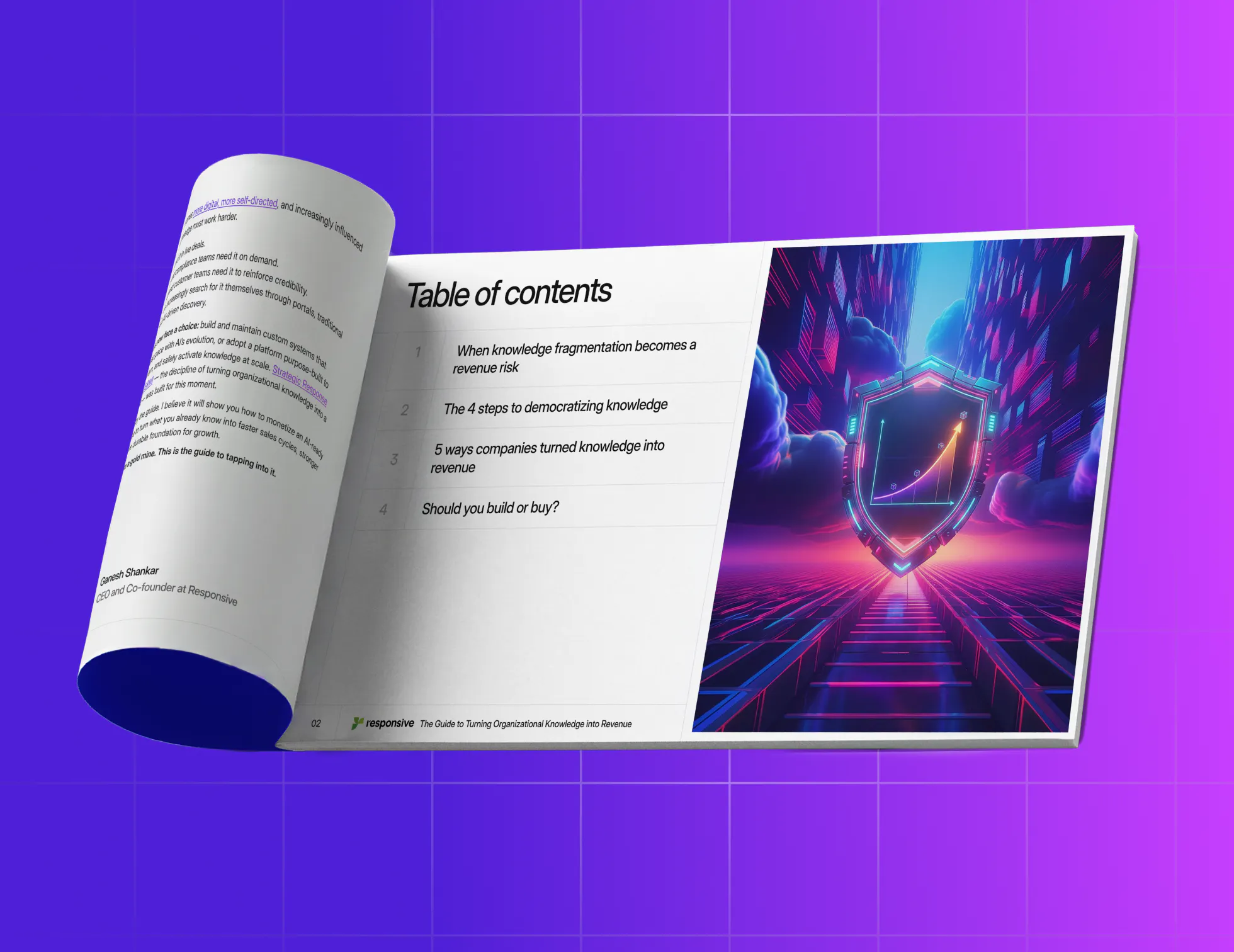
With the right AI, you can turn your organizational knowledge into revenue. Also known as “knowledge democratization” or “knowledge enablement,” it’s when sales, proposal, InfoSec, product, legal, HR, and other teams can answer buyer and customer questions from the same single source of truth. Compliance, brand, deal, and reputation risk are mitigated by AI guardrails that make every RFP, DDQ, security questionnaire, and individual response consistent, accurate, and up-to-date.
Most organizations already have the answers buyers need. They’re in the proposals that won your biggest deals, the language that passed your toughest audits, and the proof points that earned trust when it mattered most. The problem is that knowledge is scattered, inconsistently maintained, and hard to access when teams are under pressure
That creates a real decision point: Do you build an internal system to centralize and activate knowledge with AI, or do you buy a platform that’s purpose-built to govern and operationalize it?
How to equip every team with trusted, winning answers
Do you want to just simplify a task or actually grow revenue?
There’s a huge difference between “AI helps one team go faster” and “knowledge becomes revenue infrastructure.” The first may (see the next section) be accomplished by AI task automation.
A lot of these internal AI projects start the same way:
- An LLM drafts answers.
- A workflow tool routes reviews.
- A repository stores “enough” content to get started.
Some immediate productivity gains for a single team of specialists such as proposal writers may ensue. Drafting, for example, can work as a feature when it’s operated by a highly skilled proposal writer who understands the system inside and out. However, the model breaks down when you expect dozens, hundreds, or thousands of sellers and subject matter experts to respond confidently without thinking about prompts, retrieval logic, permissions, or backend workflows.
If your goal is “knowledge becomes revenue infrastructure,” then task automation is only one small part of what it takes to make your best, buyer-tested answers easy to find, safe to reuse, hard to misuse, and consistent across every buyer touchpoint.
What it takes to monetize existing knowledge with AI
If you’re evaluating build vs. buy, don’t start with features like “chat,” “summarization,” or “draft generation.” Start with the requirements of the workflow.
To reliably operationalize organizational knowledge across revenue-critical responses, you need a system that supports things like:
- Knowledge database governance
- Cited, approved answers
- Clear ownership and review cycles
- Role-based access controls
- Audit trails for mission-critical submissions
- Deterministic reuse of trusted content (not just ad hoc generation)
- Reporting that ties effort and reuse to revenue outcomes
Without those elements, early efficiency regresses to revalidation: SMEs get pulled back into routine requests, field teams hesitate to self-serve, and leaders stop trusting the output.
If you’re considering a build, a practical test is simple: Can your system provide, at a minimum…
- Clear ownership and approval status for every answer
- A way to centralize and moderate knowledge
- Structured governance with review cycles and auditability
- Permissioning down to the Q&A pair level
- Confidence signals that reassure users and stakeholders
- Reuse of approved content rather than ad hoc generation
- Workflow orchestration across intake, routing, deadlines, and escalation
- Automated formatting for every type of response
- Reporting that connects response operations to revenue impact
Finally, can you sustain all of that as models evolve, products change, regions expand, and compliance requirements tighten without continuous re-architecture or incremental hiring?
When building can make sense (and when it usually doesn’t)
Build can be the right move in bounded, low-risk use cases like:
- A narrow internal assistant for a single team
- A short-lived pilot to validate a workflow
- A lightweight drafting helper where humans are already doing intensive review
But once you’re talking about knowledge democratization, you’re touching revenue-critical workflows and cross-functional ownership models, often with legal, security, and compliance consequences. At that point, “build” isn’t a project. It’s an internal product you own forever.
The build that never stops: what operating an internal system actually requires
The first internal demo is the easy part. What follows is maintenance, iteration, monitoring, and accountability. A realistic baseline team to operate an internal SRM-grade AI system includes:
- One technical lead or architect
- Two backend and integration engineers
- One ML or LLM engineer
- One security or platform engineer
Using conservative U.S. compensation assumptions, that can translate to roughly $1.25M to $1.43M in fully loaded annual cost for five engineers. In regulated or global organizations, it often grows to eight to 12 engineers once QA, data engineering, and expanded integration coverage are added.
And that’s before you account for the strategic cost: focus.
Every engineer allocated to maintaining internal SRM infrastructure is an engineer not working on core product innovation, differentiated AI features for customers, security hardening of revenue-generating systems, or performance and reliability improvements.
A helpful way to frame the decision: Building isn’t “can we do this?” It’s “what are we choosing not to build instead?”
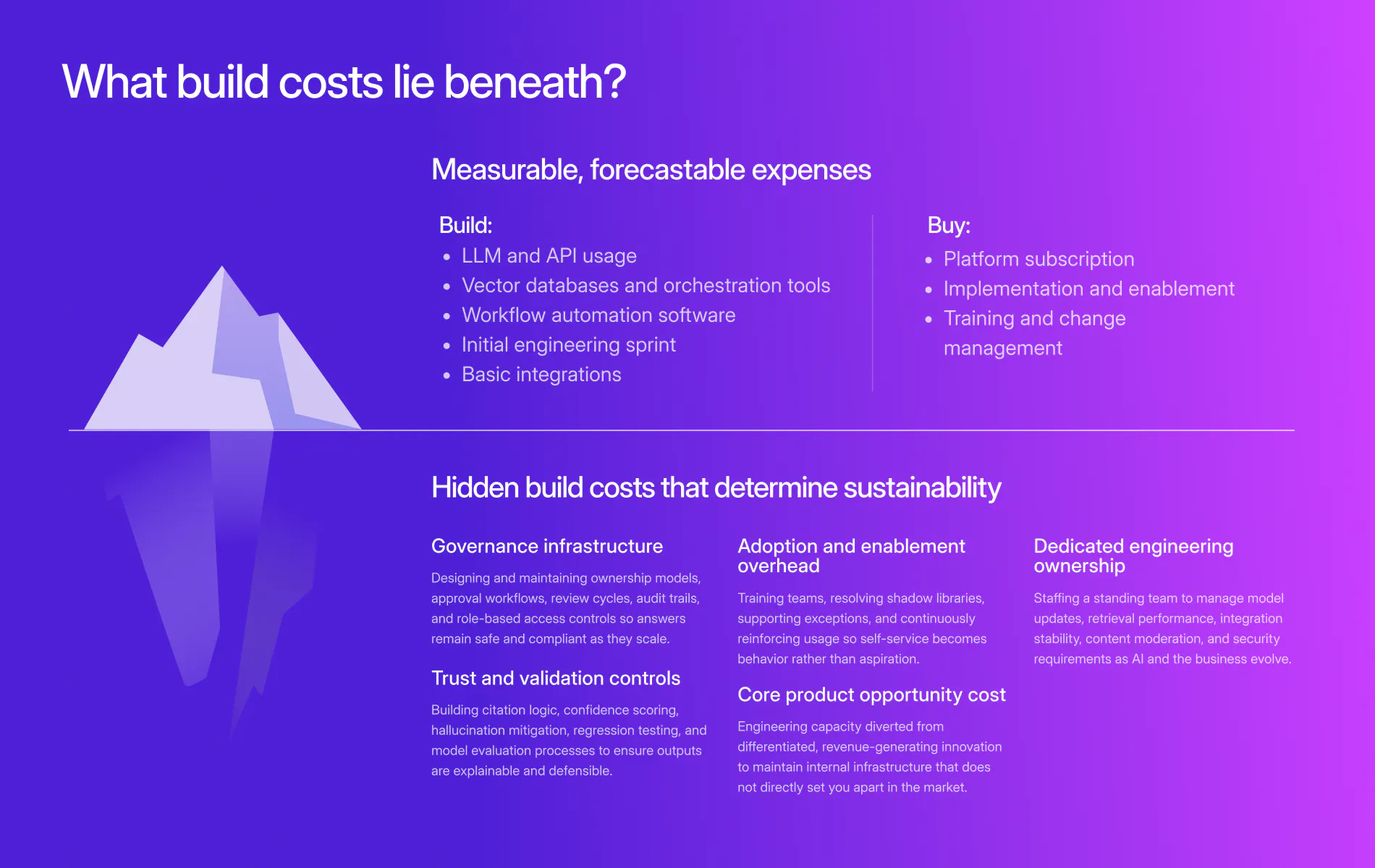
Source: The Guide to Turning Organizational Knowledge into Revenue
Buying: what you’re really paying for
When organizations choose to buy, it’s usually not because they “lack technical depth.”
Many AI-forward companies rely on Responsive AI to power Strategic Response Management because they recognize the difference between automating one step and operationalizing knowledge across the business.
The goal is that teams don’t have to think about retrieval logic, prompts, or backend complexity. They ask and receive accurate, approved answers grounded in a trusted source of truth. And the downstream impact is what you’d expect when trust and speed stop fighting each other: Sellers, proposal teams, security, legal, and SMEs can respond quickly with the relevance buyers demand.
A simple “build or buy” decision framework
If you’re debating build vs. buy, run the conversation through four questions. (These are practical on purpose.)
1) How many people need to trust the output? If success depends on broad usage across sales, solutions, security, and legal, you’re building for scale, not for a pilot.
2) How defensible do the answers need to be? If you’re responding to RFPs, security questionnaires, DDQs, audits, renewals, or regulated disclosures, “pretty good” isn’t good enough.
3) How often does the truth change? Product launches, policy updates, regional differences, and evolving compliance requirements strain your knowledge database curation. Trust is at risk if you cannot keep up.
4) Where do you want your engineering team focused? If your competitive edge is your product, your customer experience, or proprietary AI, internal SRM infrastructure will compete for the same finite capacity.
If you answer these honestly, the path tends to get clearer.
What’s the best way to tap into that gold mine you’re sitting on?
Organizational knowledge is one of your most monetizable assets if you can reliably put it at the fingertips of everyone responsible for growing and protecting revenue.
Building your own solution with an LLM can make sense for bounded use cases. But if you’re serious about knowledge democratization at scale, the real question isn’t “can we build an AI assistant?” It’s, “Can we build (and keep running) a governed knowledge system that people will trust, use, and reuse across every revenue-critical response?”
That’s the layer Strategic Response Management was built for.

RD Symms
Sr. Copywriter @ Responsive
With more than 15 years in writing, content development, and creative strategy, RD brings a rare combination of conceptual thinking and executional range to the proposal management space. He's spent his career turning complex ideas into content that earns attention which makes him a natural fit for an audience of proposal managers and sales leaders who read critically and buy carefully.