
Sound familiar? A deal is moving along nicely. The buyer likes your product or platform. Everything seems to be on track. Then the security questionnaire arrives.
At first, it looks manageable, at worst a “quick review”: a spreadsheet, a portal, maybe a request for SOC 2 documentation and a few follow-up questions. But in just a few days, or even hours, the work starts spreading. Sales forwards it to InfoSec. InfoSec flags old answers for additional review. Legal reviews a policy reference. Compliance confirms whether the latest certification can be shared. A sales engineer chases context. Someone pings Product to validate a technical detail that has probably been answered before.
Before you know it, the “quick review” has spiraled out of control into a cross-functional interruption. And when the same questions arrive across dozens or hundreds of evaluations, the cost compounds quickly. These delays impact revenue, workflows, your content library, and pull security teams from higher-value work.
How much are security questionnaires costing your team, and how much of that work could be reduced with a Trust Center?
Security questionnaires create costs across the business
The most visible costs of security questionnaires are the time spent answering them. But the deeper cost comes from the way that work moves through the business.
Most security questionnaires are not filled out by one person in one sitting. They require input from multiple departments from people who already have full-time responsibilities. Your InfoSec team may own the response, but Legal, Compliance, IT, Product, Engineering, Sales Engineering, and account teams often get pulled in to repeatedly answer the same questions.
The same questions keep resurfacing:
- Are you SOC 2 certified?
- Are you ISO 27001 certified?
- Do you undergo independent audits?
- Are security policies reviewed annually?
- How is customer data protected?
- Do you use customer data to train AI models?
- What is your incident response process?
The list of questions goes on and on. These are important questions, and buyers should ask them. Still, the answers often already exist somewhere: in prior questionnaires, approved documentation, audit reports, security policies, and your verified content library.
When that information is scattered, every request becomes a search-and-verify exercise. Teams have to find the right source, confirm it is up to date, tailor it to the buyer, and route it for review.
That friction matters earlier than many vendors realize. Responsive's research found that 90% of buyers conduct research before first contact. If buyers cannot easily find credible trust information during that early research, the vendor is already creating friction before a formal security review begins.
The hidden cost includes hours and momentum
Changes in technology and the rapid advancement of AI have elevated the cost of security questionnaires from just internal productivity to now include the pace of the deal.
The longer a buyer waits for basic security information, the more their confidence in your product or platform erodes. The product may be strong, and the sales team may be responsive, but a slow trust review sends its own signal. The buyer questions whether the company is organized, whether the answers are current, and why standard security information is so hard to access.
Internally, teams feel the strain, too. InfoSec gets pulled into repetitive requests instead of focusing on higher-risk work. SMEs are asked to approve the same language again. Sales loses sight of where the review stands. Sales Engineering becomes the translator between buyer urgency and internal bandwidth.
Across both internal and external teams, the hidden cost shows up as:
- Longer sales cycles
- Repeated SME interruptions
- Slower security and legal reviews
- Inconsistent or outdated answers
- Lower confidence in shared content
- Less time for strategic security work
- A weaker buyer experience
For companies selling into enterprise, financial services, healthcare, technology, or other risk-sensitive markets, the added costs of stricter regulations surrounding AI implementation, additional security reviews, and typically longer sales timelines only exacerbate the difficulty of securing a deal.
Why manual questionnaire response does not scale
Manual questionnaire response can work when request volume is low, but as the business moves upmarket, enters regulated industries, or sells more AI-enabled products, the review process changes.
Buyers ask deeper questions. More stakeholders get involved. Security, privacy, compliance, procurement, and legal teams all want evidence they can trust, especially when selling into heavily regulated industries like finance and healthcare.
Responsive’s buyer research shows that AI products are under especially close review. Buyers evaluating AI solutions often conduct security and privacy reviews specific to AI models and usage, along with assessments around fairness, explainability, and data governance.
The days of standard security packets are long over. Buyers need answers that are current, specific, and easy to validate. If every request still depends on manual routing, the business eventually hits a capacity ceiling. The team can either slow down to review every answer carefully or move quickly and risk inconsistency. Neither is a good long-term model.
The better approach is to separate repetitive trust requests from the questions that truly require expert review.
Trust Centers turn repetitive requests into governed self-service
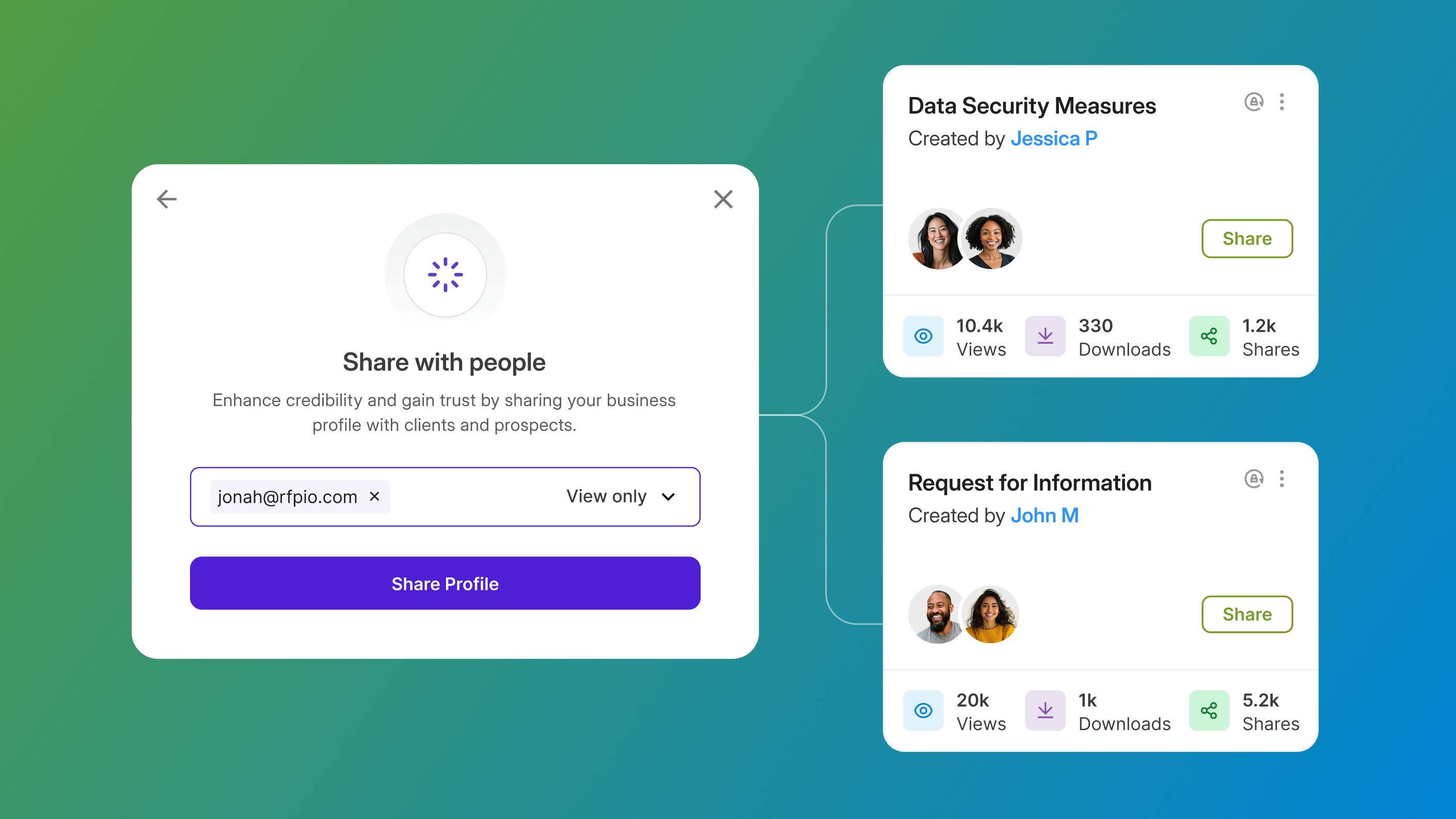
A Trust Center provides buyers with a centralized place to access approved security, privacy, compliance, and risk information. Instead of waiting for every buyer to send a questionnaire, organizations can make common trust information available earlier in the evaluation process.
That does not mean publishing everything publicly. A strong Trust Center balances transparency with control. General security practices, compliance overviews, and FAQs may be available publicly. More sensitive assets, such as SOC 2 reports, pen test summaries, or detailed architecture documents, should be gated behind access controls or NDA workflows.
The goal for an effective Trust Center is controlled transparency. When done well, these proactive centers help organizations share validated, up-to-date security posture, streamline risk assessment, and provide buyers with quick access to answers.
When buyers can self-serve approved information, InfoSec spends less time answering repetitive questions and more time on reviews that require real judgment.
Measuring the impact of a Trust Center
When it comes to impact, stats speak louder than words, and one of the most useful ways to measure Trust Center impact is the acceptance rate.
Trust Center acceptance rate shows how often buyers accept the Trust Center as part of, or in place of, a traditional questionnaire process. A higher acceptance rate means more buyers are willing to use self-service trust content rather than routing every question through a manual review. Importantly, self-service trust content can be privately shared directly with those requesting it, made publicly available with governance guardrails like NDAs and custom watermarks, or through a hybrid approach.
This is where internal benchmarks can make the story concrete. For example, Responsive internal benchmarks show that 76% of eligible buyers accept Trust Center-based review in place of a manual questionnaire response.
The calculation is simple: annual hours saved = accepted Trust Center reviews × average hours avoided per questionnaire.
Even modest gains can add up quickly. If a team handles dozens of security reviews a year, shifting a portion of those reviews to a Trust Center can return meaningful time to InfoSec, Sales Engineering, and SMEs.
But the acceptance rate is not the only valuable metric to demonstrate the value of a Trust Center. For example, Fortra found that their Trust Center reduces the back-and-forth search for their customers, as they have access to ALL documentation and not just the documents Fortra provides based on the information given by the account reps (e.g., providing a SOC 2 for only one product when they need a SOC 2 for all three products they purchase).
“The Responsive Trust Center has reduced turnaround time by 1.3 days in addition to reducing about 35% of questionnaire completion requirement from our existing customers.”
Alyssa Mosh
Security Compliance Program Lead, Fortra
Invicti Security has also seen dramatic improvements using Responsive Trust Center, reducing its time to complete from 5 days to 1.4 days. Invicti’s win rate is above 70%, and they have also automated 71% of all security questionnaires.
“Many of our larger customers need updated policies annually. Trust Center allows them to just go get them without having to wait on their business contact to reach out to our sales team who then reaches out to me…”
DeeAnn Powers
Manager Sales and Customer Enablement, Invicti Security
What a high-performing Trust Center needs
A Trust Center only reduces work if buyers can trust what they find. Static pages with outdated PDFs will not solve the problem. Instead, Trust Centers need to be current, governed, searchable, and useful, especially as buyer demands and expectations rise.
This includes approved answers to common security and compliance questions, current certifications and policies, access controls for sensitive information, buyer-specific views, AI-assisted Q&A grounded in approved sources, content ownership, review workflows, and engagement analytics.
Buyers know where and what to look for now, and research in Responsive's Trust Center eBook found that:
- 92% of buyers place moderate to significant weight on compliance during vendor selection
- 49% of buyers run security and privacy assessments for AI products
The best Trust Centers are connected to the same governed knowledge that supports questionnaires, RFPs, DDQs, and ad hoc buyer questions. That way, teams are not maintaining one set of answers for the Trust Center and another for manual response work.
Consistency is the point. Buyers get better information, and internal teams reduce the risk of conflicting answers.
Security teams should not have to answer the same question forever
Security questionnaires are growing in volume and complexity. Buyers need to evaluate risk, and vendors need to provide clear, accurate, and credible answers. But not every question needs to become a manual project.
A Trust Center provides organizations with a more efficient way to handle repetitive security reviews. It helps buyers find approved information earlier, gives security teams more control over what is shared, and reduces the operational burden of answering the same questions repeatedly.
For teams ready to act, the first step is simple: identify the questions your security team answers most often. Confirm the approved answers. Decide what can be public, what should be gated, and who owns each update. Then use those answers as the foundation for a Trust Center that buyers can actually use.
The right Trust Center strategy ensures security questionnaires do not quietly tax the business.
Ready to learn more about Responsive Trust Center? Explore how a Trust Center can reduce the time your team spends answering repetitive security questions.

Andrew Martin
Content Marketing Manager @ Responsive
Andrew Martin covers AI adoption, RFP strategy, and proposal management at Responsive, drawing on insights from Responsive's 2,000+ enterprise customer base and original research.