
Leadership stopped asking whether AI is interesting a while ago. The question now is sharper, and it's landing on the desks of CIOs, CFOs, and RevOps leaders alike:
Is AI paying off, how quickly, and how confidently can we prove it?
Our 2026 State of Strategic Response Management Report — based on responses from more than 1,100 senior decision-makers and practitioners worldwide — gives a clear, if complicated, answer. AI deployed in strategic responses (RFPs, security questionnaires, due diligence requests, and other high-stakes buyer exchanges) is paying back faster than ever.
But the ability to prove it is not keeping pace.
Proof of AI performance is arriving faster
The headline number is hard to miss: The share of organizations reporting payback on their AI investments within three months quadrupled, from 4% in 2025 to 16% in 2026. This leap represents a structural shift in how fast AI investments in strategic response work are clearing the bar.
Zoom out to a full-year view, and the trend holds. Last year, fewer than half of organizations achieved positive ROI on their SRM AI investments within 12 months. This year, that figure has climbed to around two-thirds. More organizations are also landing returns in the three-to-six-month window, while the long-tail timelines have contracted across the board.
In practical terms, boards are no longer willing to underwrite a multi-year AI runway. The market has reset its expectations to within a year (and often much sooner).
The tension executives can't ignore
Unfortunately, measurement doesn’t come easy for everyone.
Nearly a quarter of respondents (23%) cannot confidently say how many of their AI tools have achieved positive ROI. And it’s not just a knowledge gap at the edges of the organization. It's happening at scale, even as payback windows shrink for the teams that have their measurement act together.
This is the defining tension of the accountability era. ROI is arriving faster where AI is implemented well, but the discipline to measure and prove that impact remains fuzzy for a meaningful share of the market.
Leadership can't manage what it can't see, and right now, too many organizations are flying without instruments on a fast-moving asset.
What’s getting in the way of implementing AI effectively? What’s preventing organizations from measuring performance more accurately? Respondents cite trust in outputs as the single largest barrier, followed closely by readiness gaps in people and data.
- 49% flag hallucinations and errors
- 42% point to inadequate training
- 38% cite poor data quality
If the underlying content isn't governed and the teams using AI haven't been trained to validate it, no amount of tooling will produce measurement leadership can rely on.
"AI is still hallucinating a lot. And if you don't set the right base for the LLM, the results will be very disappointing... This reliability is not yet available from the AI."
Dirk Günter Karl Müller
Group Leader, Bid Management, Vodafone
Where the ROI actually comes from
The State of SRM report also settles an important question for anyone building a business case: which tools deliver ROI fastest? Purpose-built Strategic Response Management and RFP platforms outperform the alternatives by a wide margin.
- 44% of organizations using SRM-specific software saw ROI in six months or fewer
- 37% for homegrown tools
- 27% for generic, third-party AI not built for response workflows
That gap compounds. SRM Novices lean heavily on generic tools (58%, versus 40% of Leaders), while Leaders are more likely to run AI through a specialist platform with governed content, structured AI workflows, and built-in oversight.
Leaders also invest differently. 43% invested in people, technology, and training simultaneously, compared to just 17% of Novices. And 57% of all organizations increased training and upskilling spend this year, a clear signal that ROI doesn't come from procurement alone. ROI comes from giving teams the time and structure to learn and use AI well.
How to close the measurement gap
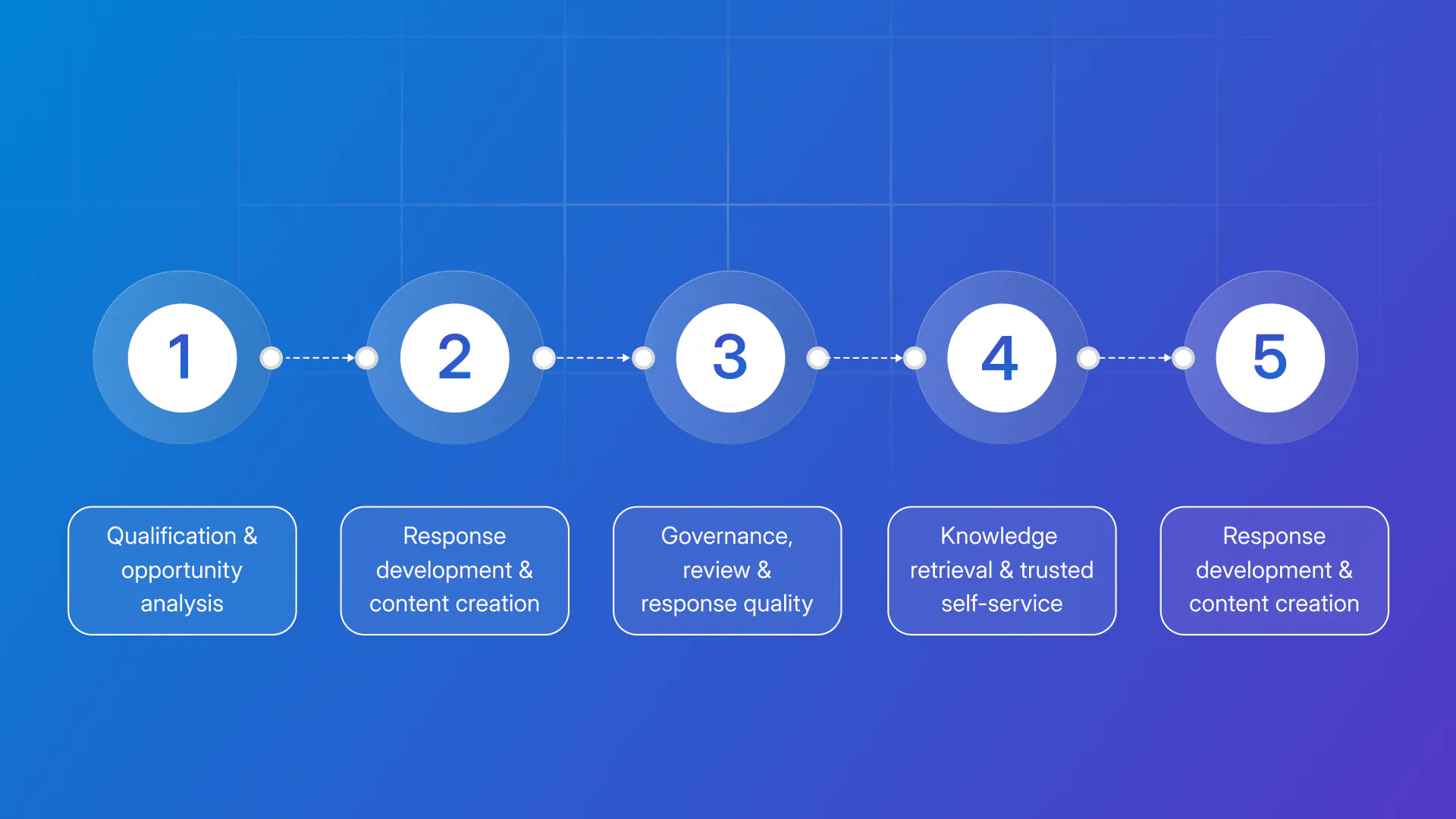
For executives trying to move their organization from "we think it's working" to "we can prove it's working," three moves stand out in the data.
- Anchor AI in a system, not a stack of point tools. SRM-specific platforms centralize content, workflows, and measurement in one place, which is exactly why they show ROI faster than generic AI layered on top of fragmented systems.
- Fund training alongside technology. The organizations pulling ahead invest in people and process at the same time they invest in tools, not sequentially or as an afterthought.
- Standardize on business metrics, not activity metrics. Leaders are far more likely to rank revenue impact and win rate among their top performance indicators, rather than tracking volume alone. That's the language boards and CFOs already speak.
“We track a focused set of indicators tied to both execution quality and business outcomes, including win rates, proposal cycle-time improvements, revenue influenced, reuse efficiency, cost avoidance, and client feedback on proposal quality and clarity of value.”
Stephanie Benavidez
Vice President of Sales Enablement and Proposal Management, EXL
Why SRM needs to be the system of record
The organizations moving ahead from here won't be the ones with the most AI tools. They'll be the ones that treat Strategic Response Management as the system of record that makes AI's impact visible, auditable, and impossible to ignore.
The largest differentiator has shifted from adoption to proof. Proof requires governed content, consistent workflows, and outcome reporting that ties directly back to revenue, win rate, and risk.
For CIO, CFO, and RevOps leaders asking whether AI is paying off, the answer increasingly depends on whether the underlying response infrastructure was built from the start to measure it
Download the full 2026 State of Strategic Response Management Report for the complete data set, the SRM Maturity Index, and the five-pillar playbook for closing the gap between AI adoption and AI proof.

Andrew Martin
Content Marketing Manager @ Responsive
Andrew Martin covers AI adoption, RFP strategy, and proposal management at Responsive, drawing on insights from Responsive's 2,000+ enterprise customer base and original research.