Bid and proposal teams have quietly become the pressure valves of modern revenue organizations. Every deal is dissected, every response is timed, and expectations for speed and personalization keep climbing, even as capacity stays flat.
In that environment, simply “having AI” or “upgrading SRM tech” isn’t the differentiator anymore. What matters is whether your response process can withstand scrutiny, demonstrate impact, and scale knowledge across the business, rather than trapping it inside a single team.
Let’s uncover the most telling signals from the 2026 State of Strategic Response Management Report: where the squeeze is tightest, how SRM Leaders are orchestrating AI and knowledge differently, and why the maturity gap is turning into a performance gap.
Living in an era of ROI and accountability
Every deal is scrutinized, and every response is on the clock — even more so this year than last. Expectations for faster response times have climbed five points YoY, and demand for a higher degree of personalization is also up.
Against this backdrop, 67% of respondents say their bid and proposal teams are under increasing pressure, a clear indication that the function is caught between rising buyer expectations and finite capacity.
“...we need to be as efficient and as fast as we can, covering deals that are growing in size, but doing so with less overhead than we have had in the last few years.”
Dirk Günter Karl Müller
Group Leader, Bid Management, Vodafone
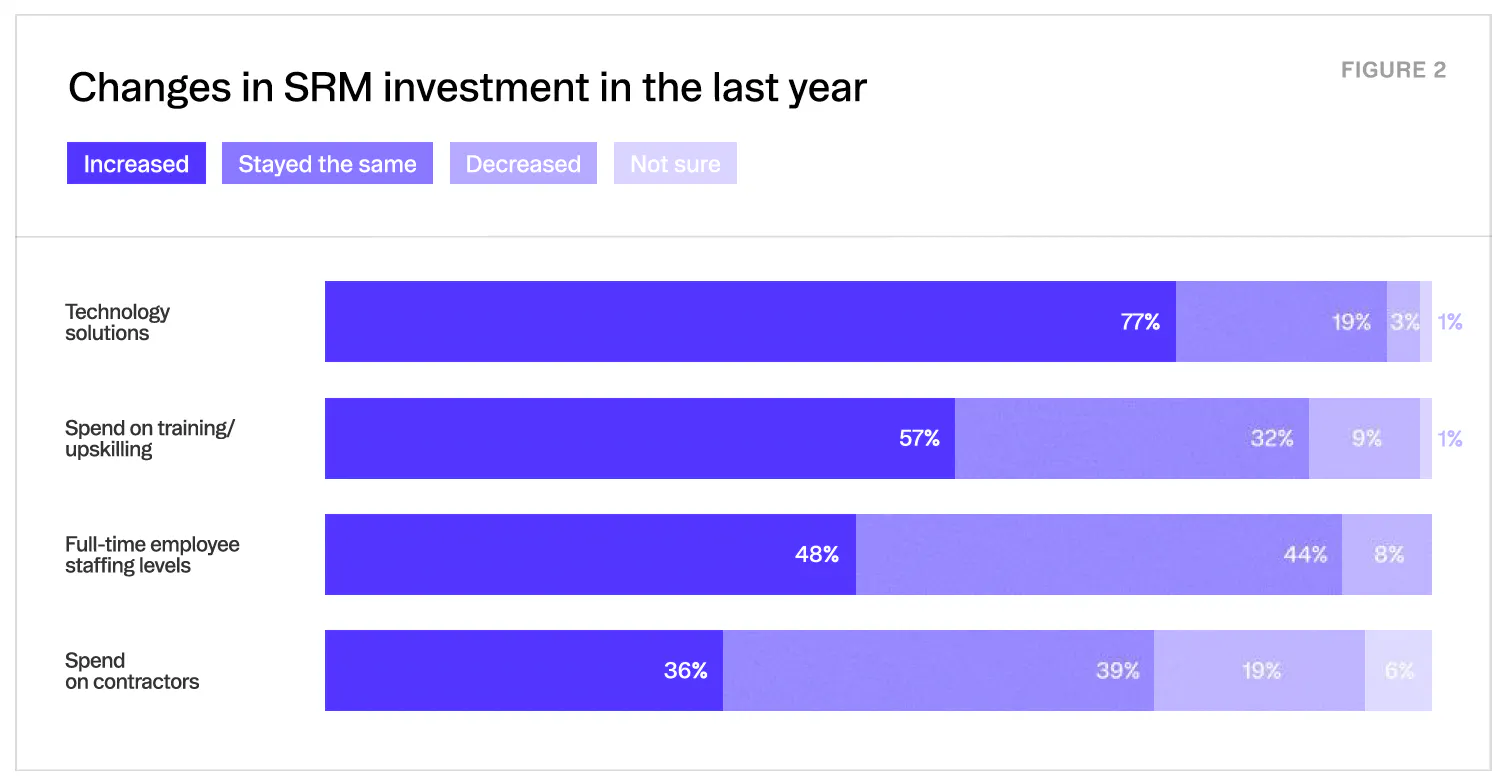
In response to the continually tightening squeeze, many teams are turning to technology, especially AI-driven tools that promise faster responses, better governance, and clearer reporting back to the business. 77% of organizations say they’ve increased spend on SRM technology solutions, up from 70% last year.
As AI becomes more embedded in SRM and other revenue-generating activities, the question from leadership has shifted from “Should we use it?” to “Is it paying off?”
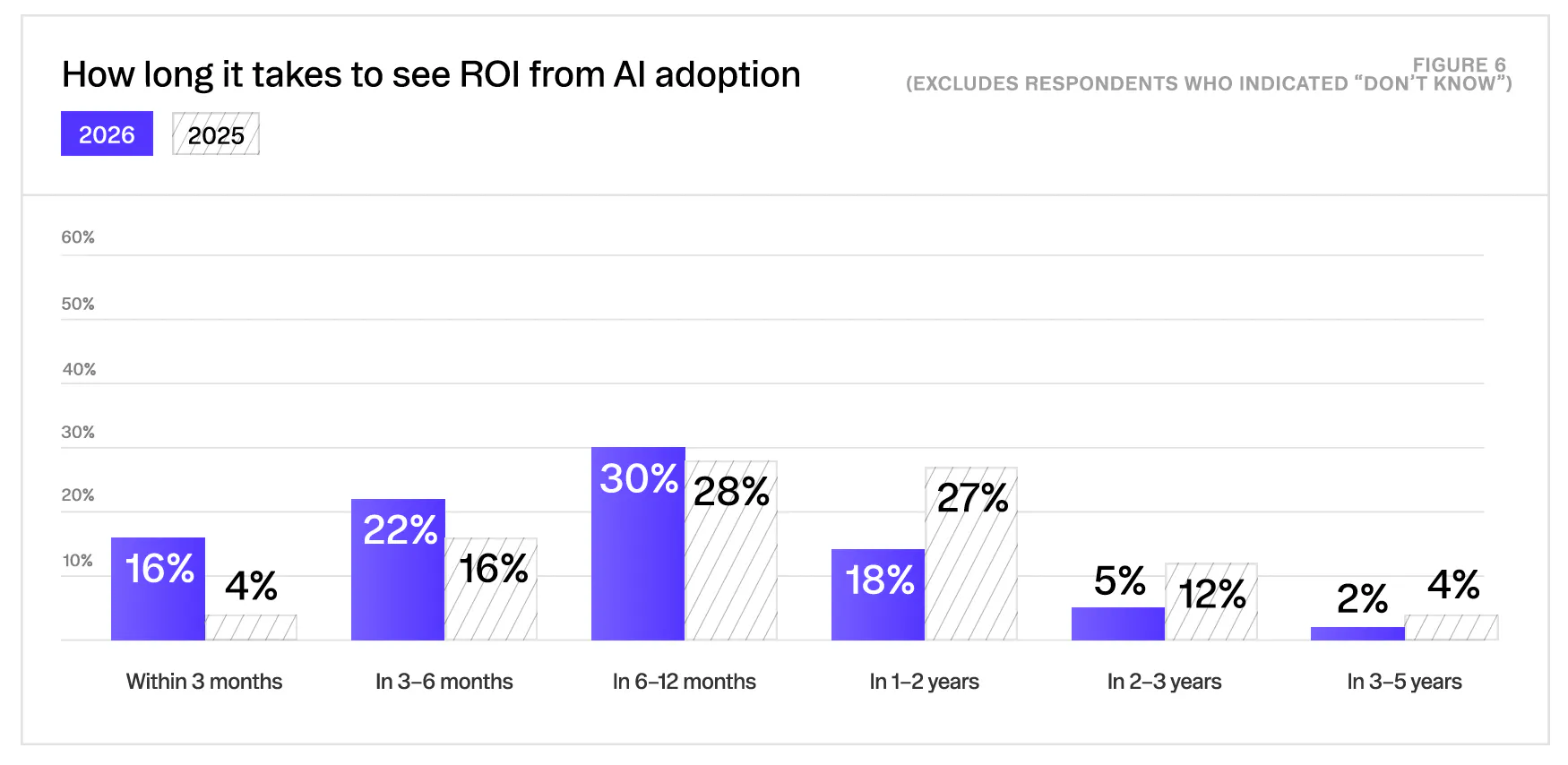
The number of organizations seeing positive ROI hasn’t changed dramatically, but among those that do, returns are arriving much faster. Last year, fewer than half of organizations achieved positive ROI on their SRM AI investments within the first 12 months.
This year, that figure has jumped to around two-thirds. Plus, the share reporting payback within three months has quadrupled, and more organizations are now seeing returns in the three- to six-month window as well.
However, some teams are still struggling to deliver and prove performance.
Nearly a quarter of respondents cannot confidently say how many of their AI tools are delivering positive returns. That tension — faster payback where AI is well-implemented, but fuzzy measurement overall — is at the heart of the accountability era. The organizations that move ahead from here will be the ones that treat SRM as the system of record that makes AI’s impact visible, auditable, and impossible to ignore.
The SRM maturity gap: Leaders vs. Novices
To understand why some organizations are pulling ahead, we created the SRM Maturity Index. The index uses seven indicators to group companies by how effectively they capture, govern, and share the knowledge that powers strategic responses.
SRM Maturity Index
The SRM Maturity Index, according to the 2026 State of Strategic Response Management Report.
| Indicator | Definition | Leaders | Novices |
|---|---|---|---|
| Centralized knowledge hub | The organization maintains a single, governed repository for content used in RFPs, questionnaires, and other strategic responses. | Widely adopted | Rare or inconsistent |
| Independent knowledge access | Sales, SMEs, and other stakeholders can independently find and use approved response content without relying on the proposal team. | Common | Limited access |
| Breadth of service | Multiple functions across the organization can directly access and use response knowledge. | Broad cross-functional access | Restricted to a few teams |
| Self-service for complex work | Self-serve capabilities extend beyond simple questionnaires and support contributions to complex RFPs and high-value pursuits | Common practice | Rare |
| SME collaboration | Proposal teams can consistently obtain timely input from subject matter experts when needed. | Reliable SME engagement | Frequent bottlenecks |
| Outcome visibility | Teams quantify SRM outcomes and share results with senior leadership. | Regular reporting | Limited measurement |
| Revenue attribution | The organization measures and reports revenue generated through RFPs and other strategic responses. | Standard practice | Rare |
Several key gaps are evident between teams that score well on these seven indicators (SRM Leaders) and their Novice counterparts:
- 73% of Leaders say their revenue from strategic responses has grown over the past year, compared to only 60% of novices.
- 83% of Leaders agree that their bid and proposal teams have high employee satisfaction, versus only 53% of Novices.
- 83% of Leaders say their bid and proposal teams are viewed as strategic business partners, compared to 64% of Novices.
The differences between these groups have real-world implications. Across the study, Leaders consistently report stronger business outcomes, including faster sales velocity and higher revenue growth. Novices, however, are more likely to struggle to accelerate deals or demonstrate a clear revenue impact.
2026 State of SRM Report
“…we’re seen as a team of people who can get things done. At the end of the day, we have the tangible proof: here are the questionnaires that we delivered, and these are all the deals that we’ve assisted on, and that these questionnaires help to close.”
Crystal Wright
Manager, Sales Operations Services, Autodesk
Leaders prioritize full-system orchestration
Across the board, organizations are using AI to remove friction from SRM workflows, but maturity levels shape which tasks are automated first. Both Leaders and Novices lean on AI for the basics: drafting content and pulling in relevant information. This is table stakes.
The picture changes once you move beyond first drafts. Leaders are far more likely to use AI throughout the full pursuit lifecycle, in steps like:
- Checking and refining responses for accuracy and compliance (77% versus 60%)
- Providing insights for personalization based on research (64% versus 49%)
- Analyzing win/loss data for insights and trends (46% versus 30%)
These patterns indicate that maturity is less about having AI in the stack and more about how it is applied. Leaders are pushing AI into the higher-value parts of SRM, such as quality control and decision intelligence.
“...the team influences the full pursuit lifecycle, from qualification and go/no-go decisioning to capture strategy, value articulation, AI-led differentiation, and delivery confidence. Our role is to bring those elements together early and consistently, so growth is intentional.”
Stephanie Benavidez
Vice President of Sales Enablement and Proposal Management, EXL
These differentiated applications of AI likely explain why Leaders are more successfully turning SRM AI into consistent ROI. 6 in 10 Leaders say that all or a majority of the AI tools they’ve deployed for SRM are already delivering positive ROI, compared with fewer than half of Novices.
Knowledge in everyone’s hands
Leaders are far more likely than Novices to run strategic responses from a centralized hub, give people outside the core proposal team independent access to that knowledge, and keep content current enough that sales, SEs, and SMEs actually rely on it.
100% of Leaders allow individuals across the organization to independently access the organizational knowledge they need, compared to only 1% of Novices, hands down the biggest discrepancy in our survey.
Among Leaders, self-serve access starts with the field: 87% enable core sales teams to independently tap into the SRM knowledge base. Roughly three-quarters of Leaders enable marketing to self-serve, around two-thirds do the same for IT and technology teams, and major control functions like legal, risk, and compliance are close behind. Even operations, finance, and corporate communications clear the 45–50% mark.
This means that in mature organizations, almost every group that touches a deal can work from (and contribute to) the same governed source of truth.
“Our team is currently prioritizing self-service to address the high volume of non-revenue-generating Information Technology Questionnaires (ITQs) from existing clients, which account for about 50% of our workload. This focus on ITQs creates a challenge, as it diverts our attention from "must-win" RFPs that are crucial for revenue generation. To ensure we remain laser-focused on revenue-generating deals, we are strategically shifting these ITQ requests to a self-service model.”
Tara Motter
CF APMP, Director of Proposals, Blackline
Leaders also extend this spirit of sharing into how they report back to the business. They’re much more likely than Novices to quantify outcomes and share results with executives.
The difference is just as sharp in which metrics Leaders choose to prioritize. When asked which performance indicators matter most, more than half ranked impact on revenue in their top three, compared with only 33% of Novices. 49% of Leaders do the same for win rate, versus 38% of Novices, and a third of Leaders put sales productivity in their top three, compared with just a quarter of Novices.
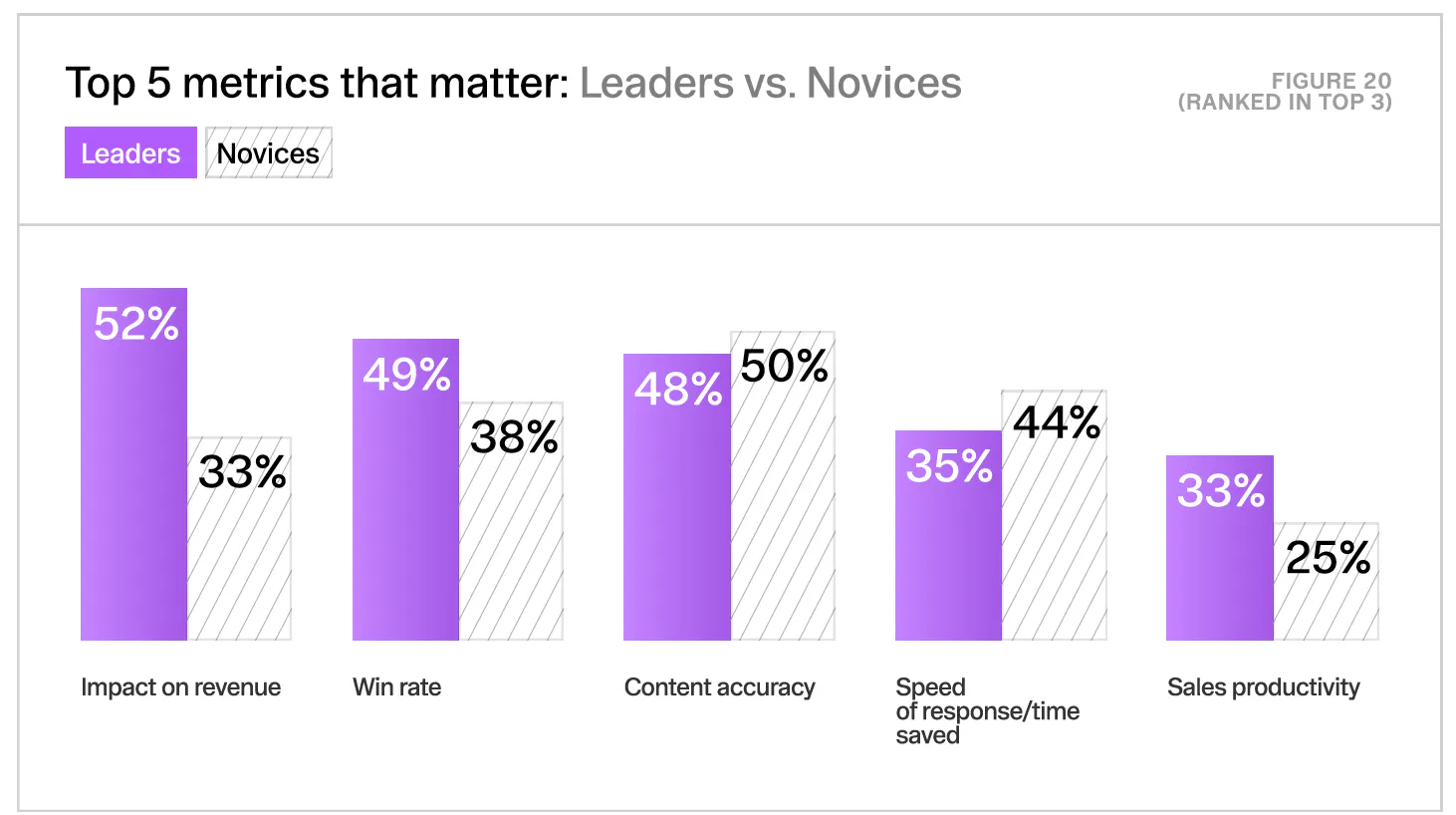
At the same time, Leaders are not deprioritizing execution. Content accuracy and response speed remain foundational across both groups, reflecting the baseline pressure to deliver high-quality answers quickly. The difference is that Leaders build on that foundation by pairing accuracy and speed with a stronger emphasis on the outcomes those responses drive.
“We track a focused set of indicators tied to both execution quality and business outcomes, including win rates, proposal cycle-time improvements, revenue influenced, reuse efficiency, cost avoidance, and client feedback on proposal quality and clarity of value.”
Stephanie Benavidez
Vice President of Sales Enablement and Proposal Management, EXL
2026 State of SRM Report
Pressure-proof your own response strategy in 2026
If there’s a single takeaway from this year’s findings, it’s this: pressure on response teams isn’t going away, but the payoff is increasingly reserved for organizations that treat SRM as a strategic system, not a tactical function.
Leaders are redesigning how knowledge flows, who can self-serve, and how outcomes are measured, turning AI from a “nice-to-have” into a visible, defendable source of ROI. Novices, meanwhile, are still trying to keep up with volume and velocity while struggling to prove impact.
This article highlights the key points, but the full 2026 State of SRM report connects the dots, supported by data cuts, maturity benchmarks, and real-world examples that can help you pressure-proof your own response strategy.

Andrew Martin
Content Marketing Manager @ Responsive
Andrew Martin covers AI adoption, RFP strategy, and proposal management at Responsive, drawing on insights from Responsive's 2,000+ enterprise customer base and original research.