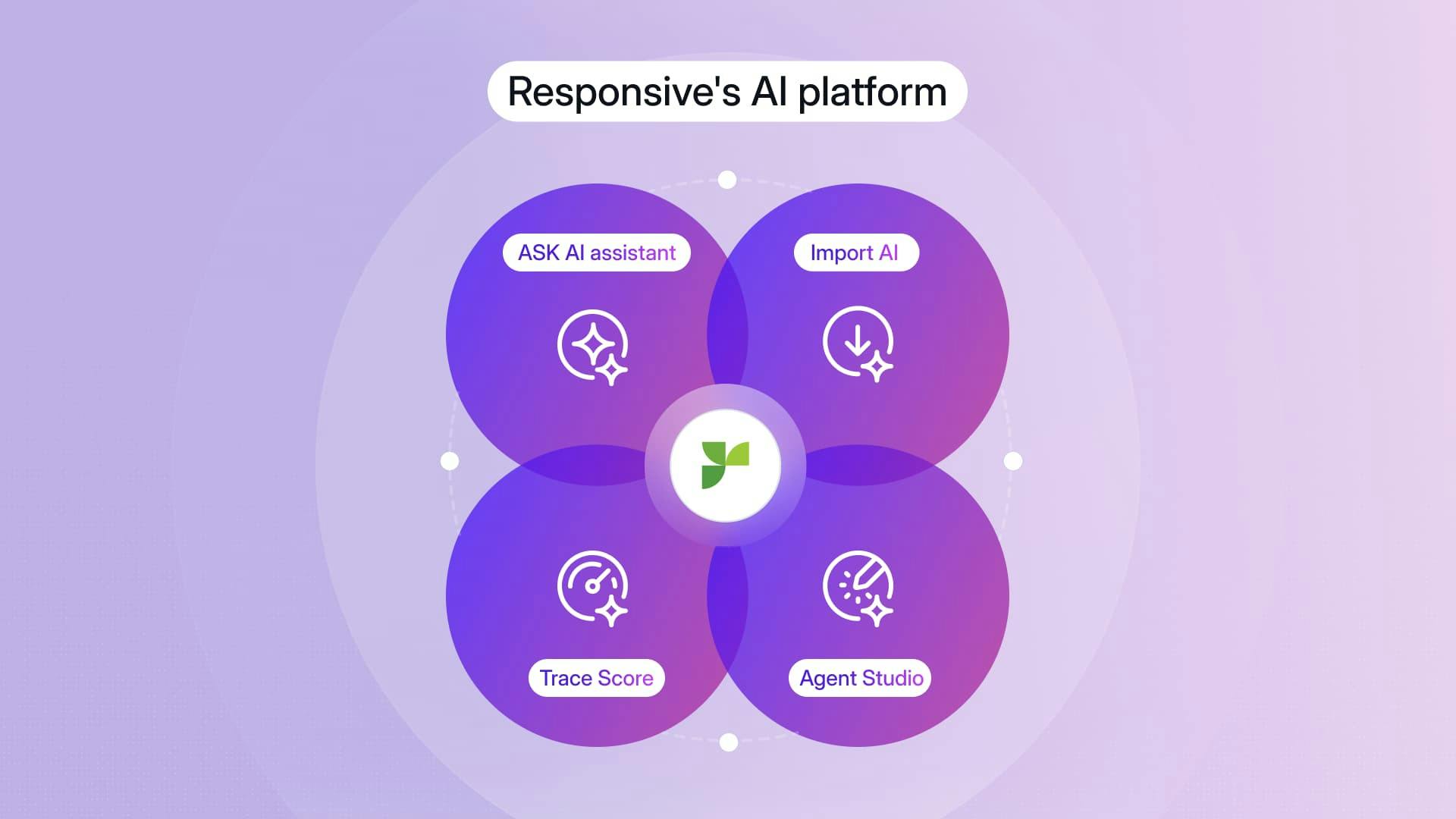
The Responsive platform's AI capabilities span from intelligent content recommendations to automated document processing, fundamentally changing how organizations approach RFP responses. AI in RFPs refers to the use of artificial intelligence to streamline and enhance the Request for Proposal process. This involves using AI to automate document processing, extract and organize requirements from complex RFP documents, generate content recommendations, and assist with response creation.
AI in RFPs can parse documents in various formats, understand the semantic meaning of questions beyond simple keyword matching, route tasks to the appropriate subject-matter experts, and provide intelligent suggestions for responses based on successful past proposals. The technology aims to reduce the time-intensive manual work traditionally associated with RFP responses while improving consistency and quality of proposals.
Core AI capabilities in Responsive
At the core of Responsive's functionality is our comprehensive suite of AI features designed to accelerate proposal creation and improve response quality.
Content recommendation engine
The core capabilities include an intelligent content recommendation engine that analyzes RFP questions and automatically suggests relevant answers from your organization's content library.
When a proposal team receives a new RFP with hundreds of questions about data security protocols, our AI examines each question's context and intent, then surfaces the most appropriate pre-approved responses from past successful proposals. This recommendation system goes beyond simple keyword matching by understanding the semantic meaning of questions, with accuracy that improves as your content library grows and becomes better organized.
Ask the AI assistant
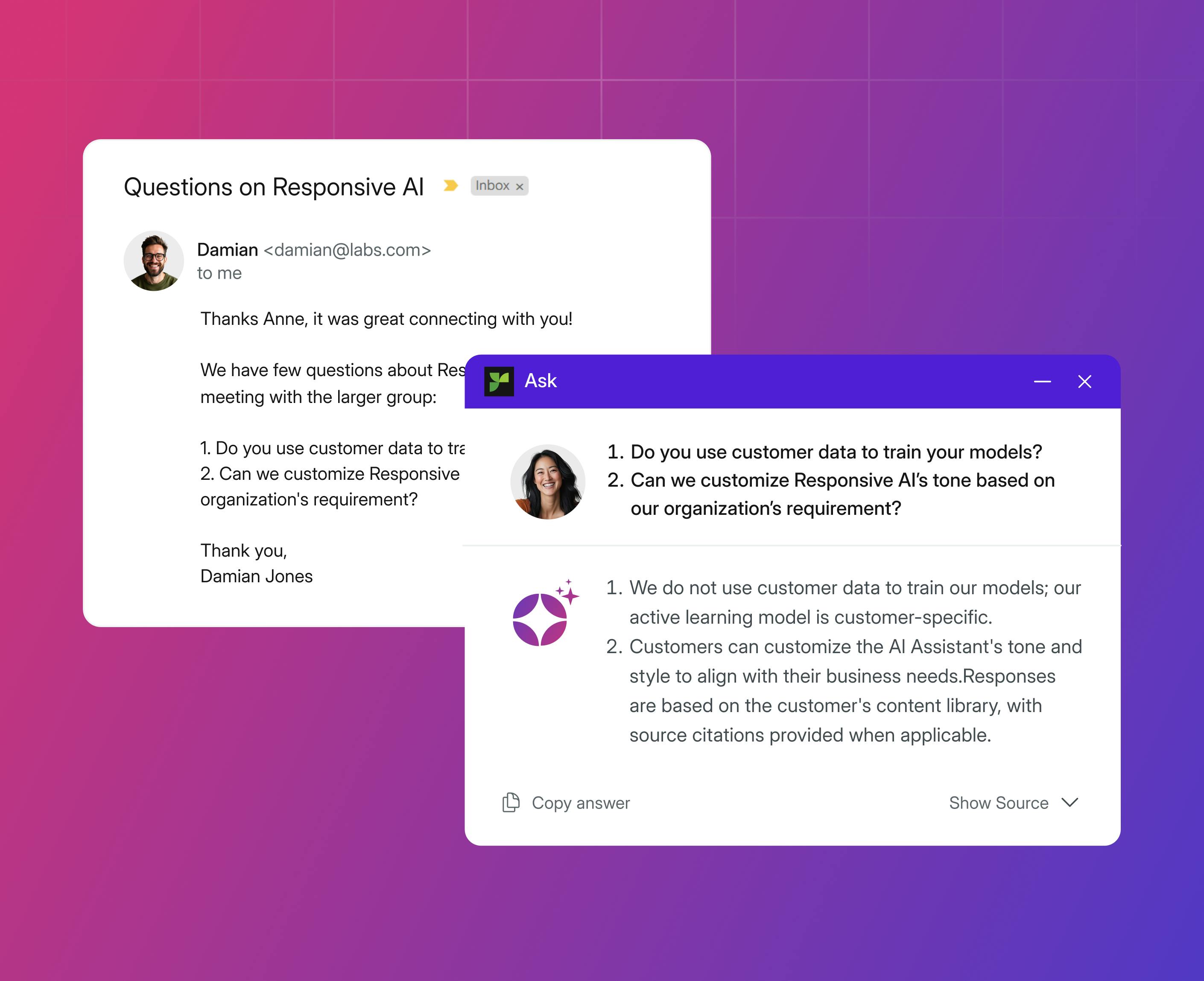
The platform features an Ask AI assistant that functions as an interactive knowledge navigator, allowing users to find and refine content through natural language queries.
Rather than manually searching through thousands of Q&A pairs, a user can ask conversational questions such as "What's our stance on GDPR compliance for European clients?" and receive contextually relevant answers from the content repository. The Ask assistant can also help users understand why certain content was recommended, providing transparency into the AI's decision-making process.
Generative AI for content creation
Our generative AI capabilities enable teams to create first drafts by synthesizing information from existing content. When faced with a question that hasn't been answered exactly before, such as a unique integration requirement combining multiple product features, the AI can generate a coherent response by pulling relevant details from related answers in the library.
This capability maintains consistency with approved messaging while adapting content to new contexts, effectively recombining existing knowledge to address novel situations.
Importing documents with AI
The Import AI agent automates document ingestion and parsing from various formats. When organizations receive RFPs in various formats—PDFs with complex tables, Word documents with nested sections, or Excel spreadsheets with hundreds of rows—the Import agent automatically extracts questions, identifies requirements, and structures them for response.
A company receiving a 200-page government RFP with technical specifications scattered throughout different sections would see the AI extract and organize these requirements into a workable project structure, with straightforward formatting handled automatically and complex layouts requiring minimal manual adjustment.
TRACE score system for AI confidence
Responsive also developed the TRACE Score system for quality control, which provides confidence ratings for AI-generated answers. Each recommendation is assigned a score indicating how well it matches the question, based on factors such as content relevance, recency, and past usage success.
A high TRACE score on an answer about product specifications would indicate strong alignment with the question and recent validation. A lower TRACE score helps teams prioritize which responses require expert attention versus those that can be approved quickly. This scoring mechanism helps teams make informed decisions about which responses require additional review.
Agent Studio: Advanced AI features and customization in Responsive

Responsive’s Agent Studio represents a more advanced capability, allowing organizations to create custom AI agents tailored to specific workflows or content types. A medical device company might develop a specialized agent for FDA regulatory questions that understands industry-specific terminology and compliance requirements, while a software company could build an agent optimized for technical architecture discussions. These custom agents can be trained on organization-specific content and processes, with implementation support available to ensure effective configuration.
Responsive's AI also extends to workflow automation through intelligent task routing and deadline management. The system can analyze project complexity, identify subject matter experts best suited for specific questions, and automatically assign sections based on past performance and availability. In a scenario where a telecommunications company receives an RFP with sections on network infrastructure, pricing, and implementation timelines, the AI would route technical questions to engineering experts, commercial terms to the pricing team, and project management queries to delivery specialists.
Implementation and continuous improvement
Every time a user selects, modifies, or rejects an AI recommendation, the system learns from these interactions to refine future suggestions. Success involves training the AI on organization-specific content and processes, consistently maintaining and updating the content repository, and providing regular user feedback to help the machine learning algorithms improve over time.
Organizations that have used Responsive for several years often find that the AI becomes increasingly accurate as it accumulates data about their specific content preferences and winning proposals, with this improvement supported by consistent content maintenance and user feedback.
We recommend establishing robust quality control measures using tools such as the TRACE Score system and maintaining human oversight for critical decisions, while allowing AI to handle routine tasks.
Enhanced natural language processing
Recent enhancements have introduced more sophisticated natural language processing capabilities that better understand context and nuance in both questions and answers. Our AI can now recognize when seemingly different questions are actually asking for the same information, such as identifying that "data backup procedures," "disaster recovery protocols," and "business continuity planning" might all require similar response elements. This semantic understanding reduces redundant work and ensures consistency across related topics.
Balanced approach to AI implementation
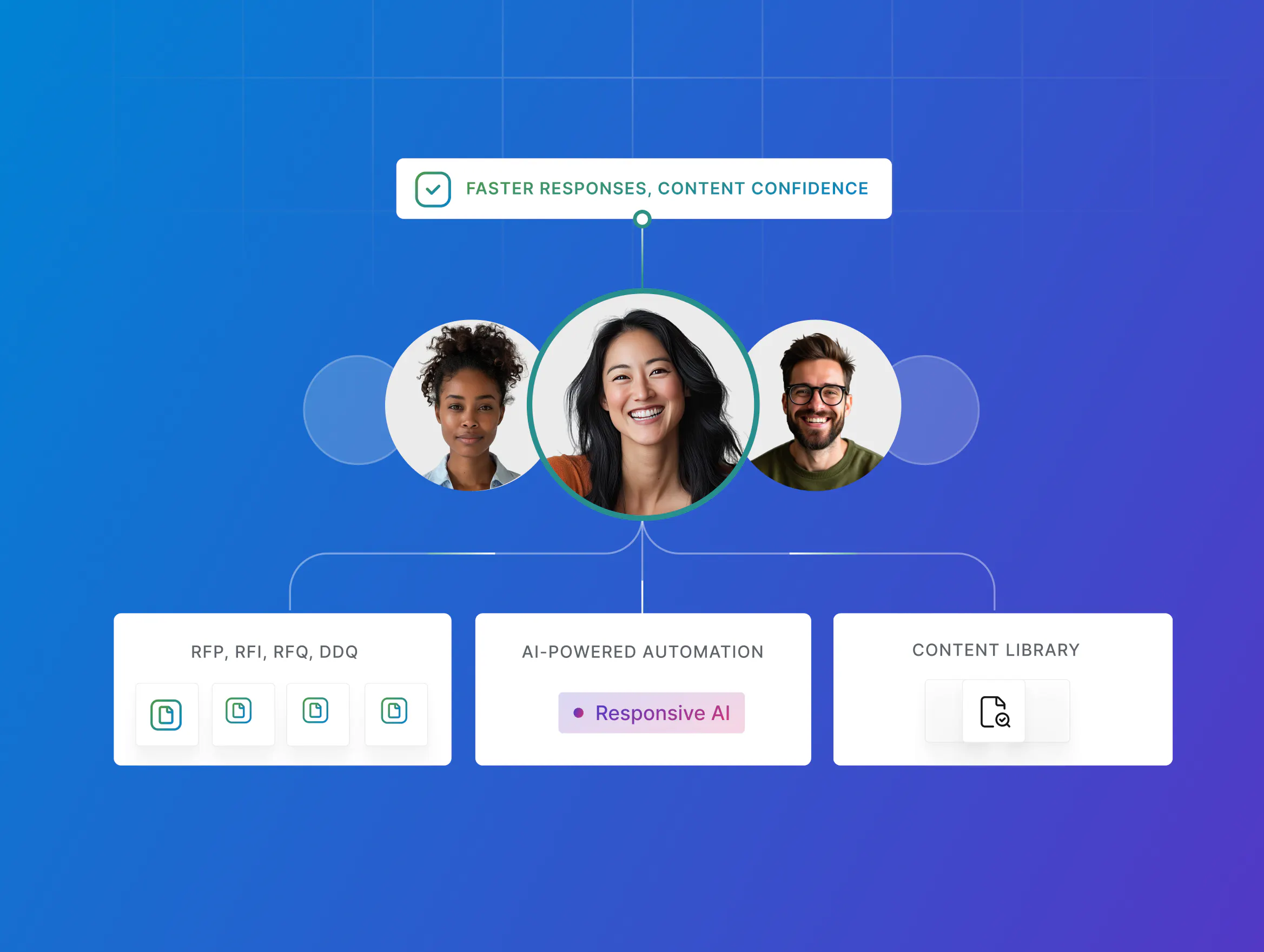
Our AI implementation focuses on augmentation rather than replacing human expertise. The platform balances AI automation with human expertise, providing tools to track AI usage and accuracy and ensuring quality control throughout the proposal development process. We provide tools to track AI usage and accuracy, enabling organizations to measure ROI and identify areas where human oversight remains critical.
Microsoft's proposal team, for instance, reported achieving significant efficiency gains while maintaining quality through a careful balance of AI automation and expert review, demonstrating that successful deployment requires thoughtful integration into existing workflows rather than wholesale automation.

Andrew Martin
Content Marketing Manager @ Responsive
Andrew Martin covers AI adoption, RFP strategy, and proposal management at Responsive, drawing on insights from Responsive's 2,000+ enterprise customer base and original research.