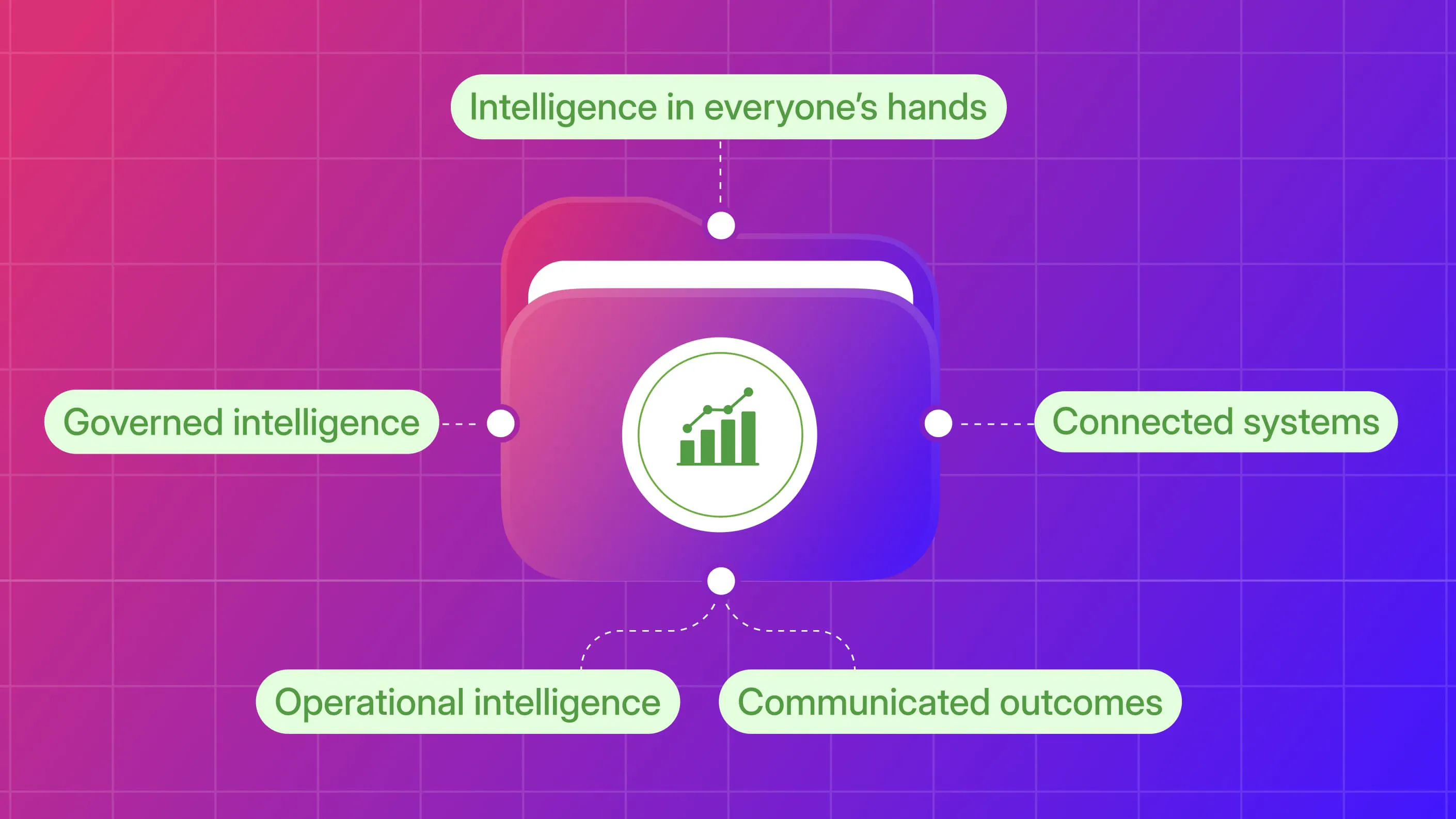
Do you file Strategic Response Management (SRM) under operations? If so, you’re not alone. Many businesses still consider SRM a cost center that keeps RFPs, security questionnaires, and due diligence requests moving on time. But that framing is outdated.
According to Responsive’s 2026 State of Strategic Response Management Report, which was written with input from more than 1,100 senior decision-makers and practitioners, the maturity of your SRM practice now appears directly on the top line.
This year's report introduces the SRM Maturity Index, the industry's first framework for scoring how well your business captures, governs, and activates the knowledge behind every strategic response. The headline finding is one every CRO and proposal executive should read twice:
SRM leaders run proposal operations more tightly than their novice counterparts. They also grow revenue faster.
What SRM maturity actually means
Strategic Response Management (SRM) is the practice of managing the people, content, and technology behind RFPs, security questionnaires, DDQs, and other buyer requests. It turns scattered knowledge into a repeatable system for responding quickly, accurately, and consistently.
However, not all businesses excel at SRM.
To understand why some are pulling ahead while others lag, we created the SRM Maturity Index. It groups companies by how effectively they capture, govern, and share the knowledge that powers strategic responses, and there are seven indicators at the core:
- Centralized knowledge hub: A single, governed repository for content used in RFPs, questionnaires, and other strategic responses.
- Independent knowledge access: Sales, SMEs, and other stakeholders can find and use approved response content on their own, without relying on the proposal team.
- Breadth of self-service: Multiple functions across the organization can access and use response knowledge directly, not just a single team.
- Self-service for complex work: Self-serve capabilities extend beyond simple questionnaires to support complex RFPs and high-value pursuits.
- SME collaboration: Proposal teams can consistently receive timely input from subject matter experts as needed.
- Outcome visibility: Teams quantify SRM outcomes and share results with senior leadership.
- Revenue attribution: The organization measures and reports the revenue generated through RFPs and other strategic responses.
We scored more than 1,100 organizations against these dimensions and grouped them into tiers. The top 20% are classified as Leaders; the bottom 20% as Novices. Next, we compared what separates these two groups, and the gap is not subtle.
Where the gap shows up: the P&L
If the Maturity Index is the diagnostic, revenue is the proof.
Across the full business, 78% of SRM Leaders report year-over-year revenue growth, compared with 69% of Novices. That may look like a modest difference at first glance, but in practice it represents a nine-point edge in the share of organizations that are expanding rather than treading water.
Zoom in on the revenue that strategic responses are directly responsible for, and the gap widens further. 73% of Leaders say revenue from RFPs and other strategic responses grew over the past year, versus just 60% of Novices. That's a 13-point spread on the exact number a CRO is asked to defend in every board meeting: is this motion generating growth or just generating activity?
The pattern holds beyond the top line. SRM Leaders are also more likely to report:
- 83% higher sales velocity, compared to virtually no uplift for Novices, when knowledge is centralized and self-serve
- 88% increased sales rep productivity, driven by the same self-service access
- 83% employee satisfaction on bid and proposal teams, versus roughly half of Novices
- 83% of Leaders say their proposal team is viewed as a strategic business partner, versus 64% of Novices
In other words, the same organizational habits that centralize knowledge and get SMEs unstuck are the habits that show up as faster deals, more engaged teams, and a proposal function that provides a seat at the strategy table, rather than a request queue.
From an operations story to a revenue story
For most of SRM's history, the pitch for investment was an efficiency pitch:
- Fewer manual searches
- Faster turnaround
- Less duplicated work
Those benefits are real, but they've never been enough to move budget at the pace the function needs. Efficiency arguments compete with dozens of similar arguments across the business.
The maturity data changes the conversation. When 73% of Leaders are growing RFP-driven revenue against 60% of Novices, SRM stops being a line item to optimize and becomes a lever to invest in. Consider how a CRO would invest in a sales methodology or pricing model that would move win rates by double digits. The C-suite should now evaluate SRM through the same lens.
This reframing elevates the importance of who is asking what questions today. Boards, CROs, and CIOs have moved past "are we using AI?" to “what value are we getting?” and “where's the evidence this is moving revenue (not just activity)?”
A maturity score tied to measurable revenue outcomes is a much stronger answer than a description of process improvements. This score also aligns with what practitioners within mature organizations are already seeing on the ground.
As Stephanie Benavidez, VP of Sales Enablement and Proposal Management at EXL, describes it in this year's report, her team has moved "from a largely reactive response function to a proactive growth and strategy partner," with visibility built on measures like revenue influenced and win-rate improvement, not just on-time submission rates.
“Today, the team influences the full pursuit lifecycle, from qualification and go/no-go decisioning to capture strategy, value articulation, AI-led differentiation, and delivery confidence. Our role is to bring those elements together early and consistently, so growth is intentional.”
Stephanie Benavidez
VP of Sales Enablement and Proposal Management, EXL
Benavidez’s story at EXL illustrates the key shift in SRM maturity. Proposal and bid management stops being an administrative function and becomes, as Responsive CEO Ganesh Shankar says, part of "the operating system behind" the moments when your organization's promises are tested in front of buyers with more options and more scrutiny than ever.
Why this matters for the C-suite
If you're a CRO or a proposal executive trying to make the case for SRM investment, the maturity gap gives you something an efficiency argument never could: a credible, benchmarked link between specific practices and revenue outcomes.
That means your pitch to the rest of the C-suite doesn't have to start with "we need a better tool." Instead, you can start with the diagnostic. Where does your organization actually sit on centralized knowledge, broad, self-service access, SME collaboration, outcome visibility, and revenue attribution?
Closing that gap isn't just an operations upgrade, according to this year's data. It's a nine- to 13-point swing in the share of your business that's growing versus standing still.
SRM has quietly become the operating system behind how your organization wins business under real scrutiny. The 2026 State of SRM Report makes the case that treating it like one — with the investment, measurement, and executive attention that implies — is what now separates Leaders from Novices.
Explore our full findings, including the seven-pillar SRM Maturity Index and 12-month roadmap, in the 2026 State of Strategic Response Management Report.

Andrew Martin
Content Marketing Manager @ Responsive
Andrew Martin covers AI adoption, RFP strategy, and proposal management at Responsive, drawing on insights from Responsive's 2,000+ enterprise customer base and original research.