Every new vendor relationship is a new source of exposure. That’s the basic math behind third-party risk management (TPRM). It’s why security, privacy, AI, and compliance reviews have become heavier, slower, and more frequent across nearly every industry.
For years, the response to that pressure was a sales enablement fix: a security packet here, a shared drive of certifications there. But that framing is no longer big enough. As evaluation volume climbs, Trust Centers are shifting from a nice-to-have sales asset into a structural part of how organizations manage vendor risk.
Third-party risk management is hitting a scale problem
Buyers are evaluating more vendors, asking deeper questions, and applying stricter security, privacy, and AI review standards than they were even two years ago. According to Responsive's 2026 State of Strategic Response Management (SRM) Report, a survey of 1,100 senior decision-makers and practitioners across regions and industries, found:
- 87% said buyers expect faster response times, up from 82% in the 2025 SRM Report.
- 84% of respondents said buyers now have tighter budgets, the same as the previous year.
- 79% said buyers require more personalization, up from 75% in 2025.
- 78% found that buyers base decisions on a broader set of requirements (including AI-specific requirements), increased from 73% in the previous year’s data.
That pressure compounds because it hits both sides of the table. Buyers are also bringing more scrutiny to how vendors use AI. Responsive's Inside the Buyer's Mind: What Shapes B2B Decisions Today report, based on a survey of 350 B2B buyers, found:
- 46% of buyer organizations now restrict entering sensitive company information into AI tools.
- 42% require fact-checking of AI-generated outputs before internal use.
For InfoSec and GRC teams, that means every vendor evaluation now carries its own governance overhead, on top of the underlying security review.
The hidden cost of unstructured vendor trust information
Most trust information still lives the way it always has: scattered across shared drives, buried in outdated PDFs, and repeated with slight variations across dozens of questionnaire responses. That model has real costs for both sides of the deal.
For InfoSec and compliance teams, it means every questionnaire starts closer to scratch than it should. Answers get rewritten instead of reused, documentation drifts out of date between reviews, and there is rarely a single, current source anyone can point to with confidence.
For buyers, it means chasing the same information through multiple contacts, waiting on manual NDA workflows, and stitching together a vendor's risk profile from whatever happens to be on hand that week.
And this gap is getting more expensive to ignore. Nearly two-thirds of buyers now use generative AI tools as much as, or more than, traditional search when researching vendors, and GenAI adoption for vendor discovery jumps to 42% among organizations with 2,000 or more employees. Those tools pull from what is accessible and crawlable. If a vendor's trust content is gated, unclear, or simply not there, AI-assisted buyers may never surface it, and the vendor loses ground before a human reviewer ever gets involved.
Why Trust Centers belong in the TPRM conversation
A Trust Center reframes trust content as infrastructure rather than a one-off deliverable. Instead of assembling a security packet on demand, security certifications, privacy practices, AI governance information, and risk documentation live in a single, governed hub that is consistently maintained, rather than reassembled every time a request comes in.
That distinction matters for TPRM specifically.
Third-party risk programs succeed or fail based on consistency — the same standard of evidence, applied the same way, across every vendor relationship. A Trust Center gives vendors a structured way to standardize how they communicate that evidence, which gives buyer-side risk teams something to standardize their own evaluation against. Everyone is working from the same current source instead of a patchwork of emailed attachments.
What buyers need from a modern Trust Center

Buyers evaluating a vendor's risk posture are looking for a system they can trust and move through efficiently, not just more documents. A modern Trust Center should give buyers:
- Searchable documentation: Certifications, policies, and disclosures are organized so buyers can find specific answers directly, instead of paging through static folders or emailed PDFs.
- Clear access controls: Sensitive material stays gated to the right audience, so transparency does not turn into oversharing.
- Version control: Buyers see the current, approved version of every document, not a copy that is a revision or two behind.
- Pre-approved answers: Standard questions are answered from a single governed source of truth, instead of an ad hoc reply drafted under deadline pressure.
- Source-backed AI responses. AI tools let buyers get a specific answer on demand, with the underlying source cited, rather than waiting on a person to respond.
- Audience-specific views: A prospect, an existing customer, and an auditor each see the content relevant to them, without the vendor duplicating material for every group.
- Engagement signals: Visibility into what has been shared, when, and with whom, so approvals do not stall for lack of a paper trail.
How vendors can make risk review easier without oversharing
The instinct to protect information and the instinct to be transparent are not in conflict, but they do require the right structure to coexist. The goal is controlled transparency: the right information sent to the right audience, at the right time, with the right governance behind it.
In practice, controlled transparency looks like tiered access rather than a single public dump.
- Public-facing summaries can sit alongside NDA-gated documentation for sensitive material, with defined ownership and a review cadence behind each.
- Audience-specific views let a Trust Center serve prospects, existing customers, and partners differently without maintaining separate systems or duplicating content across them.
- Self-attestation tools that map answers to standard frameworks such as SIG, SIG Lite, and CAIQ let InfoSec teams respond to industry-standard questionnaires in minutes rather than days, without loosening control over what gets shared externally.
Why this matters most in regulated industries
The stakes rise fastest in regulated sectors. Financial services, asset management, healthcare, and enterprise technology buyers typically face more stakeholders, tighter regulatory scrutiny, and steeper consequences when a vendor's risk posture falls short.
In financial services and insurance specifically, 58% and 56% of buyers, respectively, say AI is making it easier to compare vendors and solutions, compared with 44% overall. This indicates vendor trust content in these sectors is being compared more sharply, not less. Healthcare buyers also show the most concern about a vendor's AI governance, with 44% citing absence of clear governance as a concern.
But not just any Trust Center Framework will do.
Rather than a single generic hub offering, advanced Trust Center platforms are built around industry-specific profiles, such as a Financial Profile for banking and asset management buyers, a Medical Data Profile for healthcare reviewers, and a Regulatory Profile for compliance-heavy evaluations. Each profile should be mapped to the certifications those buyers ask for most, such as SOC 2, ISO 27001, GDPR, and HIPAA attestations.
A generic security packet rarely satisfies a healthcare compliance reviewer and a financial services auditor in the same way, which is exactly why regulated buyers need that structure most.
How Responsive Trust Center connects TPRM, InfoSec, and revenue teams
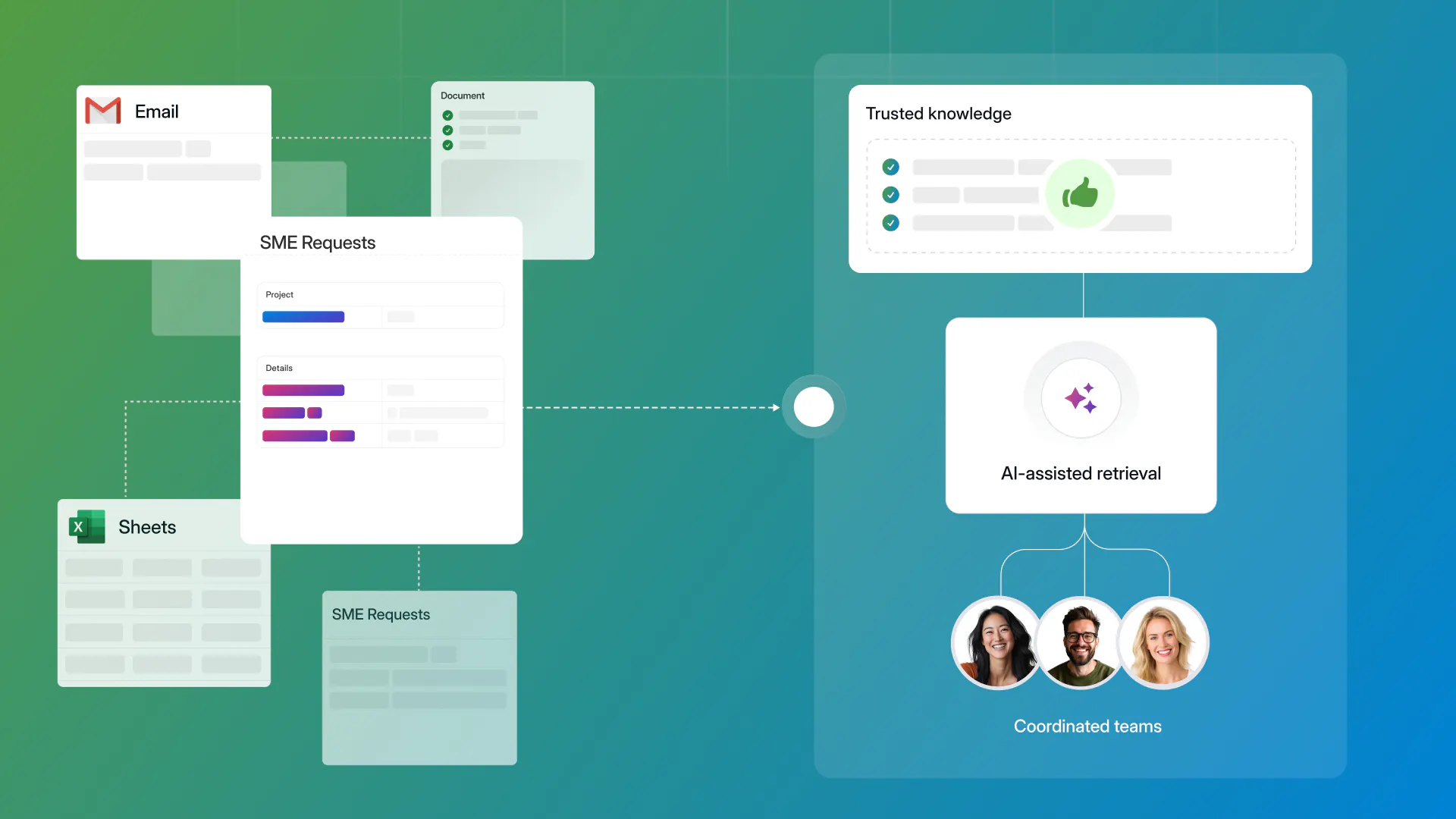
This is the operating model behind the Responsive Trust Center: a single governed hub for certifications, policies, risk assessments, and disclosures, with segmented views so each audience sees only what applies to them, NDA bypass workflows connected to Salesforce or Microsoft Dynamics, and Ask, an AI tool that gives buyers cited answers to specific questions without waiting on a person.
The Responsive Platform is built to make trusted, up-to-date answers always available to external stakeholders, which is precisely the standing capability TPRM programs need rather than a resource assembled fresh for each deal.
The results back up the model. Organizations using Responsive’s Trust Center have:
- Automated 81% of inbound security questionnaires at Invicti Security
- Cut average turnaround time by 1.3 days and reduced follow-up questionnaire requirements from existing customers by about 35% at Fortra
None of this replaces the judgment InfoSec and GRC teams bring to a genuinely complex review. Instead, it allows teams to spend less time on repetitive, standard questions that a governed Trust Center can already answer, and more on the reviews that actually require expert attention.
For vendors, this shift means fewer redundant requests and faster reviews. For buyers, it means less evaluation friction and more confidence in a vendor's security, privacy, and compliance posture. For InfoSec, it means more control, better governance, and fewer fire drills. Exactly the shift TPRM has been asking for.
Ready to learn more? See how Responsive Trust Center can help you reduce sales friction and generate more confidence in your security, privacy, and compliance posture.

Andrew Martin
Content Marketing Manager @ Responsive
Andrew Martin covers AI adoption, RFP strategy, and proposal management at Responsive, drawing on insights from Responsive's 2,000+ enterprise customer base and original research.