
Where do you go when you need:
- A bespoke proposal that wins the RFP to advance a lucrative deal?
- A SIG 2026 template you can quickly complete with AI to maintain deal momentum?
- Answers for quarterly due diligence assessments?
- An accurate answer to a buyer or customer question with high-stakes compliance implications?
And how do you know if what you find is the latest and greatest? Most organizations already have all of this information, but finding it, accessing it, and using it are critical to revenue growth.
This is the core of Strategic Response Management (SRM): centralizing, governing, and activating institutional knowledge so every team can respond to revenue-critical requests with speed, accuracy, and consistency. The four steps mentioned in this article can get you there. To see how knowledge democratization impacts revenue and to explore whether to build or buy a solution, get the full Guide to Turning Organizational Knowledge into Revenue.
Activating institutional knowledge with AI is a team sport
While one person or team can manage an SRM platform like Responsive, no single individual holds all the expertise an organization needs. Capturing and maintaining that knowledge is a team effort.
Knowledge democratization requires clear ownership. Every answer or document must have a defined reviewer; without one, a source of truth quickly becomes a source of confusion. SRM platforms like Responsive simplify governance through agentic workflows, shared collaboration, and built-in checks that surface outdated or inaccurate content before it undermines trust. The goal is to make expertise reusable and reliable without placing an ongoing review burden on subject matter experts (SMEs).

A key principle: humans own truth. AI makes it usable. The goal is to make expertise reusable and reliable without dumping ongoing work on SMEs.
Step 1: Create a single source of truth, and make it AI-ready
Your gold mine of knowledge lives with the teams that respond to RFPs, DDQs, security questionnaires, and daily buyer questions. These are the people closest to what buyers actually ask, what evaluators scrutinize, and what language ultimately wins. Unlike static marketing assets or product documentation, this knowledge is continuously refreshed through real buyer interactions, making it some of the most current and credible information in the organization.
When it is time to centralize that knowledge, pulling content from past RFPs and questionnaires, shared drives, and other scattered locations, AI-powered SRM platforms like Responsive are designed to make the process fast and manageable.
The quickest way to populate the Responsive Content Library — your knowledge base — for instance, is through bulk content loading. While it is possible to upload past RFPs as-is, doing so often creates cleanup work later. This includes deduplicating answers, removing client-specific language, updating outdated claims, and restructuring content so AI can use it effectively. Best practice is to prepare files before loading them into Responsive, focusing on reusable, up-to-date answers that represent how your business should show up in competitive situations.
Content can also be loaded directly from supported cloud storage systems such as OneDrive, SharePoint, Google Drive, Dropbox, Box, and Seismic. With Responsive, individual Q&A pairs can then be added on the fly through Slack, email, or by using Responsive Ask, capturing new knowledge as it emerges.
Structure is what makes your knowledge base usable by AI. Each Q&A pair should focus on a single idea, be written in natural language, and include enough context to stand on its own. Tags, metadata, and clearly assigned ownership give answers the structure and context AI needs to retrieve them accurately later.
By investing a little extra time here, you build a knowledge base that reflects your best, buyer-tested thinking and makes it accessible not just to your team, but to everyone who relies on it for answers.
Microsoft built its Proposal Resource Center on Responsive, centralizing content for 21,000+ sellers and SMEs. Learn how they manage it to improve proposal quality, speed, and accessibility in this video.
Step 2: Future-proof your knowledge base with governance
A centralized knowledge base needs a governance framework to avoid pitfalls of conflicting answers, inconsistent language, and teams second-guessing what’s safe to use. Otherwise adoption stalls no matter how advanced the AI is.
Governance can give you a self-healing knowledge base as you scale. It ensures that the $organization’s best expert content — the answers that have actually been used to win business — remains accurate, explainable, and current as it evolves.
In Responsive, governance is built directly into the system, not layered on through manual enforcement. Each answer has a clear owner. Review cycles keep content aligned with changing products, regulations, and buyer expectations. Content status is clearly delineated so users know whether it has been approved, is still being drafted, or is historical content that has been superseded.
AI plays a critical supporting role by making governance continuous instead of episodic. Rather than relying on periodic audits or manual spot checks, AI agents continuously observe how content is actually used. They surface answers that haven’t been reviewed recently, flag contradictions as they appear, and highlight gaps where teams are asking questions but no trusted answer exists.
This allows governance to blend into day-to-day work. Instead of preparing for a separate cleanup project, content owners can review and update answers in context, working alongside the agent as it flags issues in real time.
This step is essential because it creates the conditions for what comes next. Once knowledge is structured, owned, and governed, it can be shared broadly without introducing risk. With trust established at the foundation, you’re ready to move from controlled knowledge to confident self-service.
Tenable built no-code agents with Agent Studio to automate governance work like archiving outdated entries and reorganizing tags. See how it helps 900+ sellers self-serve trusted answers in this video.
Step 3: Spread the wealth with self-service…safely
Self-service is where knowledge democratization steps fully into the spotlight.
Once content is governed, you can expand access to your organizational knowledge beyond the proposal team, without introducing added risk. Sales, solutions engineering, security, and other stakeholders no longer need to know where answers live or who owns them. They just need to ask your SRM platform.
With Responsive, teams self-serve through conversational AI in Responsive Ask directly inside the tools they already use, like Slack, Teams, email, Word, Excel, or a browser. Instead of hunting through documents or search results, they receive answers grounded in approved content and tailored to their context.
Start with instant answers, wherever work happens
Self-service begins at the question level.
Field teams can use Ask in the moments that matter most — replying to a prospect email, answering a live call, or engaging someone on a tradeshow floor — and get immediate, usable answers. Each response is backed by a TRACE Score™, giving users a 1-100 confidence rating in its accuracy, completeness, and trustworthiness.
As this kind of self-service takes hold, behavior changes fast.
- Field teams stop creating shadow documents
- SMEs stop answering the same questions repeatedly
- Proposal teams stop acting as human routers for information they don’t own
- Your organization moves faster without sacrificing consistency
Extend self-service to entire questionnaires
Once teams trust self-service for individual answers, the model can safely scale.
At the questionnaire level, tools like Guided Projects allow field teams to independently complete routine RFPs, DDQs, and security questionnaires end-to-end without pulling in proposal, security, or product teams for every request. This is especially powerful in large organizations with dedicated SRM or bid and proposal teams. Routine work moves out of the critical path, freeing those teams to focus on high-value, complex pursuits where strategy and differentiation matter most.
Keep speed and safety in balance
Broad access only works if it’s controlled. If you’re rolling out self-service to accelerate revenue growth and mitigate risk, then you need a solution that makes it easy to move fast and hard to move recklessly.
Responsive builds guardrails into how knowledge is accessed, used, and evolved, so democratization never comes at the expense of governance. AI agents play a critical role. They reinforce good behavior by:
- Guiding users through the right workflows
- Surfacing review needs when oversight is required
- Restricting AI assistance within defined boundaries, like specific Collections within your library
- In regulated environments, controls like Verbatim ensure exact language is preserved where precision is mandatory, while still allowing AI to accelerate everything else
Because self-service happens where work already happens, adoption follows naturally. Knowledge stops being something teams go looking for and becomes something that’s simply there when they need it.
See how Qualtrics scaled access by enabling more than 1,000 employees to self-serve approved answers through conversational AI embedded in daily workflows.
Step 4: Accelerate adoption through continuous moderation
There will come a time when one of your users prompts your SRM AI, and before they submit the prompt they’ll wonder, “Are the newest product specs available yet?” Continuous moderation will keep them smiling every time.
Continuous moderation is the practice of actively monitoring and improving your knowledge base so it never falls out of sync with the business or quietly loses relevance while no one is paying attention. With Responsive, it’s built in: each time a question goes to review by an SME, it is updated. Responsive also includes a Content Health Dashboard, the system of record for library health that gives teams a clear, objective view of how strong their knowledge foundation really is.
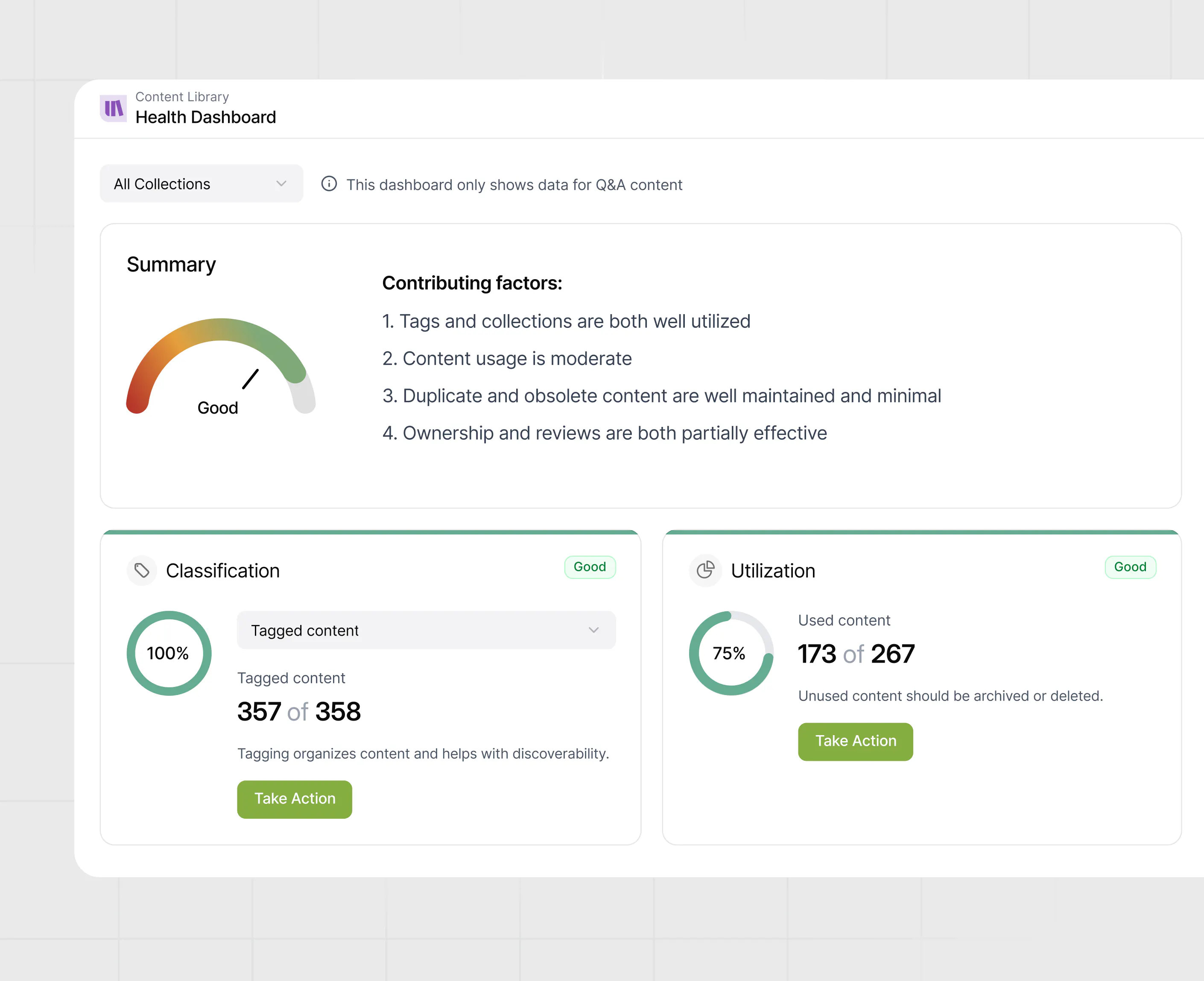
The dashboard scores content across accuracy, freshness, and usage, then pinpoints exactly what needs attention. In a few clicks, teams can identify duplicates, retire outdated entries, and see where high-impact answers are being reused or repeatedly edited across responses. Instead of relying on instinct or periodic cleanups, teams get concrete signals about where improvement matters most.
From there, AI agents turn insight into action. Teams can build and deploy agents to act on the dashboard’s recommendations:
- Route cleanup tasks to the right content owners
- Flag contradictions and recommend fixes
- Prompt reviews when content ages out
- Consolidate duplicate answers automatically
Humans still make the decisions, but agents handle the unglamorous work that makes consistency sustainable. Agents deliver more accurate results, responses stay compliant, and teams move faster because they trust the information behind every answer.
Over time, usage increases, confidence grows, and knowledge stops aging in place. It becomes a living, self-healing system. With SRM, you are operating an engine that sales and other teams can use to turn institutional knowledge into revenue.
See how Netsmart built a living, moderated knowledge base that allows AI to produce trusted answers in 30 seconds.
Set up your knowledge base for long-term AI success
In a market where buyers expect faster, more accurate, and more tailored responses, leaders are centralizing what they know, governing it with care, and putting it directly into the hands of the people closest to the deal. More than 75% of organizations say expectations for speed and personalization are rising, raising the stakes for every interaction. The teams that win are the ones that can meet those expectations consistently, without slowing down.
With knowledge enablement on an AI-powered SRM platform, the impact builds naturally. Answers come faster because teams aren’t starting from scratch. Alignment improves because everyone is working from the same source of truth. Opportunities move forward with less friction, fewer handoffs, and more confidence at every step. Over time, knowledge shifts from something you have to track down into something that actively supports how you sell, respond, and grow.
Get the full guide

RD Symms
Sr. Copywriter @ Responsive
With more than 15 years in writing, content development, and creative strategy, RD brings a rare combination of conceptual thinking and executional range to the proposal management space. He's spent his career turning complex ideas into content that earns attention which makes him a natural fit for an audience of proposal managers and sales leaders who read critically and buy carefully.