Chances are, your revenue organization has already piloted AI somewhere in the pursuit lifecycle. Maybe your team is using it to draft proposals, research accounts, analyze deal fit, automate cross-functional workflows, answer security questionnaires, or support other critical buyer touchpoints. You may have even operationalized AI for one or two of the tasks, but the bigger opportunity is connecting them.
Constellation Research argues that CROs should think beyond isolated AI use cases and toward an integrated model that supports the full pursuit lifecycle through Strategic Response Management (SRM). In that model, qualification, research, response, collaboration, validation, and post-pursuit insight are all grounded in governed organizational knowledge and managed from a single platform.
For CROs, the payoff is broader than efficiency. An integrated SRM approach can help revenue teams decide where to compete, move faster on the right opportunities, give sellers and subject matter experts (SMEs) trusted information when they need it, and turn every pursuit into intelligence that improves the next one.
So the question for CROs is likely not "build vs. buy" or "can gen AI do this?" but "what is actually fit-for-purpose?"
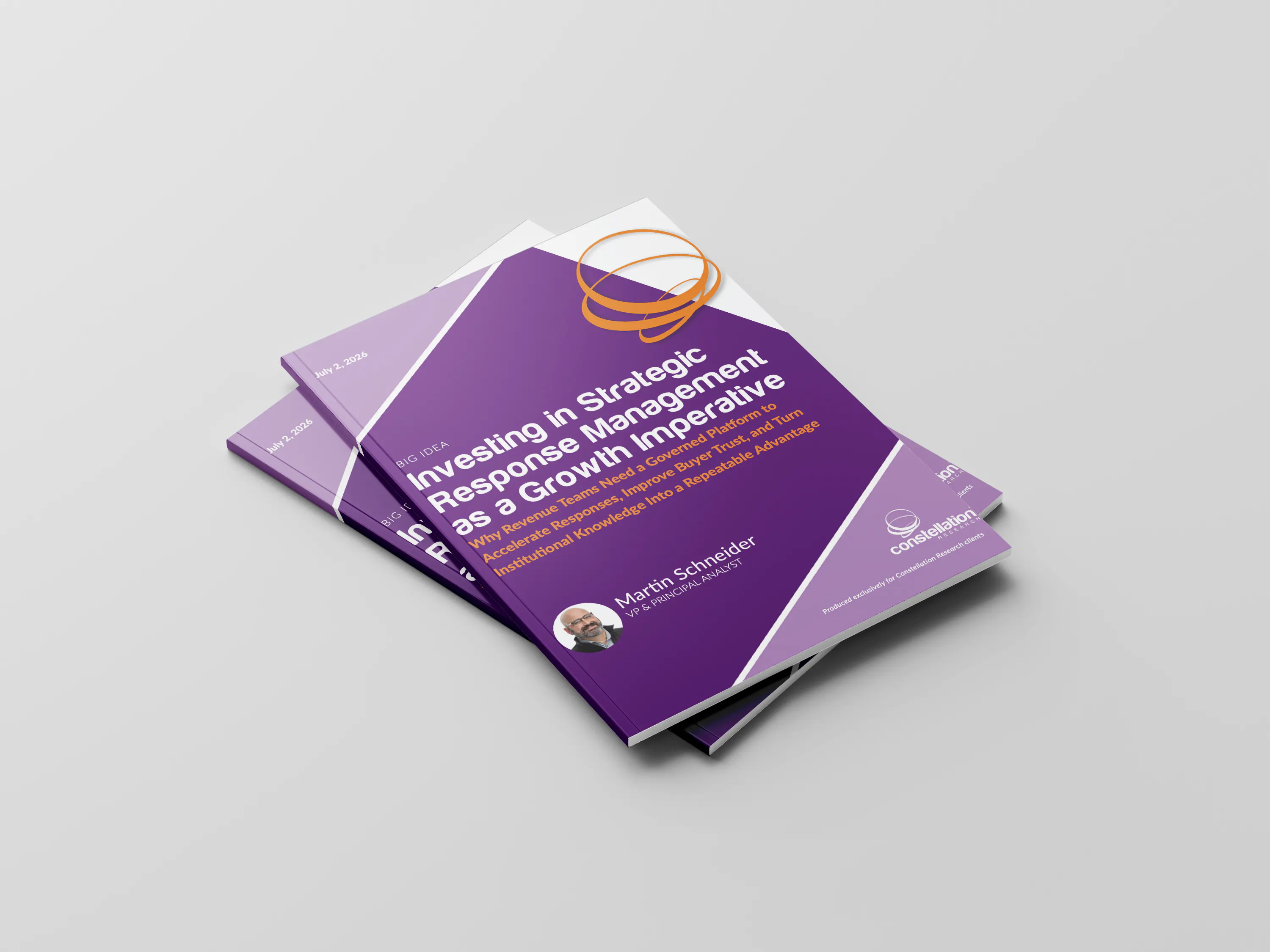
Download the free Constellation Research Report
When generic AI breaks down as the solution
Individual AI use cases can be relatively straightforward to pilot. After a team connects an enterprise LLM to company documents:
- RevOps can experiment with account research
- Proposal teams can test drafting
- Sales engineers can use AI to answer common technological questions
Operationalizing those experiments turns the relatively straightforward into the overwhelmingly complex. An AI application supporting a live pursuit needs context in the form of reliable and persistent access to updated, accurate, and auditable knowledge. Revenue teams need to be confident that an answer is based on current information, approved for external use, and a clear path for assurance if any doubt does exist.
Workflow matters, too. Complex pursuits require cross-functional assignments, SME contributions, reviews, approvals, deadlines, and visibility across multiple teams.
The analyst behind the Constellation Research report draws an important distinction between AI fluency and institutional reliability. A general-purpose LLM may draft answers, but it does not inherently carry your approved messaging, response history, governance processes, or institutional memory.
And drafting is only one task revenue teams and their leaders need to consider. AI used for:
- Qualification needs established criteria
- Customer research needs appropriate context
- Security responses needs governed sources
- Post-pursuit analysis needs structured information about the process
Without it, you could inadvertently create another generation of revenue-tech silos.
When it makes sense to build
Internal development makes sense when the capability itself differentiates the business. For example, a proprietary agent informed by unique customer data, a specialized recommendation model, or an AI experience embedded in the company’s product may justify ongoing engineering investment.
However, ownership extends beyond the initial build. The team responsible for building (usually IT) also inherits data connections, model changes, authentication, permissions, monitoring, security governance, and ongoing maintenance. Broader adoption can add requirements for reporting, collaboration, auditability, and human review.
A useful build decision should consider opportunity alongside technical feasibility. Engineering resources spent recreating established workflows and governance capabilities are pulled away from product innovation or proprietary AI that customers value.
Here is a simple framework: Build when the scope is narrow, differentiated, and IT is prepared to own it long term. Buy when the workflow is complex, cross-functional, business-critical, and expensive to recreate.
Revenue needs a system around it
When pursuing revenue, opportunities are swarmed by sales, proposal teams, solution consultants, security, legal, product, marketing, and other SMEs. Their work draws from overlapping knowledge but carries different requirements for access, ownership, review, and approval. Orchestrating these activities in a smart way is the reason why Strategic Response Management exists.
What Strategic Response Management, done well, can deliver: Revenue teams can analyze fit before committing resources, retrieve approved knowledge during discovery, draft personalized responses, coordinate SMEs, validate submissions, and capture new intelligence after the pursuit.
Value compounds when those activities share data and context. Each pursuit can improve the knowledge, qualification criteria, messaging, and decision-making available for the next one.
What to do when different AI systems have different jobs
The Constellation Research dubs it “blend.” We refer to it as “integration.” Gartner calls it an “AI Tech Sandwich.” Choose your favorite label. All refer to a model in which purpose-built SRM operates alongside enterprise AI tools, general-purpose LLMs, and internally built AI. Each technology serves a different role within the same environment.
Should you build, buy, or integrate AI?
Gartner’s AI Technology Sandwich shows tech stacks combining vendor-embedded AI, bring-your-own AI (BYOAI), internally built AI, centralized data, and trust, risk, and security management (TRiSM). Gartner advises technology leaders to evaluate build-and-buy choices on factors including strategic differentiation, data requirements, governance, resources, cost, and the vendor ecosystem.
For revenue leaders, the AI Technology Sandwich creates a practical division of labor. Enterprise AI can support broad productivity and research. Internally built AI can address proprietary use cases. SRM can provide governed organizational knowledge, specialized pursuit workflows, collaboration, validation, and reusable intelligence.
Hold the mayo. Or not? Think of integrations as the mayo, connecting those layers to employees’ daily work. For example, the Responsive MCP Server allows compatible generative AI tools to access approved organizational knowledge in Responsive. Teams can use environments such as ChatGPT or Claude while drawing from current, governed company information.
A well-designed architecture gives every technology a clear responsibility without forcing employees to navigate the architecture themselves.
How this looks in the real world
The experiences of EXL and IFS provide valuable insights for any revenue leader.
EXL shows the value of connecting AI to everyday pursuit work
The Constellation Report includes a case study for EXL that illustrates how the integrated model can work at scale. EXL had been starting over on RFPs, searching for previous content and repeatedly asking SMEs for information they had already provided. EXL connected Responsive to systems employees already used, bringing governed knowledge and structured workflows closer to everyday revenue activity. Responsive AI now extends across tools including Salesforce, Highspot, and Microsoft Teams, with Copilot and Claude also part of the broader AI strategy.
EXL reports 36% faster RFP submissions and 74% less time spent per RFP, while structured workflows can support pursuits involving as many as 50 contributors. The bigger lesson for CROs concerns reach.
A governed knowledge and workflow layer can support account teams, solution consultants, proposal professionals, and SMEs across multiple pursuit activities. AI becomes part of how teams close business rather than another standalone destination.
“I look at Responsive as much more than just a content repository. It truly is an end-to-end solution that helps with project management, versioning, metadata—understanding who has contributed, what has changed, iteration over iteration, [allowing us to manage] what could be years of data.”
Stephanie Benavidez
Vice President of Sales Enablement and Proposal Management at EXL
IFS shows how AI pilots can inform the need for scalable solutions
As a global enterprise software company, IFS had the expertise to build an internal GPT for RFP responses. Its pilot proved that generative AI could accelerate first drafts.
But enterprise deployment raised additional requirements, including governed knowledge, real-time SME collaboration, structured reviews, verification, auditability, analytics, and end-to-end- workflows. The scope quickly expanded from an AI model to a complete response system. Ongoing ownership also competed with higher-value IT priorities.
After evaluating 10 RFP and proposal solutions, IFS selected Responsive for SRM. The resulting environment combines governed knowledge, collaboration, workflow, analytics, and AI-assisted pursuit capabilities.
IFS also gained intelligence beyond response production. The team maintains a 90%+ rate of bids advancing to the next stage, yet its analysis found that 35% of deals progressing beyond the bid stage were later going dormant. The finding exposed a broader sales-cycle issue that drafting metrics alone could not reveal.
“Because the IT team possesses deep AI expertise, they quickly recognized the operational reality: their core focus was driving core product innovation, not the continuous, heavy backend maintenance required to keep a standalone RFP data model alive.”
Maria Flores
VP of Bid Management at IFS
Turn isolated AI wins into true pursuit intelligence
Most revenue organizations no longer need convincing that AI can improve individual tasks. The next stage is operationalizing those capabilities across the pursuit lifecycle.
Here is a straightforward framework:
- Build where proprietary AI creates meaningful differentiation.
- Buy mature infrastructure when recreating established capabilities consumes resources without creating a corresponding competitive advantage.
- Integrate enterprise AI, internal innovation, and specialized platforms where each can do the job it handles best.
Ultimately, the goal is for sellers and pursuit teams to use trusted AI in their existing workflows without adding more tools or friction.
When the AI is part and parcel with a connected SRM strategy, it turns individual wins into pursuit intelligence that helps the entire revenue organization get smarter about how it competes and wins.

RD Symms
Sr. Copywriter @ Responsive
With more than 15 years in writing, content development, and creative strategy, RD brings a rare combination of conceptual thinking and executional range to the proposal management space. He's spent his career turning complex ideas into content that earns attention which makes him a natural fit for an audience of proposal managers and sales leaders who read critically and buy carefully.