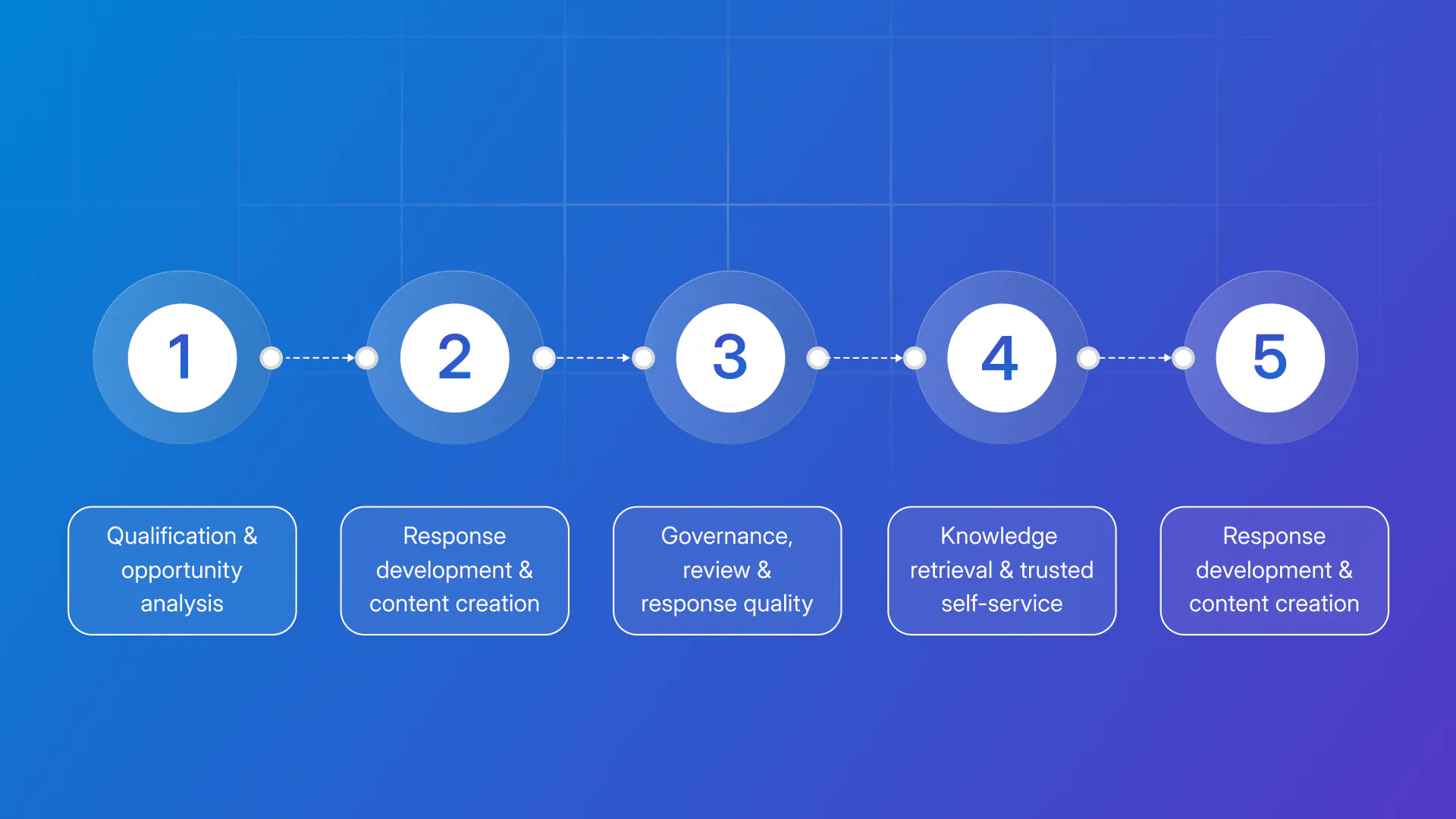
AI has moved from experiment to expectation in proposal management. Boards, CROs, and CIOs are asking:
- "What value are we getting from AI?"
- "How do we know we can trust it?”
- “Where is the proof that it is improving revenue and not just increasing activity?”
In strategic response work, including RFPs, RFIs, DDQs, security questionnaires, ESG requests, and everyday customer questions, teams face growing demands. They are expected to respond faster, deliver more personalized answers, and provide stronger proof points. At the same time, they must meet these expectations without a significant increase in capacity.
According to the 2026 State of Strategic Response Management Report:
- 87% of organizations say buyers now expect faster response times
- 84% say buyers have tighter budgets
- 79% say buyers require a higher degree of personalization
- 67% say bid and proposal teams are under increasing pressure
Proposal teams pulling ahead are using AI for much more than just writing faster. They are building an accountable AI operating model across the full strategic response lifecycle, one that connects governed knowledge, trusted workflows, measurable outcomes, and revenue impact.
This is the new proposal AI playbook, which is covered in further detail in the webinar below. Read on to discover how to use AI across the full pursuit lifecycle, driving ROI and positioning proposal teams as strategic influencers in their organizations.
How to drive AI ROI across the proposal lifecycle
Proof that AI across the proposal lifecycle grows revenue
Introduced in the 2026 State of SRM Report, the SRM Maturity Index classifies organizations as Leaders or Novices based on how effectively they capture, govern, share, and measure the knowledge behind strategic responses.
SRM Leaders turn AI from an activity accelerator into a performance engine. AI informs higher-value decisions. Teams use AI to build systems, centralize knowledge, and give field teams access to trusted answers. They measure and communicate outcomes to leadership in business terms.
These same SRM Leaders are more likely to report overall year-over-year revenue growth, at 78% compared with 69% of Novices. The gap is even sharper for revenue tied directly to RFPs and other strategic responses: 73% of Leaders report growth, compared with 60% of Novices. Leaders also report much stronger employee satisfaction on bid and proposal teams, at 83% compared with 53% of Novices.
Microsoft is a textbook example of centralizing knowledge and making it available to the entire field. Its Proposal Resource Library supports 18,000 authenticated users, has saved more than $17 million through self-service, and helps sellers access vetted content across proposals, RFPs, RFIs, security, legal, and compliance assessments.
“Centralizing the information around corporate content, technical and solution content, templates, branding — you name it — if you centralize that and open it up to the sales team, you’re ensuring that your entire company is showing up in the best way possible for customers.”
Carrie Jordan
Global Director of Proposals at Microsoft
How top teams use AI across the proposal lifecycle
Many proposal teams think about AI as a writing tool. Top-performing organizations take a broader approach. They apply AI before the first response is drafted, throughout review and collaboration, and after the proposal is submitted. AI becomes part of the entire pursuit process, helping teams make better decisions, improve response quality, and continuously strengthen the knowledge that powers future pursuits.
One of the biggest misconceptions about proposal AI is that organizations need to choose a single AI platform. High-performing organizations combine enterprise AI platforms, such as Microsoft Copilot, ChatGPT, and Claude, with purpose-built proposal management AI and organization-specific AI solutions. Each serves a different role, but all depend on the same foundation: trusted organizational knowledge, strong governance, and well-designed workflows.
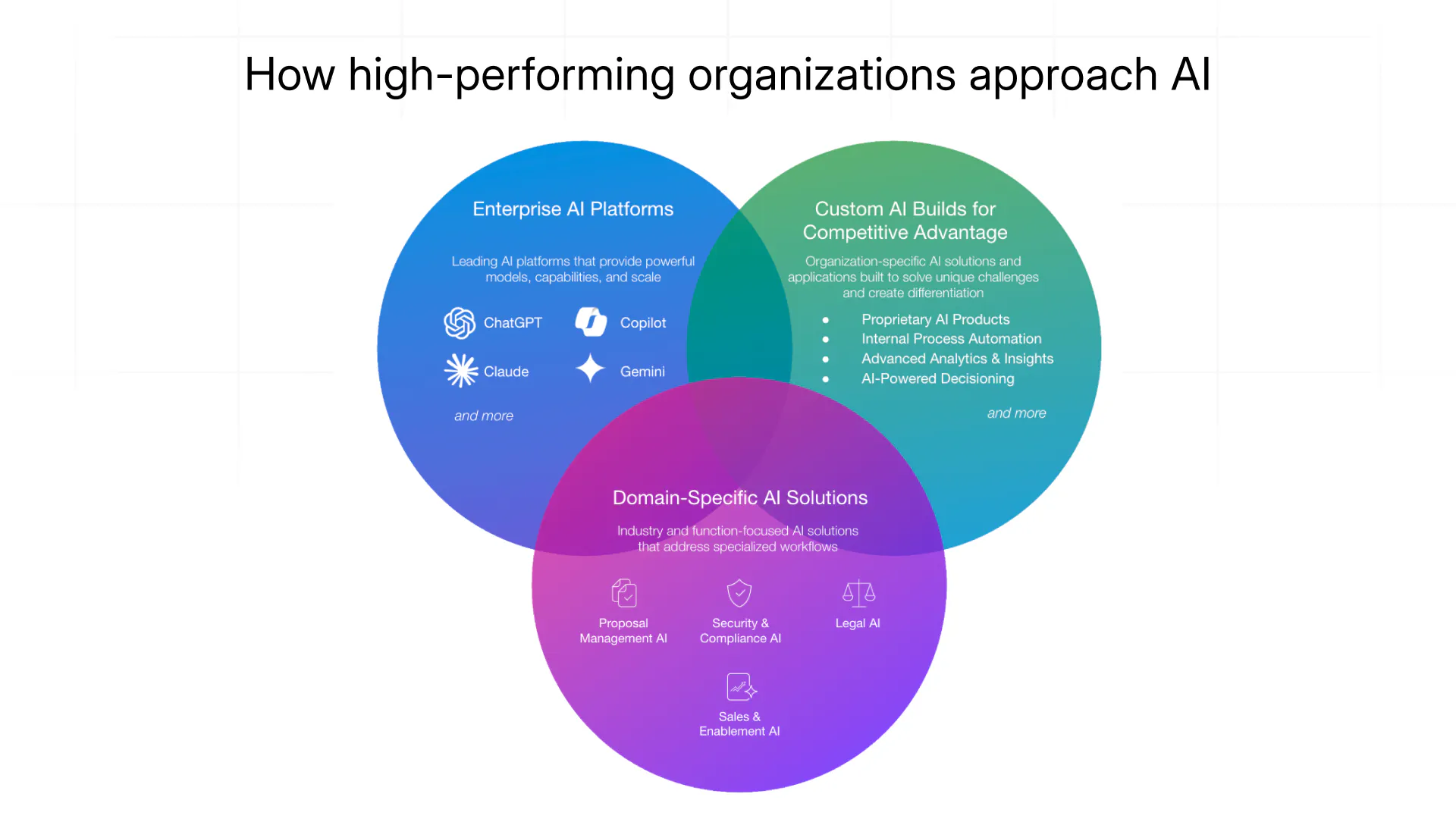
Five ways leading proposal teams are putting AI to work.
1. Qualify opportunities before investing resources
One of the biggest opportunities for AI happens before anyone starts writing. Proposal teams have finite capacity. Every hour spent pursuing the wrong opportunity is an hour that can't be invested in a stronger opportunity.
AI agents can quickly analyze an RFP, extract requirements, compare them against qualification criteria, identify compliance gaps, and recommend whether the opportunity is worth pursuing. Instead of relying solely on manual bid/no-bid reviews, teams gain objective analysis in minutes.
Drafting responses might be your first exposure to how AI can help with RFPs, but it won’t deliver ROI. Faster qualification and smarter resource allocation will. When you can help teams focus their limited resources on the right opportunities, it gives you the greatest chance of winning.
“Analysis Agent has been a fantastic time-saver in preparing for our Go-No-Go meetings. Executive Summary [agent] is also proving helpful for our team to generate quick summaries to include in their proposals. TRACE Score is a great feature and has given the team reassurance on the quality of content being generated.”
Caitlin Kelterborn, Bid Operations Specialist at AtkinsRealis, UE verified: 10/27/20252. Create stronger first drafts without starting from scratch
Content generation remains one of AI's most valuable applications, but top teams treat it as the beginning of the process rather than the end.
AI can generate first drafts and executive summaries, create response summaries, and refine tone while grounding responses in approved organizational knowledge. That allows proposal professionals to spend less time writing repetitive answers and more time tailoring messaging, improving differentiation, and strengthening win strategy.
Instead of replacing proposal expertise, AI gives teams a higher-quality starting point. Proposal managers still provide the strategic thinking, customer context, and competitive positioning that ultimately win deals. AI simply removes much of the repetitive work required to get there.
“The capabilities in Responsive have helped us accelerate turnaround time on bids, improve consistency in our messaging, and reduce manual effort in the response process. By leveraging AI suggestions and the content library, we’re able to spend more time on strategy and tailoring responses rather than repetitive drafting. This has led to faster submissions, fewer errors, and stronger overall proposal quality, which directly supports higher win rates and better team productivity.”
Medium Enterprise Internet Software & Services Company, UE verified: 10/23/20253. Build trust through governance and human review
For many organizations, trust is the biggest barrier to AI adoption. Proposal and sales teams have trust issues, and for good reason. Strategic responses carry revenue, legal, security, and reputational risk. No one can afford inaccurate answers, unsupported claims, or compliance mistakes. Leading organizations combine AI with governance rather than treating AI as an unsupervised content generator.
High-performing teams use AI to:
- Validate response quality
- Surface source citations
- Check for compliance issues
- Explain how responses were generated
- Keep humans in the review and approval process
This approach gives reviewers confidence that AI is accelerating work without sacrificing accuracy or accountability. As AI becomes more common across revenue organizations, governance becomes a competitive advantage rather than simply a risk management exercise.
“TRACE Score has been the tool that my team most appreciates in terms of trusting Ask or the AI Assistant for answers. It is very straightforward and easy to understand. I will be showing it to a wider team in a couple of weeks, hopefully demonstrating that we aren't coming up with our generated answers out of thin air.”
Justine Hescox, Miami Federal, UE verified: 10/27/20254. Turn organizational knowledge into trusted self-service
AI is only as valuable as the knowledge behind it. This has been a defining lesson of enterprise AI adoption. Without governed, current, and trusted information, AI simply produces faster versions of outdated or inconsistent answers.
Leading proposal teams solve this by centralizing organizational knowledge and making it accessible wherever employees work. AI tools like Responsive Ask can then retrieve trusted content through semantic search and retrieval-augmented generation (RAG), giving sellers, proposal professionals, and subject matter experts (SMEs) immediate access to approved answers.
Rather than repeatedly interrupting SMEs with the same questions, organizations enable self-service while maintaining consistency across proposals, security questionnaires, due diligence requests, and other strategic responses.
“The Guided Projects allows us to have a self-service option so RFIs and lower-dollar value RFPs can also be bumped up against the AI. The TRACE Score really helps my sellers have more faith in the AI. And the Executive Summary generator makes it super quick to add an Executive Summary with details about the client and the solution.
AJ Walker-Carter, Hewlett Packard Enterprise, UE verified: 10/23/20255. Automate work, not just content
Proposal teams spend significant time coordinating work: assigning tasks, routing reviews, following up with SMEs, assembling deliverables, and managing deadlines. Leading organizations increasingly use AI agents and workflow automation to handle these repetitive coordination tasks.
AI can orchestrate multi-step workflows, answer routine questions, trigger reviews, and keep projects moving with less manual oversight. Instead of simply generating text, AI in Strategic Response Management helps move work through the entire proposal lifecycle.
The outcome is higher throughput without adding headcount. Proposal teams spend more time influencing strategy and less time managing administrative work.
“The capabilities offered through Responsive AI have helped accelerate decision-making and improve productivity in solution design workflows. By automating repetitive tasks and providing intelligent insights, it has reduced turnaround time and enabled more strategic focus. We've seen improved collaboration across teams and faster prototyping of ideas, which ultimately contributes to delivering more value to clients and stakeholders at GEP.”
Large Enterprise Professional Services Company, UE verified: 10/22/2025From faster responses to stronger business outcomes
Proposal teams that embrace this model enable people to spend more time on judgment, strategy, customer understanding, and the work that ultimately wins business. As buyer expectations continue to rise, these capabilities will become the difference between proposal teams that keep up and those that lead.
The good news is that you don’t have to transform your proposal process overnight. Start by identifying the biggest bottleneck in your pursuit lifecycle, then apply AI where it creates the greatest business impact. As each improvement builds on the next, proposal teams evolve from responding to requests more efficiently to becoming strategic partners that influence revenue, improve the buyer experience, and help their organizations win more business.
The future belongs to teams that apply AI across the entire lifecycle.

RD Symms
Sr. Copywriter @ Responsive
With more than 15 years in writing, content development, and creative strategy, RD brings a rare combination of conceptual thinking and executional range to the proposal management space. He's spent his career turning complex ideas into content that earns attention which makes him a natural fit for an audience of proposal managers and sales leaders who read critically and buy carefully.